Estimated reading time: 12 minutes
If you want to relieve postural tension from sitting at a desk all day, it often takes more than a quick fix. Since opening on Upper Street in 2009, we’ve noticed that many people come to us not with sudden injuries, but with tension that has gradually built up from hours at a desk. Neck tightness, upper-back stiffness, and sore shoulders are common after long periods of sitting with little movement and lots of screen time. The problem isn’t simply one “bad” posture. Staying in the same position for hours can increase muscular demand, even if it feels comfortable at first.
Office, remote, and hybrid workers in London and across the UK often face this problem. The good news is that desk-related tension can often be approached with practical changes. In this article, you’ll find four useful tools: three simple ergonomic adjustments, a five-minute daily stretch routine, a habit for taking short movement breaks, and advice on when professional help may be appropriate. These practical changes can help you manage tension from sitting all day without relying on one single solution
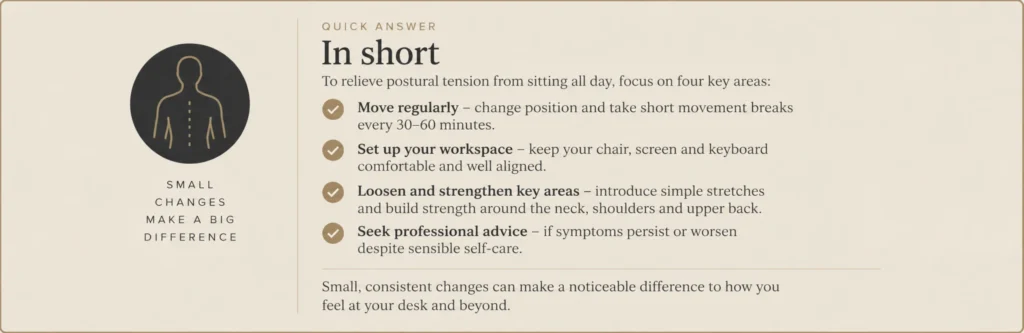
In short: change positions regularly, make your workstation comfortable, incorporate movement after prolonged sitting, and build strength in the neck, shoulders, and upper back. If symptoms remain persistent or worsen despite sensible self-care, professional advice may be appropriate.
Why sitting all day creates postural tension
To manage this problem, it helps to understand what is happening in the body. Postural tension from desk work usually has multiple contributors. Sitting for long periods, limited movement, workstation setup, repetitive screen use, and sustained muscular demand around the neck, shoulders, and back can all contribute.
How forward head posture develops at a desk
Studies on office ergonomics show that when the head moves farther forward, the mechanical demands on the cervical spine and surrounding muscles can increase. Biomechanical research has also found that cervical flexion can increase compression and shear forces compared with a neutral head position.
The further the head moves forward, the greater the mechanical demand placed on the muscles supporting the head and neck. After long periods at a screen, the deep neck muscles may be recruited less efficiently, while muscles such as the upper trapezius and levator scapulae take on more sustained work. This can contribute to tightness around the base of the skull, neck, and shoulders.
Biomechanical loading is only one part of the picture. Movement habits, strength, stress, sleep, working conditions, and individual sensitivity can all influence how someone feels after a long day at a desk.
What happens to the chest, shoulders, and upper back
Why the tension keeps returning without changing the daily load
Stretching can provide short-term relief, but if your workstation and movement habits remain unchanged, the same areas continue to experience similar mechanical demands.
There is rarely one single cause. Your sitting position, how long you sit, how often you move, your workload, strength, stress, and individual response all matter. Working on several of these factors together is often more useful than relying on a single stretch or workstation adjustment.
The next sections give you practical ways to get started.
How to relieve postural tension from sitting at a desk all day: three ergonomic changes
These changes are quick, affordable, and easy to try. They are some of the simplest ways to improve your daily work environment.
Monitor height: a simple high-impact adjustment
Set your screen so the top is at or just below eye level, and keep it roughly an arm’s length away. If your monitor is too low, you may spend more time looking down, increasing muscular demand around the neck and shoulders.
You can use a stack of books or a simple monitor riser to lift your screen. Adjusting your monitor height is easy, and even a small change can make a difference over a long workday.
Chair setup and lumbar support
Make sure your chair allows both feet to rest flat on the floor, with your hips at or slightly above knee height.
A folded towel or small lumbar cushion can add extra support and make it easier to vary your sitting position. The goal isn’t to keep your spine in one rigid posture all day, but to find a comfortable working position that still lets you move.
Many office chairs have adjustable lumbar support that goes unused. Take a few minutes to find it and experiment with different settings.
Keyboard and mouse positioning
Keep your keyboard directly in front of you at around elbow height, with your forearms roughly parallel to the floor and your wrists in a comfortable neutral position.
Keep your mouse close enough that you do not repeatedly reach forward or stretch your arm out to the side. Repeated reaching can increase muscular demand around the shoulder and upper back, especially when you repeat the movement throughout the workday.
Even small reaches add up over eight hours.
Your 5-minute desk stretch routine for neck, shoulders, and upper back
For many desk workers, tension from sitting all day is most noticeable around the neck, shoulders and upper back. Do this stretch routine once in the morning and again in the afternoon. Hold each stretch for 20 to 30 seconds, then repeat the full routine twice; this should take approximately five minutes.
The goal isn’t perfect posture. It is to introduce more movement after you have been relatively still for a while.
With regular practice, some desk workers may find that end-of-day stiffness becomes easier to manage.
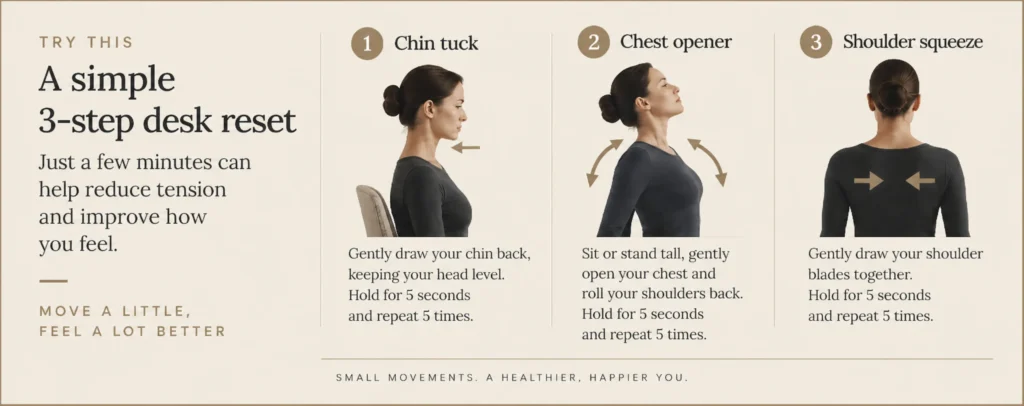
Start with chin tucks. Gently draw your chin straight back rather than down, as though you are bringing your head back over your spine. Hold for five seconds and repeat ten times.
This movement is commonly used to promote cervical control and awareness of forward head posture.
Next, try an upper trapezius stretch. Tilt your right ear towards your right shoulder, place your right hand lightly on the left side of your head for gentle overpressure, and hold for 20 to 30 seconds. Then switch sides.
These movements focus on areas commonly associated with desk-related neck and shoulder tension.
Chest opener and thoracic extension
Interlace your fingers behind your head, open your elbows wide, and gently lift your chest while allowing your upper back to extend slightly over the chair.
Hold for 20 to 30 seconds.
Next, try scapular retractions. Gently draw your shoulder blades toward each other, hold for about 10 seconds, then relax fully. Repeat ten times.
These movements introduce thoracic extension and encourage engagement of the muscles around the shoulder blades after prolonged sitting.
Relieving postural tension at a desk: the micro-break habit that stops it from building
Stretching can help relieve accumulated tension, while short movement breaks can interrupt prolonged static loading before stiffness builds.
Most people think about stretching once they already feel uncomfortable. Micro-breaks give your body regular opportunities to change position throughout the working day.
The 30 to 60 minute movement rule
Evidence-informed guidance commonly recommends standing and moving every 30 to 60 minutes of sitting, although the optimal interval is still being studied.
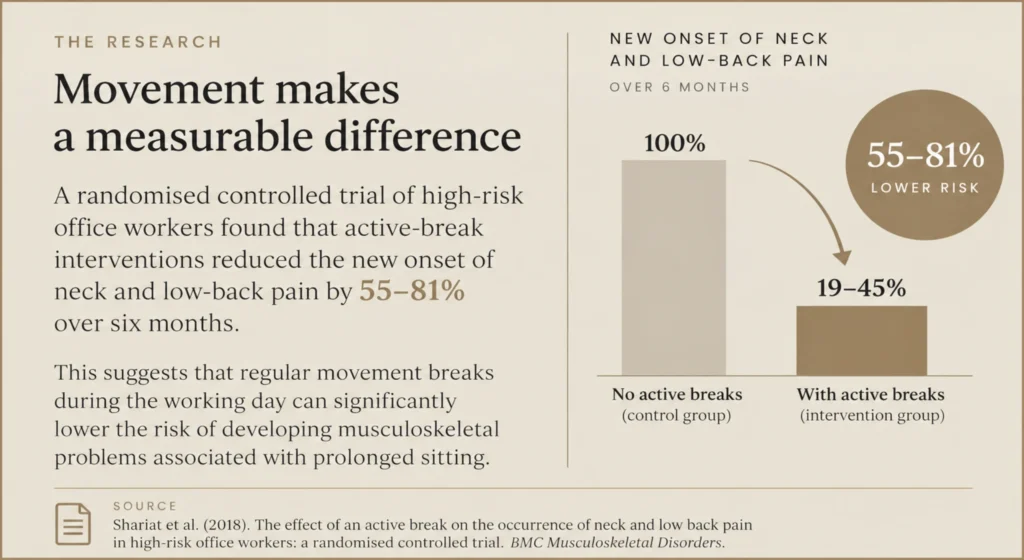
One randomised controlled trial involving high-risk office workers found that active-break and postural-shift interventions reduced new-onset neck and low-back pain over six months. The researchers reported reductions ranging from 55 to 81 per cent depending on the intervention and outcome measured.
Simple actions are enough. Stand up, roll your shoulders, walk to get some water, or do a few calf raises.
The goal is to break up long periods of sitting and give yourself regular opportunities to move. You do not have to follow the timing exactly. A routine you can maintain is more useful than a perfect schedule you give up after a few days.
Habit stacking: attaching movement to what you already do
The easiest way to add micro-breaks is to link them to things you already do during your day.
Stand up when a meeting ends. Stretch your neck after completing a task. When practical, walk to a colleague’s desk rather than sending a message.
If you often lose track of time while working, set a phone reminder every 45 minutes.
These small changes reduce the cumulative muscular demand of spending much of the workday in relatively static positions.
No-equipment strengthening to support the neck, shoulders, and upper back
Stretching and changing your workspace can help manage daily tension, while strengthening exercises can build capacity in the muscles that support your neck, shoulders, and upper back.
The goal is not to keep your shoulders pulled back all the time or force yourself into a rigid posture. The goal is to give your body more strength, control, and movement options throughout the workday.
You do not need specialist equipment for these exercises, and most can be done at home.
Scapular retractions, wall angels, and chin tuck holds
For scapular retractions, perform three sets of ten, holding each repetition for around ten seconds. This recruits the mid-back muscles involved in scapular control, including the mid-trapezius and rhomboids.
For wall angels, stand with your back and arms against a wall and slowly slide your arms up and down into a Y shape. This exercise targets muscles involved in shoulder blade control, including the serratus anterior and lower trapezius.
Chin tuck holds, performed for about 10 seconds at a time, target the deep cervical flexors that support and control head position.
Prone I, T, and Y raises for upper-back strength
Lie face down and lift your arms into I, T, and Y positions to work the rear shoulders and mid-back.
You do not need any equipment. Two or three sets of ten repetitions, performed two or three times per week, can help build strength and endurance around the shoulder blades and upper back.
You can do these exercises on a yoga mat at home in less than 10 minutes, and they can complement the movement and ergonomic strategies you use during your workday.
When postural tension needs more than stretching
Self-care can help with everyday desk-related stiffness, but persistent or worsening symptoms deserve more attention.
Know when you may need more than stretches and workstation changes.
When desk-related tension deserves professional attention
If your tension keeps returning after stretching, your neck or shoulders consistently feel tight or restricted, or discomfort starts affecting work, sleep, exercise, or everyday movement, professional advice may help.
Sports massage and bodywork may suit people experiencing muscular tension, stiffness, or movement-related discomfort.
If most of your tension is concentrated around your neck, shoulders, or upper back, you may also want to explore our Back, Neck & Shoulder Massage, which provides focused bodywork for desk-related upper-body tension.
However, persistent numbness or tingling, unexplained weakness, significant pain travelling down the arm, severe or unusual headaches, symptoms following trauma, or rapidly worsening pain should be assessed by an appropriate healthcare professional.
Asiatic’s Somatic Realignment™ approach considers how muscular tension and movement patterns may interact across the neck, shoulders, thoracic spine, rib cage, and hips rather than concentrating only on the area where discomfort is felt.
A session may combine targeted soft-tissue work, rhythmic pressure, assisted movement, and stretching, adapted to the individual client’s comfort and response.
What a professional sports massage or bodywork session involves
At Asiatic, each session begins with a brief consultation and, where appropriate, movement or postural observation before hands-on work.
This helps the therapist understand how muscular tension and movement present for the individual rather than following the same routine for every client.
Across our Angel and Highbury studios on Upper Street, the team has extensive hands-on experience working with London desk workers experiencing different patterns of muscular tension and movement restriction.
A session may combine assisted stretching, rhythmic pressure, and targeted soft-tissue work around areas that feel tight or restricted.
If you work at a desk, professional bodywork, alongside the daily strategies in this article, can support a practical approach to managing tension and maintaining comfortable movement.
How often you book sessions depends on your individual needs and preferences, so discuss this with your therapist.
If your desk-related tension keeps returning or starts affecting your everyday comfort, contact the Asiatic team to discuss whether back & shoulder massage, sports massage or bodywork may suit you.
Quick checklist: how to relieve postural tension from sitting at a desk all day
- Raise your monitor so the top of the screen sits at or just below eye level.
- Set your chair height so both feet rest comfortably on the floor, with your hips at or slightly above knee level.
- Position your keyboard and mouse within easy reach.
- Run a five-minute desk stretch routine mid-morning and mid-afternoon.
- Stand and move briefly every 30 to 60 minutes during the working day.
- Add scapular retractions, wall angels, and prone I, T, and Y raises to your home routine.
- Seek appropriate professional advice if symptoms are persistent, worsening, or include numbness, tingling, unexplained weakness, or other unusual symptoms.
Putting it all together
Relieving postural tension from sitting at a desk isn’t about one single fix. It is about approaching the problem from several angles.
Improving your workstation can reduce unnecessary mechanical demand. A five-minute routine introduces movement after prolonged sitting. Regular micro-breaks break up long periods of stillness and strengthen the neck, shoulders, and upper back.
Start with ergonomic changes because they shape the environment where you spend several hours each day. Add the stretching routine and begin taking short movement breaks during your workday. Once these habits feel natural, you can gradually add strengthening exercises.
Rather than sticking to an overly rigid schedule, notice how your body responds and find a combination of movement, workstation changes, and exercise that feels sustainable.
The most useful plan is usually the one you can maintain consistently while varying your position and movement throughout the day.
If tension persists despite sensible self-care, sports massage or bodywork may offer another way to address muscular stiffness and support comfortable movement.
Somatic Realignment™ sessions at Asiatic are personalised to the individual rather than intended as a one-time “fix”. They are designed to sit alongside regular movement, exercise, and sensible desk habits. Managing tension from sitting all day usually works best when you consider movement, ergonomics, and strengthening together.
Contact the Asiatic team to discuss whether a personalised sports massage or bodywork session suits your experience.