Choosing a massage therapist can be more complicated than finding the nearest available appointment.
Price and location matter, but they tell you relatively little about a therapist’s training, experience, professional standards or whether their approach is suited to what you actually need.
In the UK, massage therapy does not operate under one universal statutory licensing system. Professional requirements can vary according to the type of treatment, insurer, professional body and local authority. In parts of London, massage and other special treatments can also fall within local licensing requirements or exemptions.
That makes it worth asking a few questions before you book.
At Asiatic, we have worked with clients on Upper Street in London since 2009. In our experience, qualifications matter, but they are only part of the picture. A good therapist should also listen carefully, understand the treatment they offer, communicate clearly, adapt appropriately and recognise when massage may not be suitable.
This guide explains what to look for when choosing a massage therapist in the UK, how to check qualifications and professional credentials, which questions to ask before booking, and which warning signs deserve closer attention.
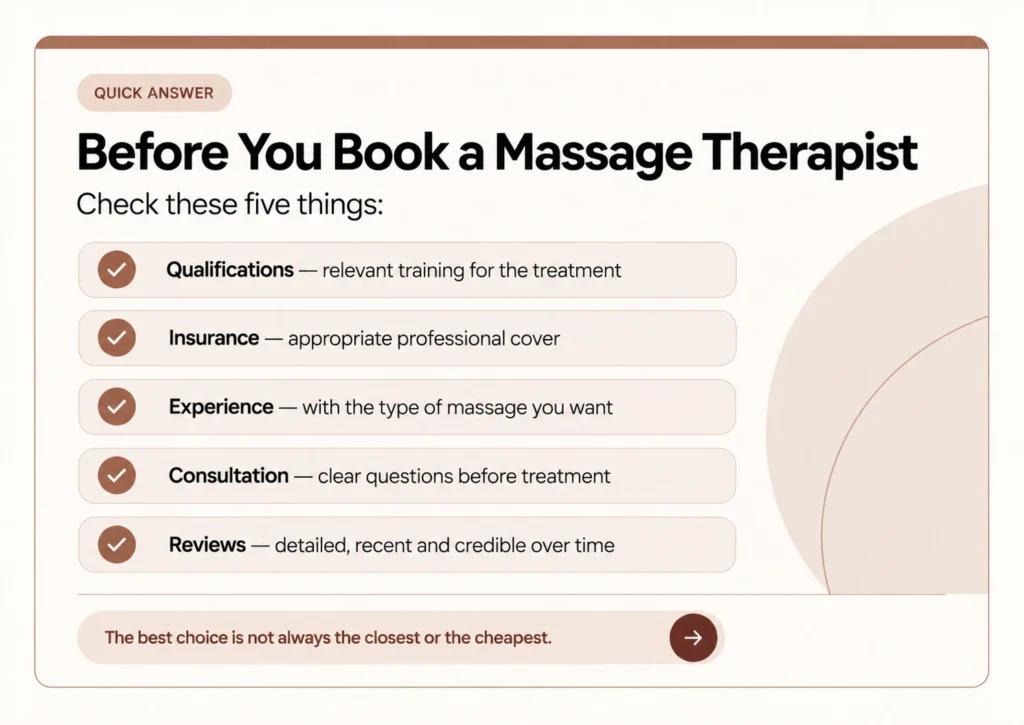
Quick answer: what should you look for in a massage therapist?
A professional massage therapist should be able to explain their relevant training, experience and treatment approach clearly.
Look for recognised qualifications appropriate to the massage being offered, suitable professional insurance, experience relevant to your needs, a proper consultation process, clear pricing and independent client feedback.
For specialist treatments such as sports massage or pregnancy massage, additional training or relevant experience may also be important.
Most importantly, the therapist should listen to you, respect professional boundaries and be willing to adapt the treatment when necessary.
1. What qualifications should a massage therapist have in the UK?
This is one of the first questions worth asking.
The UK has recognised vocational massage qualifications, including regulated Level 3 awards and diplomas. For example, the government qualifications register lists VTCT Skills (ITEC) Level 3 Diplomas in Massage and Massage Therapies as regulated occupational qualifications.
Level 3 is therefore a commonly recognised professional foundation for general massage practice. It is not, however, a universal statutory licence that every person describing themselves as a massage therapist must hold.
That distinction matters.
What does Level 3 tell you?
A substantial vocational massage qualification typically includes practical massage technique alongside areas such as anatomy and physiology, client consultation, health and safety, treatment planning and contraindications.
It gives you a more meaningful reference point than a website simply describing somebody as “fully trained”.
When comparing therapists, ask for the actual qualification name and awarding organisation.
You can also use the government’s Register of Regulated Qualifications to check whether a qualification is officially recognised in England and Northern Ireland.
Does the awarding body matter?
Names such as VTCT Skills and ITEC are commonly encountered in UK massage education.
The important point is not simply recognising a logo. It is understanding what qualification the therapist completed and whether that training is appropriate for the treatment they provide.
A qualification in one form of massage does not automatically demonstrate expertise in every other form.
Traditional Thai massage, sports massage, pregnancy massage and other specialist forms of bodywork involve their own knowledge and practical skills.
2. Does the therapist have experience relevant to the treatment you need?
Qualifications tell you where a therapist’s training began.
Experience shows how that training has developed in practice.
Someone looking primarily for quiet relaxation may need a very different approach from a runner booking Sports Massage, an expectant mother considering Pregnancy Massage, or a desk worker seeking focused work around the neck and shoulders.
Ask a simple question:
“How much experience do you have with the type of massage I am booking?”
The answer should be specific enough to be useful.
Sports massage and more advanced work
Sports massage has its own training pathway.
For CNHC registration in Sports Massage, practitioners must demonstrate training that meets the relevant National Occupational Standards and Sports Massage Core Curriculum, with the minimum qualification level equivalent to Level 4 unless competency is demonstrated through an approved experience-and-assessment route.
This is a good example of why relying only on the number attached to a qualification can be misleading.
The better question is:
Does the therapist’s training and experience match the work they are actually offering?
Specialist traditions such as Thai massage
Traditional Thai bodywork also has its own techniques, movement principles and training traditions.
It can include rhythmic pressure, assisted movement and stretching, requiring different practical skills from a standard oil-based relaxation treatment.
If you are specifically looking for Thai Massage or Thai Yoga Massage, ask about the therapist’s Thai massage training rather than assuming a general massage qualification automatically covers that expertise.
A professional practitioner should be comfortable explaining where and how they trained and what their treatment involves.
3. Is the therapist professionally insured?
Professional insurance is another useful check.
Insurance should be appropriate to the treatments the therapist actually performs.
For example, FHT professional standards require practising members to hold insurance appropriate to their business practice, including relevant treatment liability and public or product liability where required.
You do not need to interrogate a therapist about the details of their insurance policy.
A straightforward question is enough:
“Are you professionally insured for this treatment?”
A reputable practice should be able to answer without difficulty.
This becomes particularly relevant with specialist therapies because insurance cover may depend on the practitioner holding appropriate training for the treatment they provide.
4. Is the therapist registered with a professional body?
Professional membership or registration can provide an additional layer of reassurance, although it should not be treated as proof that one therapist is automatically better than another.
The Complementary and Natural Healthcare Council (CNHC) operates a voluntary register covering disciplines including Massage Therapy and Sports Massage.
Applicants must meet education and training requirements based on the relevant National Occupational Standards and core curriculum, or meet an approved experience-and-assessment route.
CNHC also works with professional organisations including the Complementary Therapists’ Association (CThA), Massage Training Institute (MTI) and Sports Massage Association (SMA) as verifying organisations for relevant applications.
Other organisations, such as the Federation of Holistic Therapists (FHT), also maintain professional membership structures.
The useful question is not simply:
“Do you have a professional logo on your website?”
It is:
“Which professional body are you registered with, and can I verify the membership?”
Where a public register exists, you can check it directly.
5. Does the therapist carry out a consultation before treatment?
A good massage begins before the therapist starts using their hands.
The consultation should establish what you want from the session and whether anything in your health history means that treatment should be adapted, postponed or avoided.
Depending on the treatment and your circumstances, the therapist may ask about previous injuries, pregnancy, recent surgery, allergies, medications, skin concerns or other relevant health information.
They should also ask about your reason for booking, pressure preference, the areas you would like them to concentrate on and anything you would prefer them to avoid.
The conversation does not need to be lengthy.
It needs to be relevant.
The consultation reveals a great deal about the therapist
In our experience at Asiatic, qualification certificates can tell you how somebody was trained, but the consultation often tells you how they actually practise.
Does the therapist listen before deciding what to do?
Do they ask useful questions?
Can they explain what they recommend and why?
Do they adapt when your needs change?
Those are important indicators of thoughtful professional care.
A therapist who assumes that every client needs exactly the same pressure, sequence or technique may not offer the personalised experience you expect.
6. Will the therapist adapt pressure and technique?
Massage should not become a test of how much discomfort you can tolerate.
Pressure preference varies considerably between clients.
Some people enjoy firm, focused work. Others prefer slower or gentler techniques. Appropriate pressure can also vary between different parts of the same session.
A good therapist should be able to adapt.
At Asiatic, this principle is part of our wider Master-Led Somatic Bodywork™ approach: treatment is shaped around the individual rather than delivered as one fixed routine.
You should always feel comfortable saying:
“Could you make that lighter?”
or:
“Could we spend a little more time here?”
A therapist who responds professionally to feedback gives you useful information about the standard of their practice.
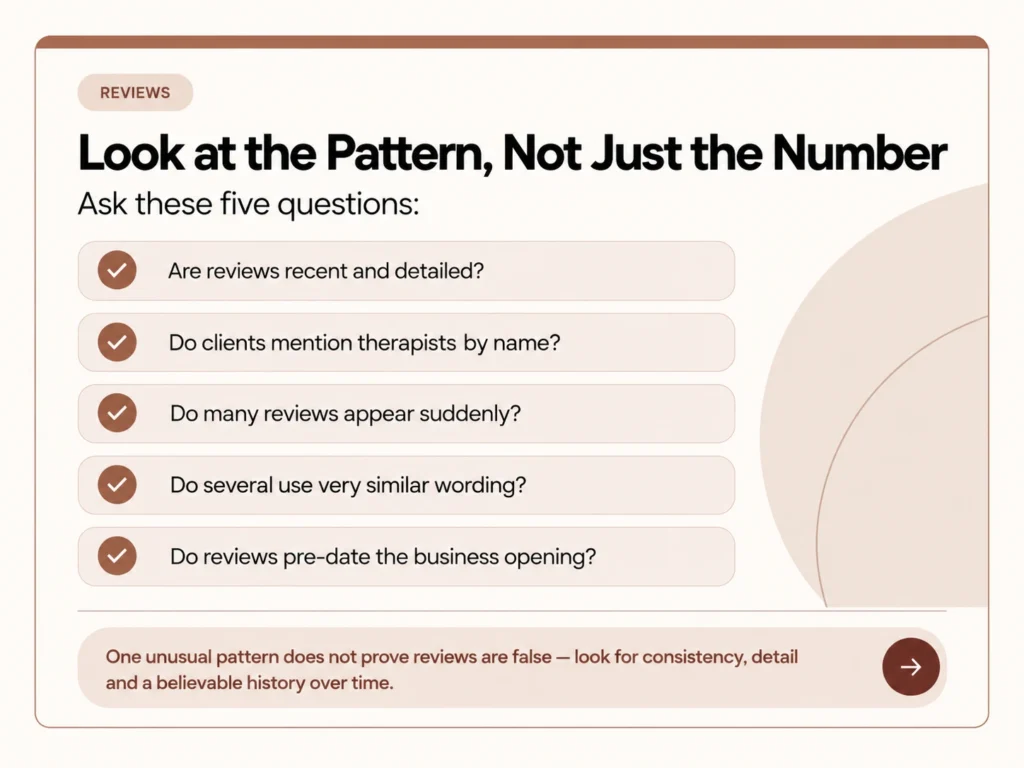
7. What do the reviews actually tell you?
Reviews can be valuable, but the headline rating is only one part of the picture.
Detailed reviews can tell you about therapist communication, pressure adjustment, cleanliness, consistency, consultation quality and whether clients return to the same practitioner.
These details are often more informative than generic comments saying only that the massage was “amazing”.
Also consider:
How recent are the reviews?
Do they appear across independent platforms?
Do returning clients mention individual therapists?
How does the business respond when somebody is dissatisfied?
A calm, professional response to criticism can reveal almost as much about standards as a five-star review.
At Asiatic, client feedback across Google, Treatwell and ClassPass has helped shape everything from therapist standards to the booking and arrival experience.
Look at review patterns, not just the number
Lots of reviews do not automatically mean a business provides better care.
Pay attention to the pattern behind the reviews as well as the total number.
For example, how quickly new reviews appear — often described as review velocity — can provide useful context. A sudden concentration of reviews within a short period is not proof of manipulation, but it may be worth looking at more closely, particularly if the pattern seems difficult to reconcile with how long the business has been operating.
Pay attention to how the reviews are written too.
If several reviews repeatedly use the same promotional phrases, treatment names, nearby station names or very similar wording, it may be worth examining the wider pattern rather than relying only on the star rating.
Similarly, if reviews appear to pre-date a business’s documented opening, check the context rather than immediately accepting or rejecting them. There may be legitimate explanations — for example, a business may have moved, rebranded or previously operated elsewhere.
No single pattern proves that reviews are false.
Google requires reviews to reflect genuine experiences. Its policies prohibit reviews that have been paid for or incentivised and identify unusual volumes or patterns of review contributions as a potential sign of rating manipulation.
UK consumer-protection law also now contains specific prohibitions relating to fake reviews and concealed incentivised reviews under the Digital Markets, Competition and Consumers Act 2024, with the relevant provisions applying from April 2025.
The sensible approach is therefore not to assume that every business with a large number of positive reviews is suspicious.
Look instead for consistency, detail, credible chronology and a believable history over time.
Does the website publish useful, responsible content?
A business’s website can also tell you something about its professional standards.
Do not judge it only by how polished it looks.
Ask whether the content genuinely helps you understand the treatment, its limitations, what to expect and when massage may not be appropriate.
Good professional content should demonstrate real knowledge rather than simply repeat search terms.
Be cautious of websites containing large amounts of thin or repetitive material that appears designed primarily to rank for keywords without adding meaningful information for the reader.
Google’s Search guidance recommends creating helpful, reliable, people-first content that provides original information, experience or analysis rather than content produced primarily to manipulate rankings.
Health claims deserve particular attention.
Massage can reasonably be discussed in relation to relaxation, muscular comfort and general wellbeing. The ASA and CAP specifically regard claims around relaxation, everyday stress and general wellbeing as more straightforward than claims that a massage therapy treats medical conditions.
If a business claims that massage treats anxiety, improves digestive disorders, accelerates surgical recovery or resolves other medical conditions, those are materially different claims.
Objective health or treatment claims need appropriate evidence, and claims relating to conditions requiring medical supervision may also be restricted unless treatment is being carried out under appropriate professional supervision.
A responsible practice should therefore distinguish clearly between supporting general wellbeing and claiming to treat a medical condition.
It should use reliable sources when discussing health topics and recognise when a client should seek advice from an appropriate healthcare professional.
8. What should you ask before booking a massage therapist?
You do not need to conduct a formal interview.
Eight straightforward questions will usually tell you a great deal:
- What massage qualifications do you hold? Ask for the actual qualification or training rather than simply accepting “fully qualified”.
- Do you have specific training or experience in the treatment I want? This is particularly useful for sports massage, pregnancy massage, Thai massage and other specialist therapies.
- Are you professionally insured for the treatment you provide?
- Are you registered with a professional organisation, and can the membership be verified?
- What happens during the consultation before the massage?
- Can you adapt pressure, positioning and technique during the session?
- What should I expect during the treatment, including clothing, oils, positioning and draping?
- What are your prices, cancellation terms and booking policies?
A professional therapist should be able to answer ordinary questions about their practice clearly without becoming defensive or vague.
How can you verify a massage therapist’s credentials?
If you want to go beyond the therapist’s own website, verification is relatively straightforward.
For regulated qualifications in England and Northern Ireland, the government provides a searchable Register of Regulated Qualifications and a separate register of regulated awarding organisations.
If a therapist says they are registered with CNHC or another organisation that maintains a public directory, search for the practitioner directly rather than relying solely on a logo displayed on their website.
For specialist work, check whether the qualification actually relates to that treatment.
A general massage diploma is valuable, but it should not automatically be interpreted as proof of advanced sports massage, pregnancy massage or every other specialist modality.
How to find a reputable massage therapist near you
Searching for “massage therapist near me” is useful for finding options, but proximity should be the beginning of your search rather than the end.
Once you have a shortlist, look at the therapist’s qualifications, relevant experience, treatment descriptions, professional standards, reviews, consultation process and whether the business clearly explains who will actually perform the treatment.
If you are looking in London, there is another consideration.
Massage and other special treatments can be subject to local-authority licensing requirements depending on the borough, premises and practitioner status. CNHC advises practitioners to check with the relevant local council because licensing and exemptions can vary across London.
Clients do not need to become licensing experts.
It simply reinforces why transparent, professionally operated premises are worth looking for.
For London clients, Asiatic operates from two established Upper Street studios in Angel and Highbury.
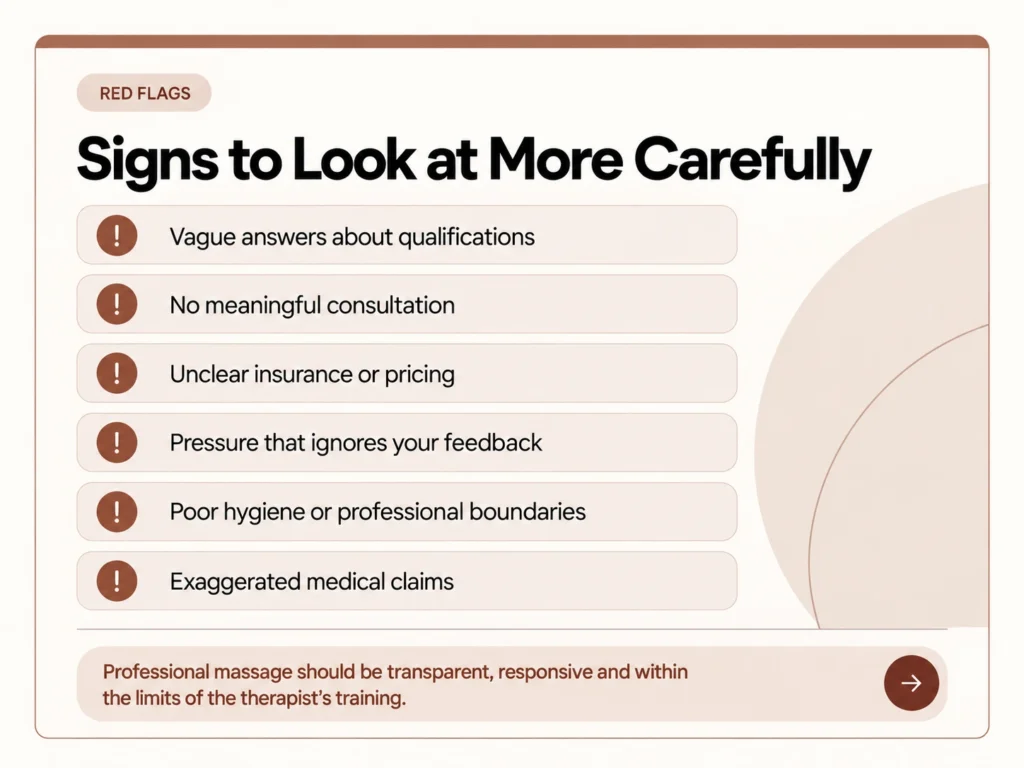
Red flags when choosing a massage therapist
No single detail automatically proves that a therapist is unsuitable.
Several warning signs together, however, should encourage you to look more carefully.
Be cautious if a therapist cannot or will not explain their training, provides no meaningful consultation, gives vague answers about professional insurance, ignores your pressure preferences, has unclear pricing, uses poor hygiene practices or behaves in a way that does not respect consent and professional boundaries.
Also watch for exaggerated promises.
Massage can support relaxation, muscular comfort and general wellbeing, but a therapist should be cautious about claiming that massage can diagnose, cure or guarantee the resolution of medical conditions.
Professional judgement includes understanding the limits of massage.
A practical massage therapist checklist
Before booking, the main checks are straightforward:
| Check | What to look for |
|---|---|
| Qualifications | Recognised training appropriate to the treatment being offered |
| Specialist experience | Relevant experience for Thai, sports, pregnancy or other specialist work |
| Insurance | Professional cover appropriate to the therapist’s treatments |
| Professional standards | Verifiable registration or membership where applicable |
| Consultation | Relevant health questions, treatment goals and pressure preferences |
| Communication | Willingness to explain, listen and adapt |
| Reviews | Detailed, recent feedback with a credible pattern over time |
| Content quality | Useful, responsible treatment information without exaggerated health claims |
| Professional boundaries | Clear consent, appropriate draping, hygiene and transparent pricing |
No single line in this table proves that somebody is an excellent therapist.
Taken together, however, these checks give you a much stronger basis for deciding than price, star rating or proximity alone.
What professional therapist standards look like at Asiatic
Asiatic has been practising on Upper Street since 2009, first from our Angel studio and now across Angel and Highbury.
Our therapists work within founder-led standards, hold recognised massage and bodywork qualifications appropriate to the treatments they provide, and carry appropriate professional insurance.
Treatments are supported by consultation, client feedback and ongoing practical oversight.
Our approach is based on a simple principle:
The treatment should respond to the person receiving it.
That means listening before beginning, adapting pressure and technique, working within professional boundaries and recognising when another treatment — or advice from an appropriate healthcare professional — may be more suitable.
Our Master-Led Somatic Bodywork™ methodology was developed to provide a consistent framework across both studios while still allowing the therapist to respond to the individual client.
Our forthcoming therapist profiles will make individual backgrounds, qualifications and treatment experience easier for clients to review before deciding whom they would like to book with.
So, how should you choose the right massage therapist?
→ Start with evidence rather than marketing language.
→ Ask what training the therapist has.
→ Check whether that training is relevant to the massage you want.
→ Look for appropriate professional insurance and transparent standards.
→ Read reviews for their detail, chronology and pattern, rather than simply counting stars.
→ Look at what the business publishes and whether its health claims are responsible.
→ Pay attention to the consultation.
→ And above all, notice whether the therapist listens.
→ A qualification establishes a foundation.
Good professional practice is demonstrated by what happens after that foundation: experience, communication, judgement, consistency, transparency and respect for the individual client.
If you are looking for a massage therapist in London, contact the Asiatic team before booking. Tell us what you are looking for and we can help you choose the treatment — and therapist — that best matches your needs.