Estimated reading time: 11 minutes
If you’re looking for a stress relief massage in London, the right treatment depends on how stress shows up in your body.
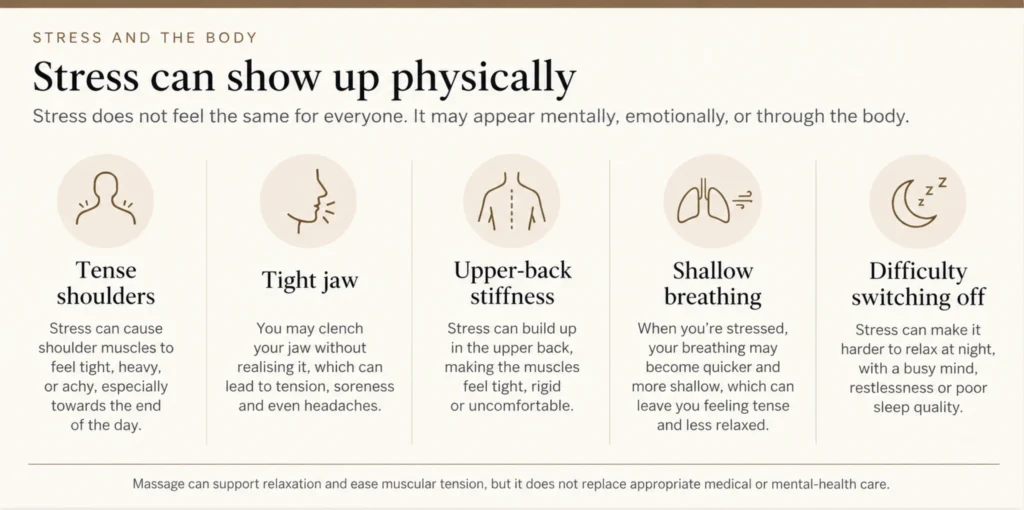
Some people experience stress as a racing mind. Others feel it physically: tense shoulders, a tight jaw, a stiff upper back, shallow breathing, or simply the sense of bracing through a difficult week.
Massage cannot remove stress at its source, replace sleep, or replace appropriate medical or mental-health care. What it can offer is dedicated time to slow down, ease muscular tension and step away from some of the physical habits that accompany a busy life.
At Asiatic, we have been working with clients on Upper Street in London since 2009. We’ve learned that there isn’t one universally “best” massage for stress. The right treatment depends on whether you want calm, movement, focused muscular work, or a combination.
This guide will help you choose the right treatment, understand what to look for in a therapist, and know what to expect when booking a stress relief massage in London.
Quick answer: which massage is best for stress relief?
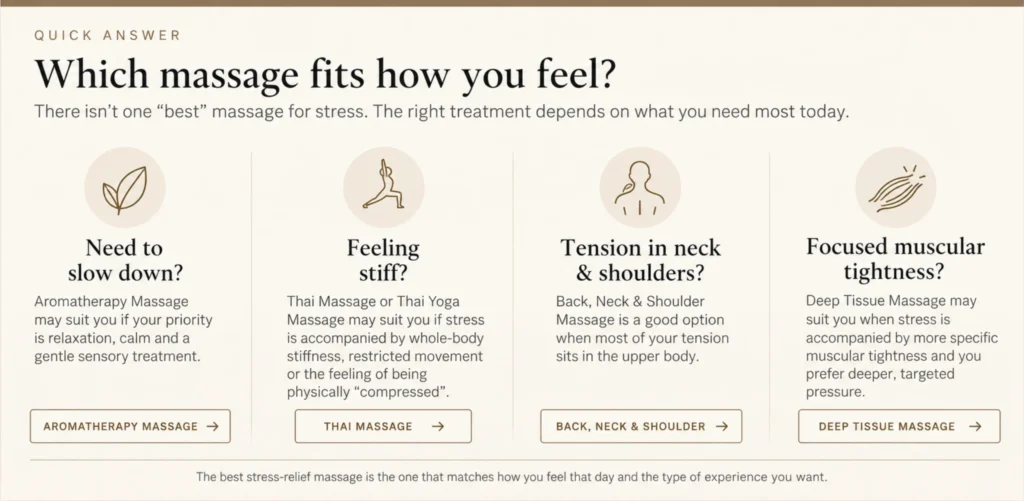
→ Aromatherapy Massage may suit you if your priority is slowing down, relaxing and enjoying a gentler sensory treatment.
→ Thai Massage or Thai Yoga Massage may suit you if stress is accompanied by whole-body stiffness, restricted movement or the feeling of being physically “compressed”.
→ Back, Neck & Shoulder Massage is a good option when most of your tension sits in the upper body.
→ Deep Tissue Massage may suit you when stress comes with more focused muscular tightness, and you prefer deeper, targeted pressure.
There is no universally superior option. The best stress-relief massage matches how you feel that day and the experience you want.
How massage may support stress relief
Most people know massage can feel relaxing, even without a scientific explanation. Still, understanding what massage can and cannot do helps set realistic expectations.
Stress can influence breathing, muscle tone, sleep, concentration, and posture. Someone working through deadlines may notice their shoulders rising towards their ears. Someone commuting across London may arrive home feeling tense even without exercise.
Massage offers a caring touch, steady rhythm, quieter environment, reduced physical demand, and a break from screens and daily responsibilities.
Research has found short-term changes in anxiety and heart rate after massage. Claims that massage consistently reduces cortisol are less certain; evidence is mixed, and effects appear smaller than sometimes suggested.
This matters because massage does not need a dramatic hormonal explanation to be useful.
For many, the benefit is simpler: feeling calmer, less tense, and more comfortable in their body after slowing down.
Which stress relief massage should you choose in London?
Aromatherapy Massage: when you mainly need to slow down
If your primary goal is relaxation rather than intensive muscular work,
→ Aromatherapy Massage is a natural place to start. This treatment uses flowing massage techniques with aromatic oils to create a slower, sensory experience. Pressure can be adapted, but the emphasis is generally on comfort and relaxation rather than working deeply into every tight area.
It may be a good choice if you feel mentally overloaded, tired, restless, or want an hour in which very little is expected of you.
Aromatherapy also suits people who do not want strong pressure. Stress does not always need increasingly intensive techniques.
Sometimes the better choice is to reduce stimulation.
Thai Massage and Thai Yoga Massage: when stress feels like stiffness
Some people do not experience stress primarily as anxiety or mental fatigue. They feel physically stuck.
Long hours sitting at a desk, commuting, travelling, and limited movement can leave hips, back, shoulders, and legs stiff. In this case, a gentle relaxation massage may feel pleasant, but it may not be the experience you want.
→ Thai Massage combines rhythmic pressure with supported movement and stretching.
→ Thai Yoga Massage places even greater emphasis on assisted stretching and positioning. These treatments may appeal particularly if you want to leave feeling as though your body has moved and stretched rather than rested.
If you are interested in the connection between Thai massage, stress, and emotional wellbeing, our separate guide to Thai Massage and mental wellbeing explores that topic in greater detail.
That distinction matters: this article helps you compare massage styles, while the Thai Massage article looks more deeply at one particular approach.
Back, Neck & Shoulder Massage: when stress sits in the upper body
For many London workers, stress has a very obvious physical address.
It often settles across the tops of the shoulders.
By late afternoon, the neck can feel heavy. The upper back tightens after hours at the laptop. You may notice yourself rubbing the same area between meetings without thinking about it. If most tension is there,
→ Back, Neck & Shoulder Massage may be a more focused choice than a full-body treatment, since it sounds more comprehensive. Focusing on these areas gives the therapist more time to adjust pressure and technique around tight or fatigued areas. This can be particularly useful when work stress and desk-related tension overlap.
Deep Tissue Massage: when tension feels more focused
→ Deep Tissue Massage serves a different purpose. It may suit you if stress shows up as specific areas of muscular tightness, stubborn knots, or if you prefer slower, more focused pressure.
Deeper pressure is not always better. Good deep tissue massage should respond to your needs rather than test how much pressure you can tolerate.
If you feel overwhelmed and mainly want to switch off, Aromatherapy Massage may make more sense.
If your whole body feels stiff and you want pressure combined with movement and stretching, Thai Massage may suit you better.
If you can point to one or two areas and say, “That’s where I feel it,” Deep Tissue Massage may be the more logical option.
Stress relief massage in London: how to choose the right therapist
Choosing the treatment matters, but the therapist matters as much.
Look for recognised training and clear professional standards
A reputable massage practice should be open about therapist qualifications, insurance and the type of work its practitioners perform.
You do not need to be an expert in massage qualifications before booking. Phrases like “highly trained” are less useful than recognised qualifications and a clearly explained professional approach.
At Asiatic, therapist standards include recognised massage and bodywork qualifications, with treatments adapted around the individual rather than delivered as one identical routine.
Pay attention to the consultation
A useful question is:
Does the therapist ask what you actually want from the session?
Someone booking a massage because they feel mentally exhausted may need something very different from someone whose stress is accompanied by significant upper-back tension.
Pressure preference matters. So do your previous massage experience, any areas you would rather avoid, and whether you want to talk during the session or simply switch off.
The consultation need not be long, but it should be relevant.
If you find a therapist whose pressure, communication style, and approach work well for you, it can be valuable to return to them.
They already know what you prefer and how you responded previously.
That does not mean you must always book the same therapist, but continuity can make the experience more personal over time.
When choosing a massage provider in London, look beyond the star rating and read what clients actually say about therapist care, communication and consistency.
Stress relief massage at Asiatic in Angel and Highbury
Asiatic has been part of Upper Street since 2009 and now operates from two studios in Angel and Highbury
Our approach is simple: the treatment should respond to the person receiving it.
Some clients arrive wanting quiet relaxation. Others want more movement. Some want the therapist to concentrate on their neck and shoulders, while others prefer a full-body session.
Our Somatic Realignment™ approach considers how muscular tension and movement may interact across the body rather than assuming every client needs the same routine.
Depending on the treatment chosen, a session may include rhythmic pressure, soft-tissue work, assisted movement, stretching, or slower techniques focused primarily on relaxation.
We do not promise to “reset” your nervous system or claim that one massage will solve all your stress.
We aim to provide a thoughtful treatment adapted to how you feel that day.
What should you expect from your first session?
Your first visit should start with a short conversation.
Tell your therapist:
→ Where you are carrying tension;
→ Whether you want relaxation or more focused muscular work;
→ Your preferred pressure;
→ Any recent injuries, sensitivities or areas you would like avoided;
→ Whether you have any health circumstances the therapist should know about.
→ You can ask to change pressure at any point during the session.
→ You should feel comfortable asking for lighter or stronger pressure. Good communication is part of a good massage.
→ Afterwards, some people feel relaxed immediately, while others notice that they feel less tense or move more comfortably.
There is no single “right” way to feel after a massage.
Building a routine that manages stress long-term
Massage can be useful as a one-off way to slow down, but some prefer to make it part of a regular stress-management routine.
How often should you book massage for stress?
There is no one-size-fits-all schedule for massage.
Some people book massage only during particularly demanding periods. Others enjoy making it part of a more regular wellness routine.
Frequency depends on:
→ What you want from massage;
→ Your budget;
→ Your schedule;
→ How your body responds;
→ Whether you are also managing a specific muscular issue.
Some clients prefer monthly appointments, while others choose fortnightly sessions during busier periods. Neither schedule is automatically “better”.
Be cautious of providers who tell every client they need the same weekly or fortnightly treatment plan.
Your needs may change over time.
A more useful question is:
Did the session help enough that you would personally benefit from repeating it?
If yes, discuss timing with your therapist rather than following a generic schedule.
If tension repeatedly builds in the same areas, returning to a therapist who already understands your pressure preferences and previous response may also make the experience more consistent.
Massage should complement the rest of your stress-management routine
Massage works best when you do not expect it to manage every source of stress alone.
Regular movement, adequate sleep, time away from screens, social connection and whatever genuinely helps you unwind all matter.
For some people, that is exercise.
For others, it may be walking, reading, meditation, spending time outdoors or simply protecting enough time to rest.
Massage can sit alongside these habits.
And if stress becomes persistent, overwhelming, begins affecting your mental health or becomes difficult to manage independently, massage should not be treated as a substitute for appropriate professional support.
How much does a stress relief massage in London cost?
Massage prices in London vary by area, treatment style, therapist experience, and session length.
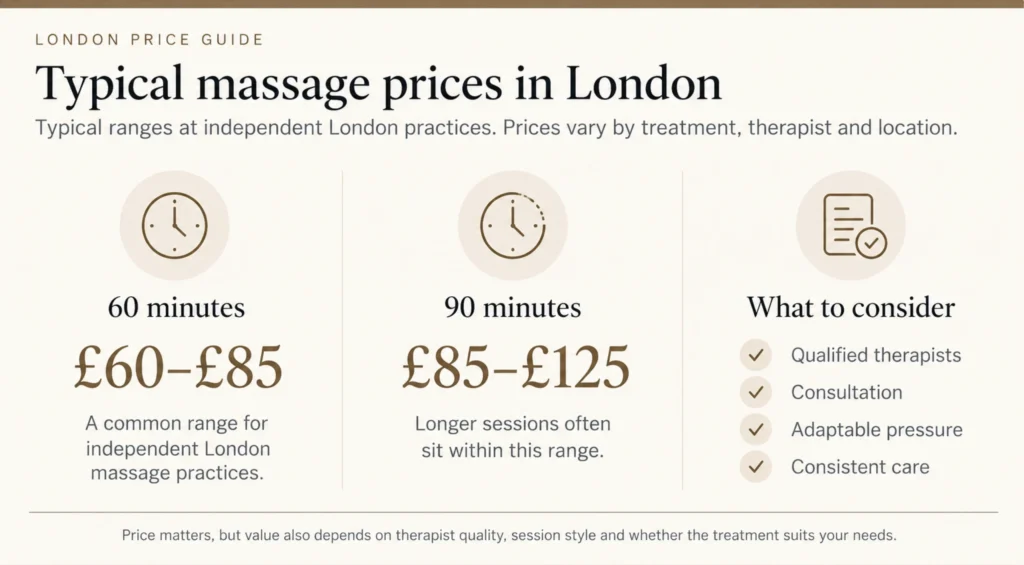
As a broad guide, 60-minute sessions at independent London practices commonly sit around £60–£85, while 90-minute sessions are often around £85–£125. Premium hotel spas and specialist clinics may charge more, while some neighbourhood studios sit below these ranges.
Rather than judging value by the lowest hourly rate, consider what is included.
→ Does the studio use qualified therapists?
→ Is there a consultation?
→ Can pressure and technique be adapted?
→ Can you return to the same therapist if you find someone who suits you?
A lower headline price isn’t automatically better value if the treatment doesn’t match what you want.
For current Asiatic treatment prices, check our Massage Prices page before booking, as prices, durations and treatment options can change.
So, what is the best massage for stress relief in London?
There is no single answer because stress feels different for everyone.
If you want quiet, sensory relaxation, Aromatherapy Massage may be the best place to start.
If you feel physically stiff and want pressure combined with movement, consider Thai Massage or Thai Yoga Massage.
If stress has gathered mainly around your neck and shoulders, choose Back, Neck & Shoulder Massage. And if you prefer targeted work on specific areas of muscular tightness, Deep Tissue Massage may suit you better.
The treatment name matters less than finding an experienced therapist who listens, adapts and understands what you want from your session.
At Asiatic, our Angel and Highbury teams have followed that principle since we first opened on Upper Street in 2009.
If you are not sure which treatment to choose, contact the Asiatic team and explain how stress is showing up for you. We can help you choose a massage that matches what you need rather than leaving you to guess from a treatment menu.