Estimated reading time: 14 minutes
Deep tissue massage vs sports massage is a common comparison for people dealing with muscular tension, regular training or post-exercise stiffness. Although the two treatments may share certain soft-tissue techniques, their purpose, pace and application can differ.
People usually choose deep tissue massage when they want slow, focused pressure on areas of ongoing muscle tightness. Sports massage, on the other hand, is planned around your activities—what you do, which muscles you use most, your training schedule, and whether the session is before or after exercise.
So, the main difference isn’t just about which massage is deeper or more intense. A good therapist will think about why you’re coming in, what you’ve been doing lately, your symptoms, how you move, how much pressure you like, and any upcoming training or events.
Quick Answer
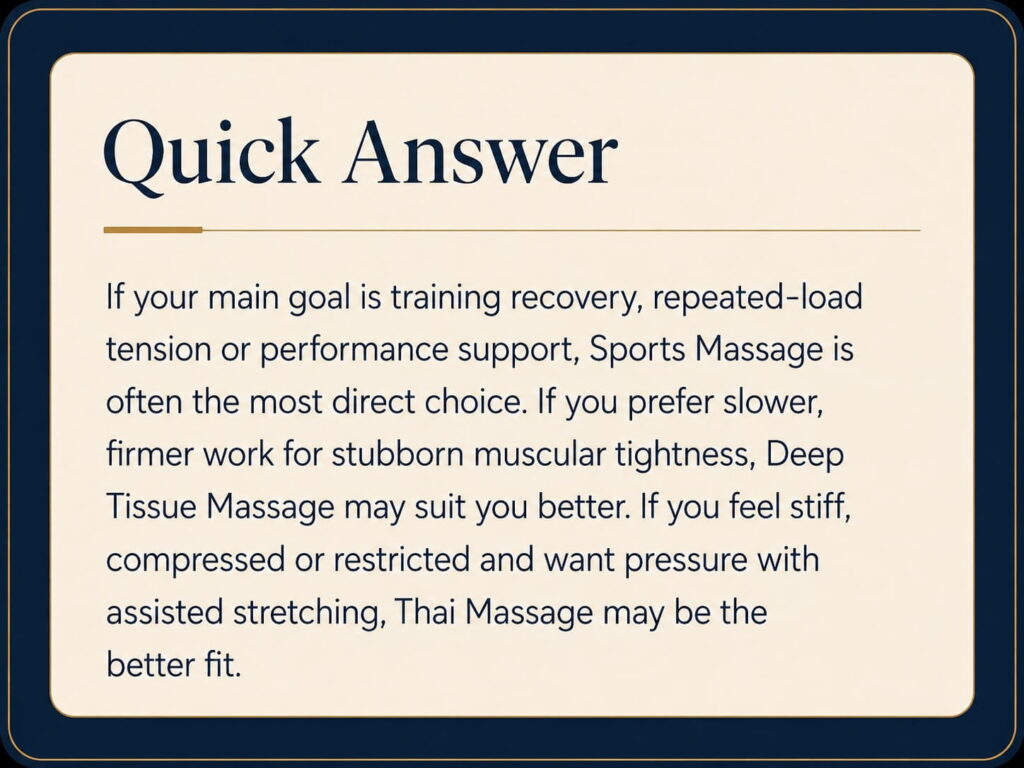
→ Choose deep tissue massage when your main concern is persistent muscular tension, and you prefer slow, focused pressure.
→ Consider sports massage or sports-focused bodywork when your concern relates to training, repeated movement, preparation for activity or post-exercise comfort.
There isn’t a single best option for everyone. The right choice depends on your reason for booking, what your body has been through recently, and whether your symptoms might need a check-up instead of a massage.
Deep tissue massage vs sports massage: the main difference
The clearest distinction is treatment intention.
→ Deep tissue massage is usually centred on:
- Slow and sustained pressure;
- Specific areas of muscular tension;
- Gradually working through superficial and deeper soft tissue;
- Clients who prefer a firmer treatment than relaxation massage.
→ Sports massage is usually centred on:
- The demands of a particular activity;
- Tissues or movement patterns that are repeatedly loaded;
- Timing around exercise or an event;
- Targeted pressure, compression, movement or stretching;
- A functional goal rather than relaxation alone.
A sports massage isn’t always deeper than a deep tissue massage. Sometimes, it’s lighter, shorter, or more active, especially if it’s right before an event. Deep tissue massage can also be firm and focused, even if it has nothing to do with sports.
Deep Tissue Massage and Sports Massage Compared
The table below provides a practical overview of deep tissue massage vs sports massage, although individual sessions may include overlapping techniques.
| Factor | Deep Tissue Massage | Sports Massage |
|---|---|---|
| Primary purpose | Focused work around persistent muscular tension | Bodywork organised around activity, training or recovery |
| Typical pace | Slow and gradual | Variable depending on the session goal |
| Pressure | Usually medium-firm to firm | Can range from moderate to firm |
| Techniques | Sustained pressure, slow strokes and focused soft-tissue work | Targeted massage, compression, movement and sometimes stretching |
| Movement assessment | May be discussed but is not always central | Often more closely related to activity or movement demands |
| Timing | Commonly booked according to general tension or preference | May be planned before or after training or an event |
| Who may consider it | Desk workers, commuters and people who prefer focused pressure | Runners, gym-goers, dancers, cyclists and physically active clients |
| Typical experience | Slow, concentrated and pressure-led | More functional and activity-led |
| Medical role | Does not diagnose or treat injury | Does not replace sports medicine or physiotherapy assessment |
What is deep tissue massage?
Deep tissue massage uses slow, controlled pressure around areas that feel tight, heavy or restricted. The therapist may use the hands, thumbs, knuckles, forearms or elbows, depending on the area and the client’s comfort.
Deep tissue doesn’t mean using the strongest pressure possible. Skilled therapists work gradually, letting your muscles and you adjust, instead of pushing hard into areas that feel tense or sore.
→ People may consider deep tissue massage when they:
- Regularly feel tension through the back, shoulders or neck;
- Spend long periods sitting or commuting;
- Experience general stiffness after physical work;
- Prefer focused pressure rather than a light relaxation massage;
- Have areas of muscular tightness that build gradually.
The treatment should remain adjustable. A client should breathe comfortably, communicate, and ask for less pressure at any time.
→ People often pick deep tissue massage for muscle tension, but it’s not meant to diagnose injuries, remove scar tissue, or promise pain relief. Deep tissue massage is often selected for localised areas of tension. Read more about muscle knots and trigger points and how massage may form part of a broader approach.
What is sports massage?
Sports massage is more about reaching your goals than following a set routine of techniques.
A sports massage therapist may consider:
- The client’s sport or physical activity;
- Recent changes in training volume or intensity;
- Which areas are repeatedly loaded;
- Whether the session is before or after exercise;
- Current tenderness or fatigue;
- Relevant injuries or medical history;
- The client’s next planned training session or event.
The practitioner may use massage, pressure, compression, supported movement, and stretching. The combination should reflect the situation, not follow the same routine for every active client.
For example:
- A runner may discuss the calves, hips and thighs;
- A cyclist may notice tension around the hips, thighs or upper back;
- A weight-training client may seek focused work around the shoulders, back or legs;
- A dancer may value movement awareness alongside soft-tissue work.
Research does not support claims that sports massage directly improves performance. A systematic review found no overall performance improvement, though small benefits appeared for flexibility and delayed-onset muscle soreness. Sports massage is better seen as part of a broader recovery routine, not a substitute for training, sleep, nutrition, or injury rehabilitation. or a broader comparison of treatment choices, training schedules and recovery timing, read our guide to the best massage for runners and gym-goers.
Five differences between deep tissue and sports massage
Deep tissue and sports massage have different primary goals
1. Purpose
→ Deep tissue massage is commonly selected because an area feels persistently tight and the client wants slow, focused pressure.
Sports massage begins with the activity. The therapist considers what the client is doing, when they are doing it and which areas are repeatedly placed under demand.
2. Timing
→ Deep tissue massage may be booked whenever general muscular tension becomes noticeable.
Sports-focused treatment may be planned in relation to:
- A demanding training week;
- An upcoming race or event;
- Post-event soreness;
- A return to activity;
- Repeated loading from a particular sport.
An intensive and unfamiliar session immediately before important activity may be inappropriate if it leaves the person tender or alters how the body feels. Treatment intensity should reflect timing as well as preference.
3. Pressure
Deep tissue massage is usually slower and progressively firmer.
→ Sports massage pressure varies. A post-training session might include calm, focused work, while a session close to activity might be lighter and more selective.
Neither treatment should be judged by pain level. Excessive discomfort can cause guarding and hinder communication.
4. Movement and stretching
Deep tissue work may concentrate primarily on pressure and localised soft-tissue tension.
→ Sports massage may include supported movement or stretching when appropriate. This does not mean forcing a joint through its maximum range. Movement should stay controlled and relevant to the client.
Physiotherapy differs: physiotherapists assess and manage injury, illness, or disability using exercise, education, manual therapy, and other methods. Massage can be part of physiotherapy, but a massage session alone is not equivalent to a physiotherapy assessment or rehabilitation plan.
5. Treatment scope
Deep tissue massage can suit people who do not exercise regularly.
→ Sports massage is not only for professional athletes, but it is usually most relevant when the client’s concern has a clear relationship to activity, repeated movement or physical workload.
Which treatment may suit you?
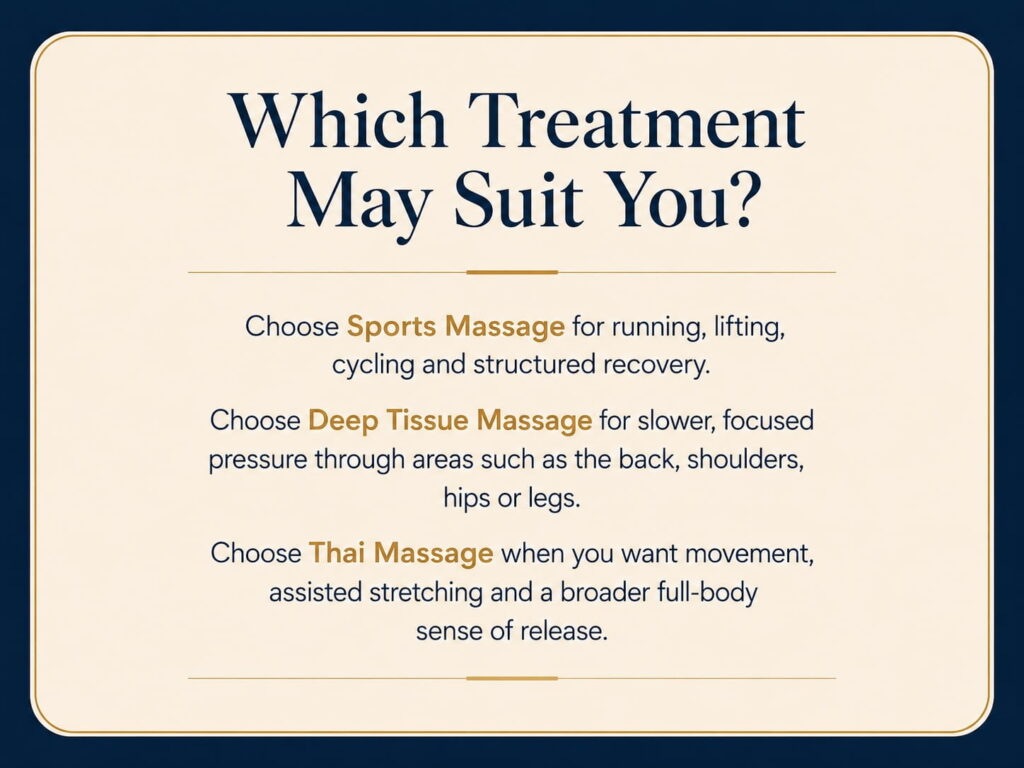
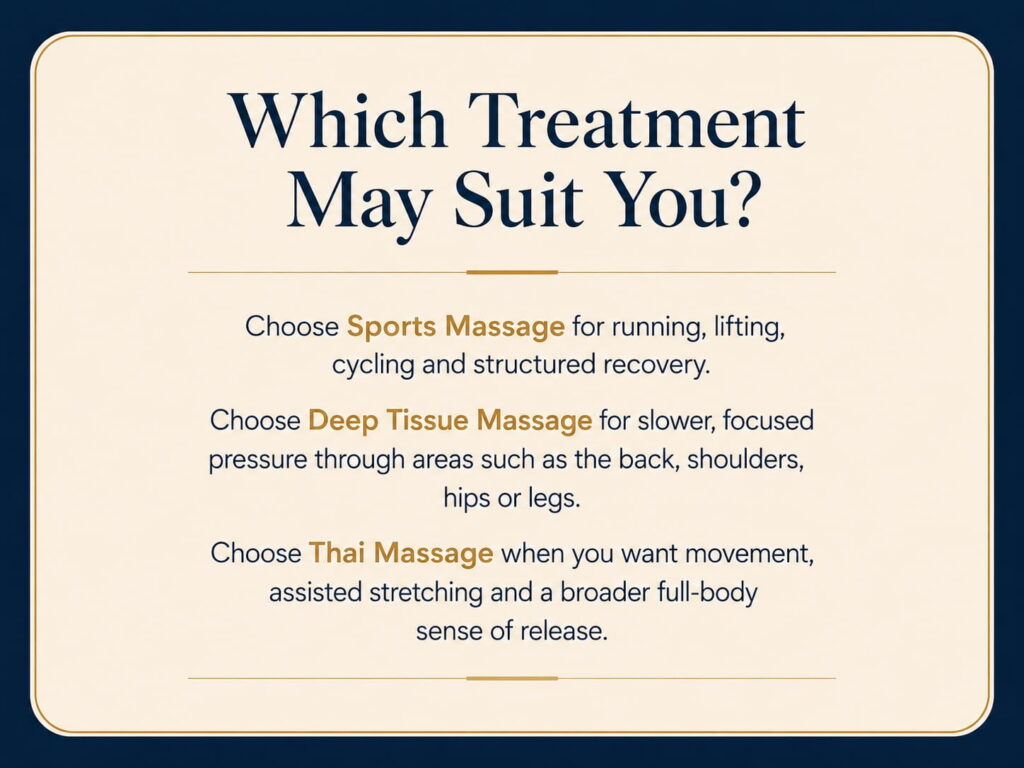
Deep tissue massage may suit you when:
- Your tension has developed gradually;
- Desk work or commuting leaves you feeling stiff;
- You prefer slow and focused pressure;
- You have no immediate competition or training goal;
- You want a treatment that feels concentrated rather than movement-led.
Sports massage may suit you when:
- You train or exercise regularly;
- One group of muscles is repeatedly loaded;
- You want the treatment planned around your activity;
- You need to discuss an upcoming event or training session;
- Your concern is linked to movement rather than general tension alone.
Thai yoga massage may suit you when:
- You want pressure and assisted movement together;
- You feel generally stiff rather than focused tension in one area;
- You prefer compression and supported stretching;
- You want a more integrated full-body experience.
The name of the treatment is just the beginning. A good consultation will help figure out if you need focused pressure, activity-based massage, assisted movement, or a mix of these. Our guide to Thai Yoga Massage vs assisted stretching explains how practitioner-led bodywork differs from a standalone stretching session
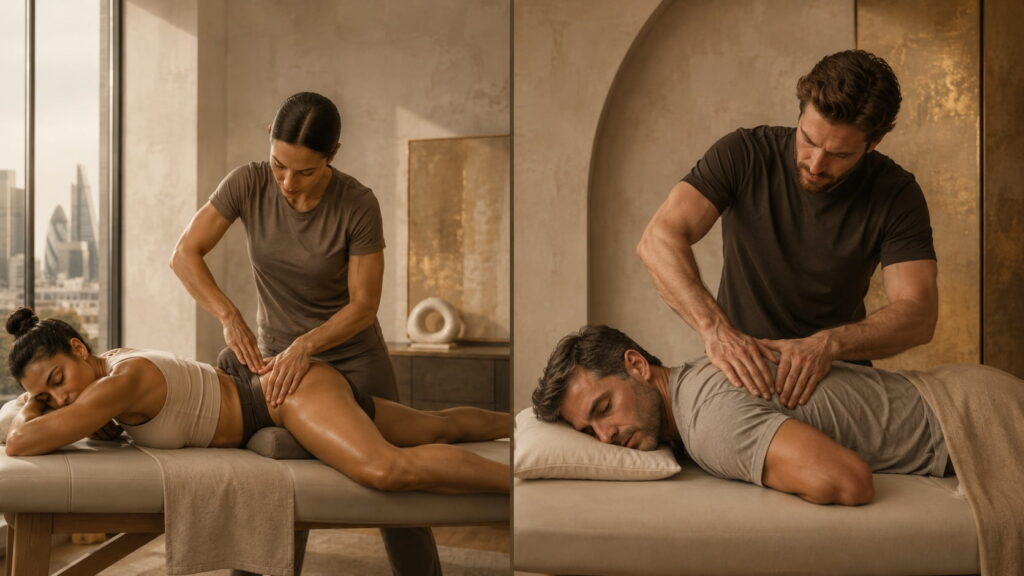
Two practical treatment examples
Illustrative case study 1: the desk-based client
→ This composite example illustrates a common decision and does not describe an identifiable client.
A London office worker reports persistent upper-back and shoulder tension after long hours at a computer. The client is not training for an event and does not describe a recent injury, swelling or sudden loss of movement.
In this situation, deep tissue massage may be a logical starting point because the main goal is slow, focused work around accumulated muscular tension. The practitioner can adapt the pressure and avoid treating the session as though it were sports rehabilitation.
The key consideration is not whether the client is “active enough” for sports massage. It is whether an activity-led treatment adds value to the appointment’s goal.
Illustrative case study 2: The Runner During a Training Block
→ This composite example illustrates treatment planning and does not describe an identifiable client.
A recreational runner reports calf and hip tightness during a demanding training week. A longer run is planned in two days, and there is no sharp pain, marked swelling or recent traumatic injury.
A sports-focused approach may be more suitable because the treatment can be adapted around:
- Recent mileage;
- The areas repeatedly loaded;
- The timing of the next run;
- Current soreness;
- How the runner usually responds to massage.
The practitioner might avoid an intensive session close to the planned run and focus on comfortable, targeted work. If the runner reports sharp pain, worsening swelling, difficulty bearing weight, or reduced function, massage should not replace proper assessment. Guidance recommends seeking help when an injury is very painful or worsening, substantially swollen or bruised, difficult to move, or prevents normal weight-bearing.
From the treatment room at Asiatic
“Clients sometimes assume that sports massage must be harder than deep tissue massage. In practice, the main difference is not simply pressure. We consider why the client is booking, what activity they have recently completed, what they plan to do next and whether the body would respond better to slow focused work, assisted movement or a combination.”
Ben Pianese — Co-Founder of Asiatic and bodywork practitioner since 2001
At Asiatic’s Angel and Highbury studios, the consultation should cover:
- The reason for booking;
- Recent training or physical workload;
- Any current soreness or sensitivity;
- Pressure preference;
- Previous responses to massage;
- Forthcoming exercise or events;
- Relevant health information.
This prevents the session from becoming a generic “firm massage” when the client’s needs are more specific.
Deep tissue massage, sports massage or Swedish massage?
Swedish massage is usually lighter, more flowing and relaxation-led.
→ Choose based on the experience and purpose you want:
- Swedish massage: relaxation, lighter pressure and a calmer treatment;
- Deep tissue massage: slow, focused work around muscular tightness;
- Sports massage: treatment organised around activity and physical workload;
- Thai Yoga Massage: pressure, compression and supported movement.
No single style is best for everyone. The better question to ask is:
What should this session help me feel or do more comfortably, and is massage appropriate for the symptoms I have?
Can massage treat a sports injury?
Massage should not be presented as a way to diagnose or solely rehabilitate a sports injury.
An acute injury may involve:
- Sudden pain;
- Swelling;
- Bruising;
- Reduced movement;
- Difficulty taking weight;
- Heat or redness;
- Weakness or instability.
Massage soon after some soft-tissue injuries may worsen bleeding or swelling. NHS guidance advises avoiding massage during early stages of certain injuries.
A sports massage therapist can work with active clients, but this differs from assessing an undiagnosed injury. Physiotherapists are trained to assess movement and function and may use exercise, education, and manual techniques as part of a wider plan.
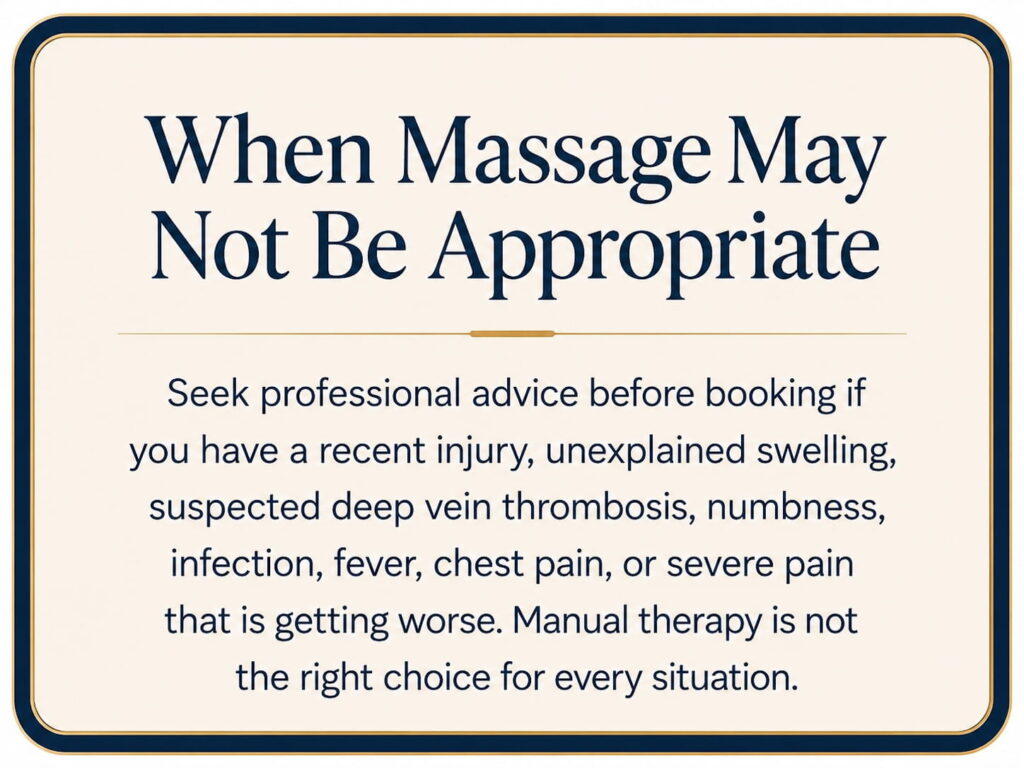
Seek appropriate assessment before massage when you have:
- Sharp, severe or worsening pain;
- Marked or unexplained swelling;
- A recent fall, collision or traumatic injury;
- Inability to bear weight normally;
- Weakness, numbness or radiating symptoms;
- Significant heat, redness or fever;
- Pain that wakes you repeatedly or prevents normal activity;
- Symptoms that are not improving.
For low-back pain, manual therapy may be part of a broader management programme. NICE recommends it only as part of a treatment package including exercise, not as an isolated cure.
What about scar tissue and old injuries?
Massage is sometimes described as “breaking down” scar tissue. This wording is too simplistic.
Massage can help you feel more comfortable and confident moving around healed areas, but it shouldn’t be seen as a sure way to get rid of scar tissue.
Recent surgery, unexplained pain or unresolved injury requires appropriate professional guidance. The practitioner should know:
- When the surgery or injury occurred;
- Whether the area has healed;
- Whether the client has medical clearance;
- Whether there is altered sensation, swelling or medication affecting risk.
London clients: desk work, commuting and training
At Asiatic, clients often have more than one source of tension.
Someone may spend the week at a desk, commute across London, and train at the gym in the evening. The body may feel both generally stiff and specifically tired from activity.
Rather than choosing a treatment by its name alone, the practitioner can consider:
- Whether the tension is mainly desk-related or activity-related;
- Whether the client wants stillness or assisted movement;
- How much pressure feels appropriate;
- Whether any recent training should affect the session;
- Whether symptoms suggest that massage should be postponed.
A client with gradual upper-back tension may consider Deep Tissue Massage. A runner or gym-goer may discuss sports-focused adaptations. Someone wanting compression and assisted movement may prefer Thai Yoga Massage.
Other Massage Options to Consider
Back, neck and shoulder massage
A focused option when the primary concern is limited to the upper body and the client does not need a full-body session.
Thai yoga massage
May suit clients seeking pressure, compression and assisted movement in the same treatment.
Aromatherapy massage
A gentler option for clients prioritising relaxation and lighter pressure.
Thai foot massage
May suit people whose feet and lower legs feel tired after standing, walking or commuting.
The appropriate treatment depends on the full consultation, not just the strongest pressure available.
Choosing Between Deep Tissue and Sports Massage
There is no universal winner.
When comparing deep tissue massage vs sports massage, neither treatment is automatically deeper, more advanced, or better. Deep tissue massage suits people seeking slower, focused work on persistent muscular tension. Sports massage is more appropriate when treatment relates to running, lifting, repetitive movement, training demands, or recovery planning.
The right choice depends on how your body feels that day. A brief consultation lets the therapist consider your activity, symptoms, pressure preferences, and goals before adapting the treatment.
Uncertain clients can discuss both approaches when booking at our Angel and Highbury studios.
Frequently Asked Questions
What is the difference between sports massage and deep tissue massage?
The principal difference is purpose. Deep tissue massage generally uses slow, focused pressure around persistent muscular tightness. Sports massage is organised more closely around training, repeated movement, activity and recovery.
Is sports massage better than deep tissue massage?
No. Sports massage may suit an activity-related goal, while deep tissue massage may suit general muscular tightness. The more appropriate treatment depends on your symptoms, recent activity, comfort and reason for booking.
Is sports massage more painful?
Not necessarily. Sports massage can range from moderate to firm, and the pressure should reflect the timing and purpose of the session. Neither sports massage nor deep tissue massage should feel unbearable.
Can I have deep tissue massage if I do not play sport?
Yes. Many people choose deep tissue massage because of desk work, commuting, physical work or general muscular tension rather than sport.
Is sports massage only for athletes?
No. It may suit runners, gym-goers, dancers, cyclists and people with physically demanding routines. The activity and treatment goal matter more than whether someone competes professionally.
Which massage is better for lower-back tension?
Deep tissue or sports-focused bodywork may be considered for general muscular tightness, depending on recent activity and comfort. Sharp, severe, radiating or unexplained back pain should be assessed appropriately before massage.
Can sports massage improve athletic performance?
Research has not shown a direct overall improvement in sporting performance. It may offer small benefits for perceived soreness or flexibility in some circumstances, but it should remain part of a wider recovery approach.
Can massage help an injury?
Massage may be included within a broader rehabilitation plan, but an undiagnosed injury should not be treated through massage alone. Acute pain, swelling, bruising, reduced function or inability to bear weight requires appropriate assessment.
How often should I book deep tissue or sports massage?
There is no universal schedule. Frequency depends on how you respond, your activity, treatment intensity, goals and relevant health considerations. Persistent or recurring pain should not automatically be managed through increasingly frequent massage.
Should I choose Thai yoga massage instead?
Thai Yoga Massage may be worth considering when you want supported movement, compression and pressure in one session. It may suit clients who feel generally stiff rather than focused tension in a single area.