Estimated reading time: 14 minutes
Both Thai Yoga Massage and assisted stretching involve practitioner-guided movement, but they offer distinct experiences.
Thai Yoga Massage integrates assisted stretches with pressure, compression, rhythmic movement and traditional Thai bodywork. Assisted stretching targets flexibility and mobility primarily, without the broader massage component.
Choose assisted stretching if your main goal is focused flexibility. Opt for Thai Yoga Massage if you prefer guided stretching with hands-on pressure and a more immersive, full-body treatment.
Key takeaway
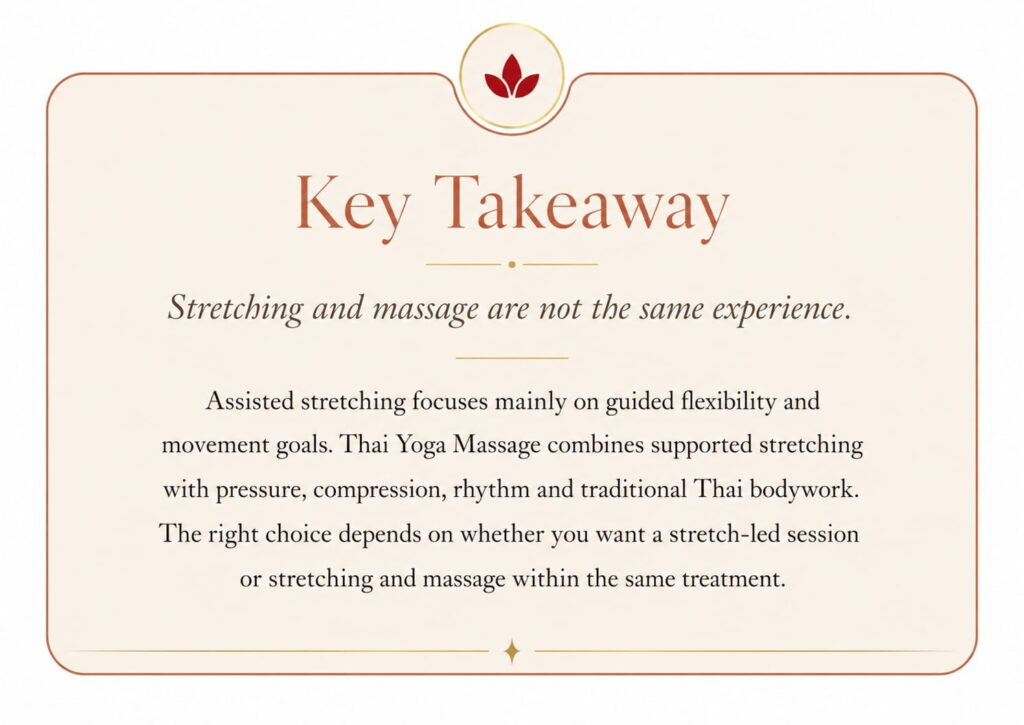
Assisted stretching focuses on guided flexibility and range of movement. Thai Yoga Massage includes assisted stretching along with pressure, compression, rhythm and traditional Thai bodywork. Neither is universally better; the right choice depends on whether you prefer a stretch-focused session or a combination of stretching and massage.
Wellbeing information
This article provides general wellbeing information and does not diagnose or treat injuries, pain or medical conditions. Speak to an appropriate healthcare professional if you are unsure whether massage or stretching is suitable for you.
Written by Natasha Parker. Reviewed by Ben Pianese, Co-Founder of Asiatic and bodywork practitioner since 2001
What is Thai Yoga massage?
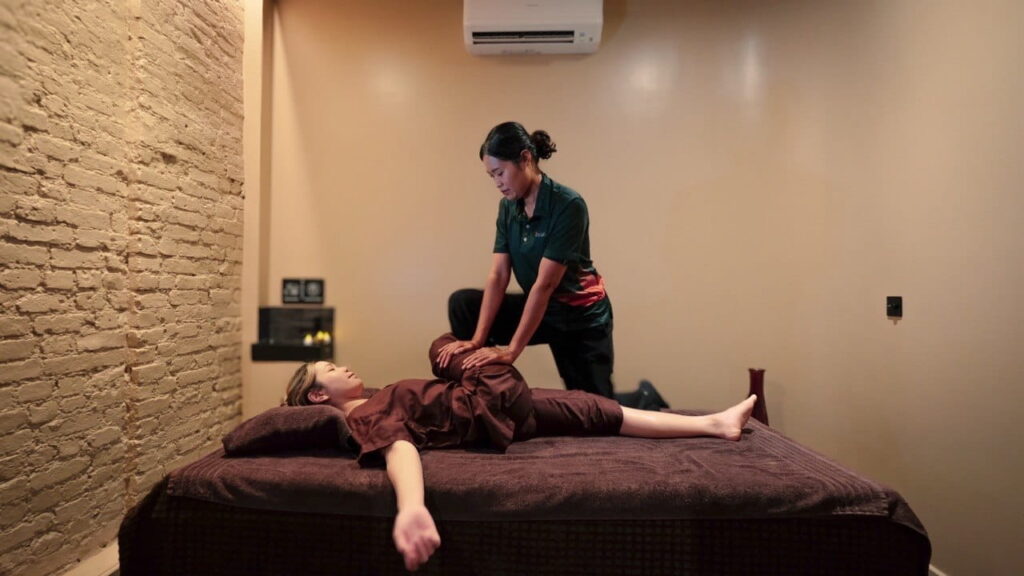
Thai Yoga Massage is a clothed, movement-based form of bodywork. The therapist may use their hands, forearms, elbows, knees or carefully controlled bodyweight to apply pressure while guiding the client through supported positions.
A session can include:
- Rhythmic compression;
- Gentle rocking;
- Assisted yoga-inspired stretches;
- Pressure using the hands or forearms;
- Controlled movement through comfortable ranges;
Pauses that allow the body to settle.
It is typically performed on a padded floor mat without oil, though the format may vary by practitioner.
Traditional Thai massage is known in Thailand as Nuad Thai. UNESCO recognises it as part of Thailand’s intangible cultural heritage and describes a practice involving manipulation with the hands, elbows, knees and feet.
In traditional Thai practice, therapists may refer to pathways known as sen lines. These belong to the traditional framework of Thai bodywork and should not be confused with anatomical structures recognised by modern medicine.
At Asiatic, Thai Yoga Massage combines supported movement, rhythmic compression and pressure tailored to the client’s comfort. The treatment extends beyond stretching by incorporating pressure, rhythm and hands-on bodywork. Asiatic has offered Thai massage and bodywork on Upper Street since 2009 and now operates studios in Angel and Highbury.
What is Assisted Stretching?
Assisted stretching is a practitioner-guided session where another person supports or moves your body through specific stretch positions.
It may involve:
- Passive stretches, where the practitioner supports most of the movement;
- Active-assisted stretches, where the client also participates;
- Static positions held for a period;
- PNF-style techniques involving contraction and relaxation;
- Stretches selected for a particular area or mobility goal.
Sessions are typically performed fully clothed on a mat or treatment table. Depending on the provider, appointments may include a movement assessment and a programme targeting areas such as the hips, hamstrings, shoulders or back.
Assisted stretching is generally more functional and focused on stretching than massage. It typically does not include the continuous compression, acupressure or rhythmic bodywork found in Thai Yoga Massage.
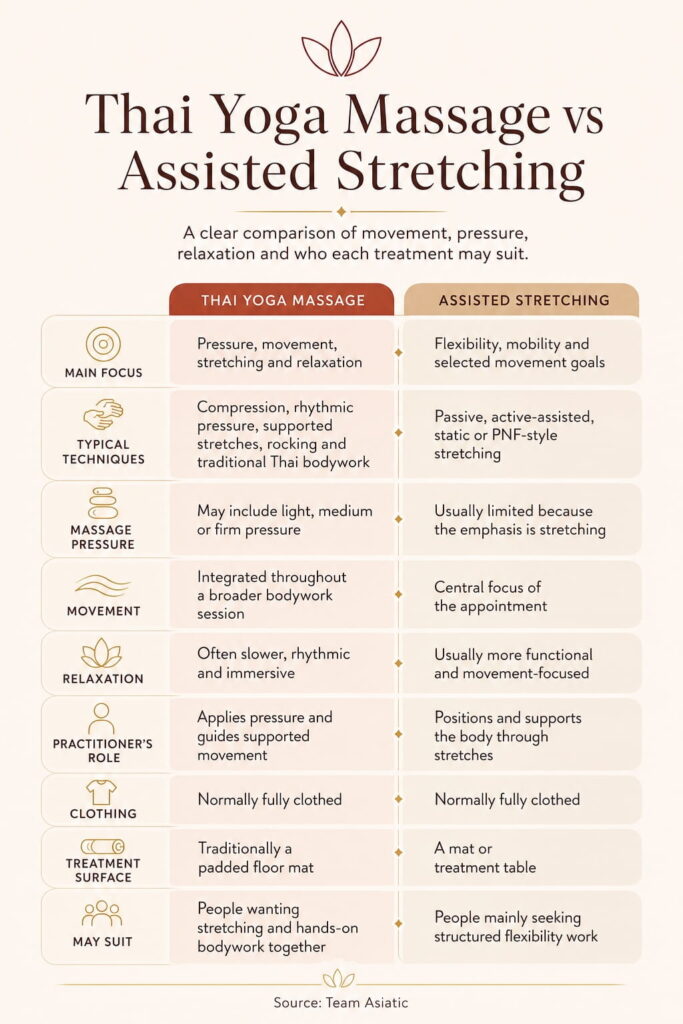
| Factor | Thai Yoga Massage | Assisted Stretching |
|---|---|---|
| Massage pressure | May include light, medium or firm pressure | Usually limited because the emphasis is stretching |
| Movement | Integrated throughout a broader bodywork session | The central focus of the appointment |
| Relaxation | Often slower, rhythmic and immersive | Usually more functional and movement-focused |
| Practitioner’s role | Applies pressure and guides supported movement | Positions and supports the body through stretches |
| Clothing | Normally fully clothed | Normally fully clothed |
| Treatment surface | Traditionally a padded floor mat or table | A mat or treatment table |
What does each treatment feel like?
Thai Yoga massage
Thai Yoga Massage often feels rhythmic, varied and immersive—pressure and movement alternate throughout the session, rather than focusing on a single stretch.
The therapist may apply compression, guide the body through supported positions, pause, and then move to another area. Pace and depth are adjusted to the client’s comfort and mobility.
Assisted Stretching
Assisted stretching often resembles a coached mobility session. The practitioner may assess movement, position the body and hold or repeat specific stretches.
The experience is typically focused and practical, rather than massage-led. Many clients appreciate concentrating on a specific flexibility goal without a full massage.
Which is better for flexibility?
Both approaches can include stretching, but assisted stretching places flexibility and range of movement at the centre of the appointment.
Thai Yoga Massage may suit those who feel generally stiff and also want pressure, compression and relaxation. However, it is not a substitute for regular movement, exercise or a structured mobility program.
Research suggests that stretching can improve range of motion, but the evidence does not establish one stretching method as universally superior. A systematic review of PNF stretching found that much of the evidence comparing it with other methods was of low or very low quality. Another review found that both PNF and static stretching could increase range of motion, without demonstrating that PNF was consistently more effective.
This distinction matters because marketing may promise dramatic or permanent results from specific stretching methods. In practice, outcomes depend on:
- The person’s starting mobility;
- The technique used;
- Comfort and tolerance;
- Frequency and consistency;
- Everyday activity;
- Strength and movement habits;
- Injury or medical history.
A single session may create a temporary feeling of openness, but longer-term changes generally depend on consistent movement, exercise and everyday activity rather than occasional treatment alone.
Which is more relaxing?
Thai Yoga Massage is generally the more massage-oriented choice.
Its rhythm, pressure and whole-body approach often create a calmer, more immersive experience than sessions focused solely on selected stretches.
Assisted stretching can also be relaxing, especially for those who prefer guided movement without traditional massage pressure. However, relaxation is usually a secondary benefit rather than the main focus.
Choose what helps you switch off:
Thai Yoga Massage: pressure, rhythm, movement and a full treatment experience.
Assisted stretching: focused stretches with the practitioner doing much of the physical positioning.
Is Thai Yoga massage the same as Passive Stretching?
No.
Passive stretching can form part of Thai Yoga Massage but is only one element. Thai Yoga Massage also includes compression, rhythmic pressure, rocking, careful body positioning and traditional Thai techniques.
An assisted stretching session typically focuses on selected stretches, while a Thai Yoga Massage alternates between pressure, movement and rest.
Where do Deep Tissue and Sports Massage Fit?
Thai Yoga Massage and assisted stretching are not the only options for addressing tightness or restriction.
Deep tissue massage
Deep Tissue Massage is typically more pressure-focused and involves slower work on specific areas of muscular tension. It may suit those who prefer firmer, table-based massage with less guided movement.
Sports massage
Sports massage is often chosen for training, repetitive movement, physical workload or recovery goals. Depending on the practitioner, it may combine massage, movement assessment and stretching.
Back, neck and shoulder massage
A Back, Neck and Shoulder Massage may be more suitable when concerns are focused on the upper back, shoulder blades or neck rather than the entire body. The treatment name alone does not determine the quality of the appointment. Practitioner experience, communication, pressure control and the ability to adapt the session all matter.
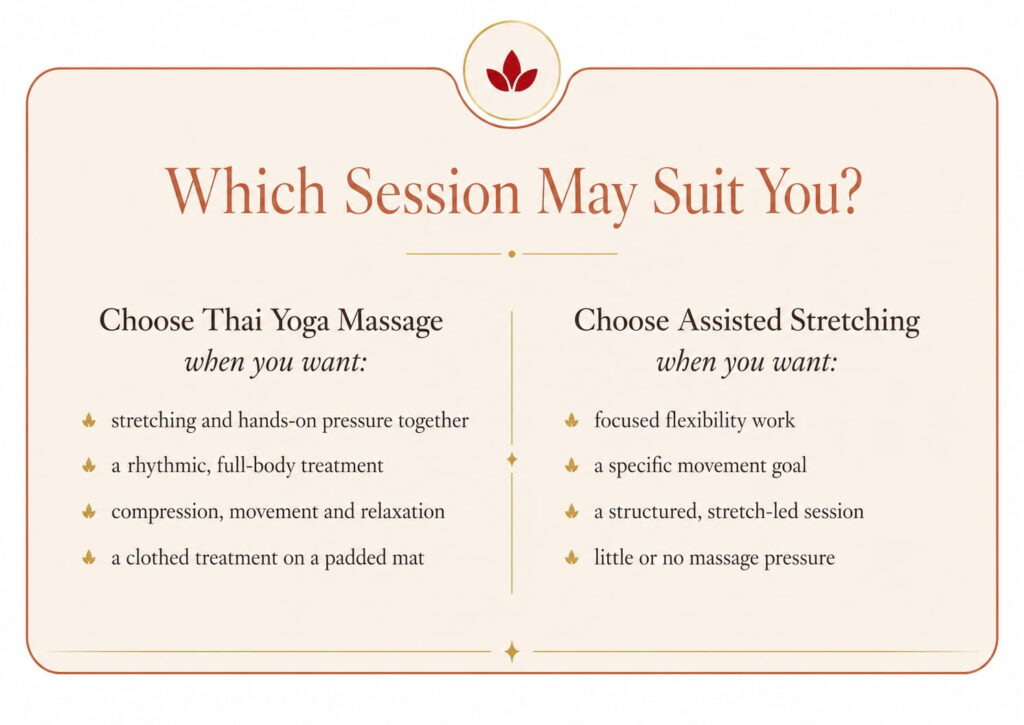
Choose Thai Yoga massage when you want stretching and bodywork together
Thai Yoga Massage may suit you when you want more than a series of isolated stretches.
You may prefer it when:
- Stiffness feels spread across several parts of the body;
- You enjoy massage pressure as well as guided movement;
- You want a fully clothed treatment without oil;
- You prefer a rhythmic, whole-body experience;
- You want the session adapted rather than following a fixed stretching routine;
- You like yoga-inspired positions but do not want to attend a yoga class.
Thai Yoga Massage offers a broader scope than a stretch-only session. This does not make it inherently better; it simply means stretching is part of a more comprehensive bodywork experience.
Choose Assisted Stretching when flexibility is the main goal
Assisted stretching may be preferable if you want a structured session focused on movement.
It may appeal to:
- Gym clients working on a specific range of movement;
- Runners or active clients who want a stretch-focused appointment;
- People who already receive massage but want separate mobility work;
- Clients who do not enjoy massage pressure;
- People who prefer a measurable or programme-based approach;
- Those seeking guidance with positions they find difficult to perform alone.
Ask the provider what their session includes, as “assisted stretching” can refer to various methods, practitioner backgrounds and appointment formats.
Where can you book Assisted Stretching in London?
People researching assisted stretching in London will find dedicated stretching studios as well as fitness and recovery businesses that include it within a wider service menu.
The following are neutral examples rather than rankings or personal endorsements:
Vive Fitness
Vive Fitness offers one-to-one assisted stretching alongside fitness, Pilates and recovery services. Its official website currently lists London locations including Westminster, Mayfair and Richmond.
Stretch Life
Stretch Life focuses on practitioner-guided PNF assisted stretching and currently lists studios in Islington, Waterloo and King’s Cross.
StretchLAB
StretchLAB offers one-to-one assisted-stretching sessions using passive, active, static and PNF methods. Its website currently lists seven London studios and states that its programme is designed and supervised by an HCPC-registered physiotherapist.
These providers demonstrate that assisted stretching is now a distinct wellness category in London. Their services vary in training, assessment, session length and techniques.
The Asiatic Practitioner Perspective
At Asiatic’s Islington studios, our therapists often meet clients who feel “tight” but are unsure which appointment to choose.
The most helpful starting question is not, “Which treatment is best?” but rather:
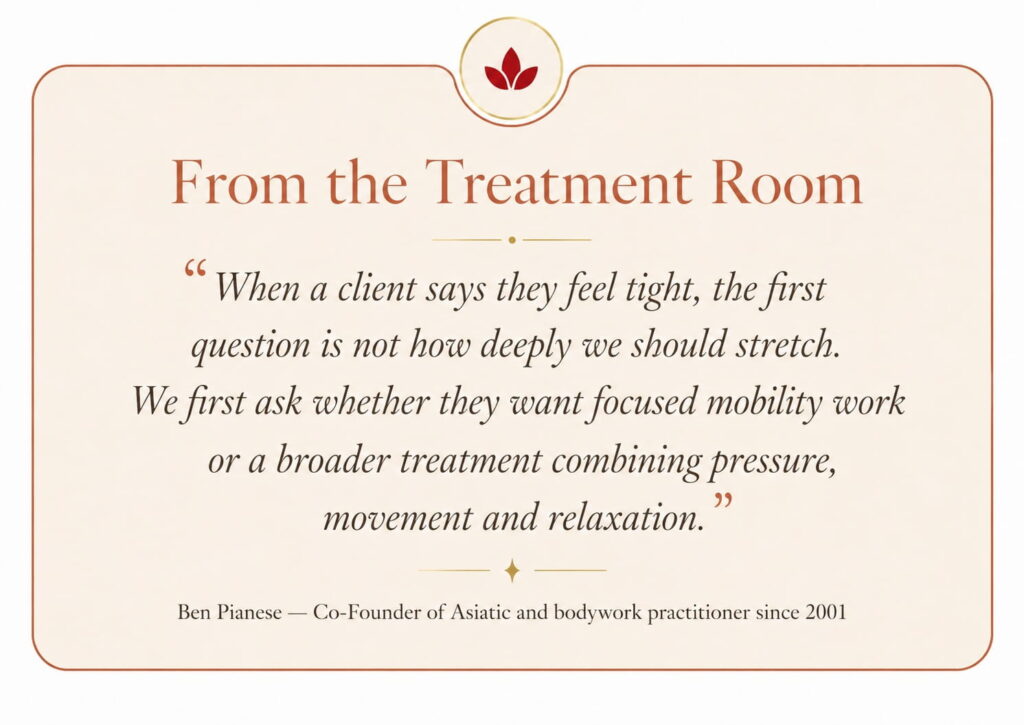
Do you mainly want to work on flexibility, or do you want guided movement combined with massage pressure and relaxation?
Someone preparing for training may prefer a focused stretch session. A desk worker with restrictions in the shoulders, back, hips and legs may benefit more from a broader Thai Yoga Massage that combines movement with pressure and rhythm.
Every individual responds differently. At Asiatic, therapists ask about comfort, preferred pressure, restricted areas and any movements or positions to avoid. Sessions are then adjusted based on how the client feels that day.
Asiatic’s team includes practitioners trained in traditional Thai massage and related bodywork, with some holding UK qualifications such as ITEC or VTCT. Both Upper Street studios follow founder-led standards emphasising communication, adapted pressure and client comfort.
London desk work, training and commuting stiffness
Extended periods of sitting, laptop use, commuting, standing or training can leave the body feeling heavy or restricted. However, these sensations do not always require the strongest massage or deepest stretch.
Some clients benefit most from gentle sessions that help them slow down, while others prefer focused movement or firmer pressure. The best choice depends on individual needs, rather than assuming one treatment addresses all types of stiffness.
At Asiatic, Thai Yoga Massage is available at two Upper Street studios:
Asiatic Angel at 93 Upper Street, near Angel station.
Asiatic Highbury at 262 Upper Street, near Highbury & Islington station.
Both studios provide clothed, movement-based Thai Yoga Massage focused on comfort, communication and supported stretching.
What should you wear?
Wear soft, comfortable clothing that allows for easy movement, such as:
- A T-shirt or lightweight long-sleeved top;
- Leggings, tracksuit bottoms or flexible trousers;
- Clean socks.
Avoid restrictive jeans, belts, thick seams or any clothing that limits hip and knee movement.
At Asiatic, Thai Yoga Massage is typically performed fully clothed on a padded mat without oil. Dedicated assisted stretching providers also generally request clients wear comfortable exercise clothing.
When should you ask for professional advice first?
Massage and assisted stretching are not suitable for every person or every situation.
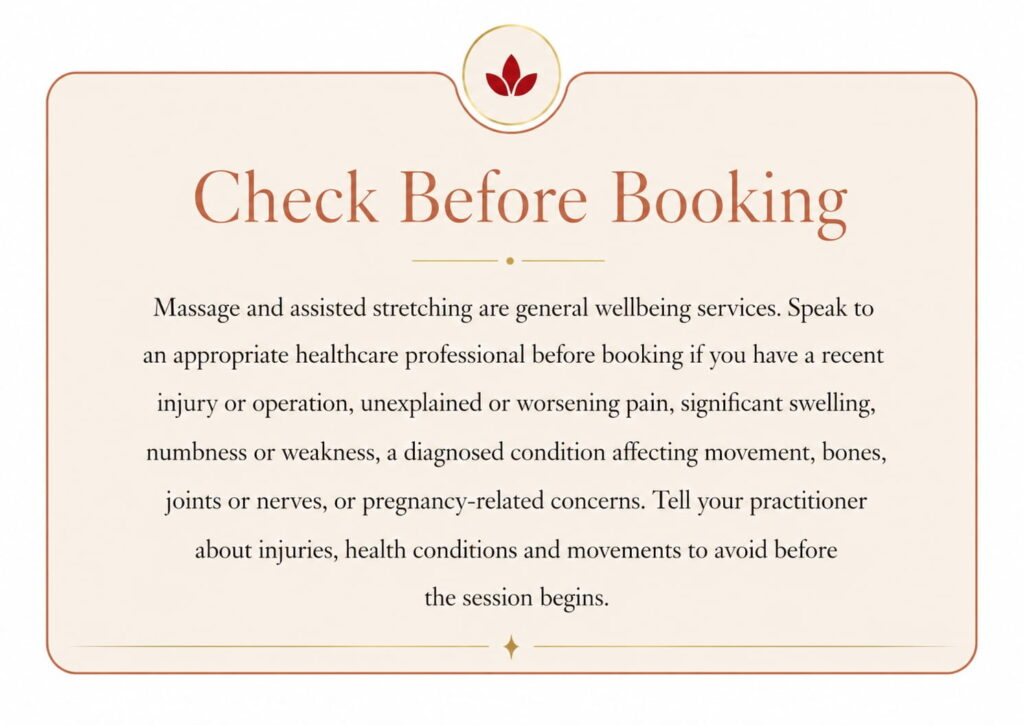
Speak to an appropriate healthcare professional before booking when you have:
- A recent injury or operation;
- Unexplained, severe or worsening pain;
- Significant swelling, numbness or weakness;
- A diagnosed condition that affects movement, bones, joints or nerves;
- A high-risk pregnancy or pregnancy-related concerns;
- Uncertainty about whether manual therapy or stretching is appropriate.
Inform the practitioner of any relevant conditions, injuries, pregnancy or areas to avoid before the session. Stop the treatment if you experience sharp pain, numbness, dizziness or unusual discomfort.
The NHS advises that complementary therapies are not safe or suitable for everyone and recommends checking suitability where health conditions or other risks are present.
Neither Thai Yoga Massage nor assisted stretching should be presented as a guaranteed treatment for pain, injuries, headaches, sciatica or medical conditions.
How to choose the right appointment
Consider these four questions before booking:
1. Do I primarily want flexibility work?
Choose assisted stretching if your main priority is guided stretching and movement.
2. Do I want hands-on pressure as well?
Thai Yoga Massage may be more suitable if you want compression and massage combined with supported movement.
3. Do I prefer a mat or massage table?
Traditional Thai Yoga Massage is usually performed on a padded floor mat. Assisted stretching may occur on a mat or a raised treatment table.
4. Is my concern general stiffness or a specific injury?
Massage and general stretching appointments are wellbeing services. A qualified healthcare professional should assess persistent pain, recent injury or unexplained symptoms.
Thai Yoga Massage vs Assisted Stretching: The Verdict
Thai Yoga Massage and assisted stretching share an important feature: another person helps guide the body through movement.
Their purposes and overall experiences differ. Assisted stretching is the more direct choice when flexibility or a specific movement goal is your main priority. Thai Yoga Massage may be the more suitable choice when you want stretching combined with pressure, compression, rhythm and a complete bodywork experience.
Neither approach is inherently better. The right appointment depends on your desired outcome, treatment preferences and whether you prioritise focused mobility or broader hands-on care.
Explore Thai Yoga massage at Asiatic
Experience Thai Yoga Massage in London at Asiatic’s Angel and Highbury studios.
Choose your location:
- Book Asiatic Angel
- Book Asiatic Highbury
- Contact Team Asiatic if you are unsure which treatment to choose.
FAQs About Thai Yoga Massage and Assisted Stretching
Is Thai Yoga Massage the same as assisted stretching?
No. Thai Yoga Massage includes assisted stretches, but it also incorporates pressure, compression, rhythmic movement and traditional Thai bodywork. Assisted stretching is normally more focused on flexibility and selected ranges of movement.
Is Thai Yoga Massage performed on a massage table?
Thai Yoga Massage is traditionally performed fully clothed on a padded floor mat. This provides room for supported movement and body positioning. Some practitioners may adapt the treatment to a table when appropriate.
Can Thai Yoga Massage improve flexibility?
Thai Yoga Massage includes assisted movement that may support a temporary feeling of greater openness or easier movement. Results vary, and longer-term flexibility generally depends on consistent movement, exercise and stretching habits.
Is assisted stretching better than Thai Massage for athletes?
Not necessarily. Assisted stretching may suit athletes who want focused mobility work. Thai Yoga Massage may appeal to those who also want massage pressure, rhythm and relaxation. Training demands, injuries and individual preferences should guide the choice.
Is PNF stretching better than other forms of stretching?
Research does not establish that PNF is consistently superior. Studies suggest that PNF and static stretching can both increase range of motion, while comparisons between different methods have produced mixed or low-quality evidence.
Should I choose Thai Yoga Massage or deep tissue massage?
Choose Thai Yoga Massage when you want assisted movement and clothed, mat-based bodywork. Consider deep tissue massage when you prefer firmer, more localised pressure with less movement.
What should I wear for Thai Yoga Massage or assisted stretching?
Wear comfortable clothing that lets your hips, shoulders and knees move easily. Leggings, tracksuit bottoms and a T-shirt are generally suitable.
Can Thai Yoga Massage replace regular stretching?
No. A massage session may complement an active lifestyle, but it does not replace regular movement, strength work or a stretching routine appropriate to your needs.
Where can I book Thai Yoga Massage in Islington?
Asiatic offers Thai Yoga Massage at 93 Upper Street near Angel station and 262 Upper Street near Highbury & Islington station. Both studios adapt pressure and movement to the client’s comfort.