





From Active Movement to Assisted Stretching
The key difference between Thai massage and yoga is who leads the movement. In yoga, you move into each posture on your own. With Thai Yoga Massage at our Angel and Highbury studios in Islington, you stay fully clothed and relax on a treatment table while your practitioner helps you stretch and uses gentle, rhythmic pressure.
Both approaches encourage more comfortable movement, but in different ways. Understanding the difference between Thai massage and yoga can help you decide whether to develop your own practice, experience supported stretching, or combine the two.
Thai Massage and Yoga: How Do They Compare?
The main difference is who performs the movement. In yoga, you actively participate in each posture. In Thai yoga massage, the practitioner supports and guides your movements while you remain relaxed.
The traditional style is fully clothed, on a mat, without oil. Our Thai Yoga Massage at Asiatic is table-based and performed fully clothed, generally without oil. We recommend loose, comfortable clothing that allows easy movement.
Swipe left or right to compare
| What to expect | Thai Yoga Massage | Yoga class | Swedish or deep tissue massage |
|---|---|---|---|
| Movement | Your therapist supports and moves you through stretches. | You move into and hold the poses, guided by your teacher. | You usually rest while your therapist works on your muscles. |
| Setting | Traditionally on a floor mat. At Asiatic, you rest on a padded treatment table. | On a yoga mat, usually in a studio or at home. | Usually on a padded treatment table. |
| Clothing | You stay fully clothed. A T-shirt and loose trousers work well. | Wear comfortable clothing that lets you move freely. | You undress to your comfort level and stay draped. |
| Oil | Generally performed without oil at Asiatic. | None. | Your therapist usually uses oil or lotion. |
| Choose it if… | You enjoy assisted stretching and rhythmic pressure. | You want to practise balance, build strength and learn poses you can repeat. | You prefer flowing strokes (Swedish) or slower, focused pressure (deep tissue). |
| Format | One-to-one with your therapist. | Usually a group class. Individual lessons are also an option. | One-to-one with your therapist. |
Yoga and the Art of Sun Salutation
Sun Salutation, traditionally known as Surya Namaskar, is a flowing sequence of yoga postures coordinated with breathing. Moving through forward folds, lunges, gentle backbends and downward-facing dog, the practitioner engages different muscle groups while developing balance, flexibility and body awareness.
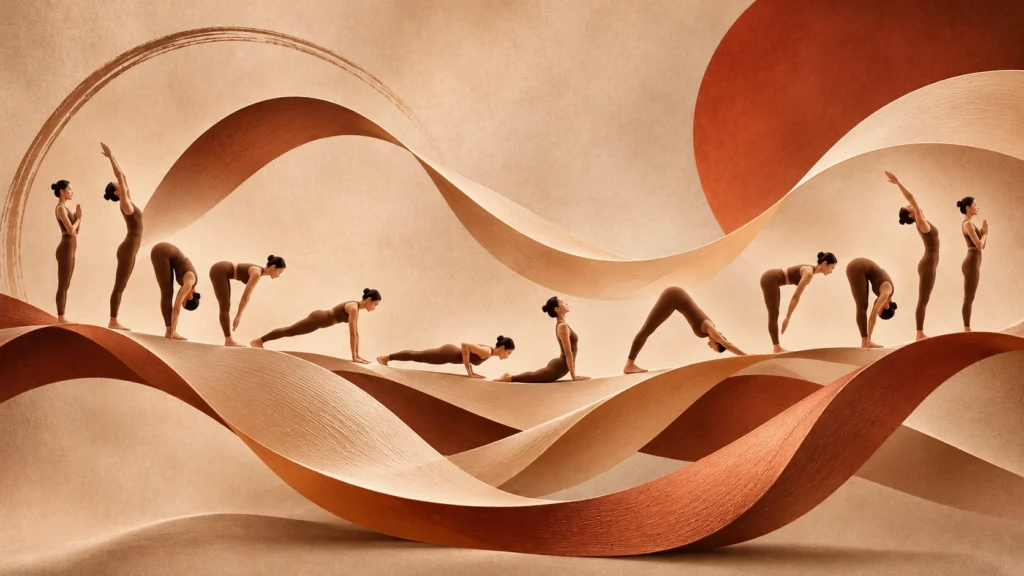
Unlike Thai Yoga Massage, where a therapist guides and supports movement, Sun Salutation encourages you to move independently, connecting breath, strength and concentration through a continuous sequence.
Both approaches celebrate mindful movement, but one is actively practised while the other is received through skilled hands-on bodywork.
How do Thai massage and yoga differ in practice?
Yoga builds self-reliance and strength and gives you something you can take home and repeat. Assisted bodywork lets you relax into stretches and receive pressure along the muscles without holding anything yourself. Neither replaces the other.
An active yoga practice helps develop movement skills through repetition, balance and muscular engagement. Thai yoga massage offers a different experience: supported movement with hands-on pressure, without requiring you to maintain each posture independently.
If you enjoy yoga but feel uncomfortable holding certain stretches, an adapted Thai yoga massage may offer a chance to experience movement in a more supported setting. This does not mean pushing beyond your natural flexibility or replacing regular exercise.
What happens during a Thai yoga massage session at Asiatic?
What to expect at Angel and Highbury
Asiatic is a master-led Thai bodywork practice, established in 2009 on Upper Street, London, with studios in Angel and Highbury. Our team includes professionally trained and insured practitioners with qualifications such as VTCT or ITEC and memberships including CThA. Asiatic Master-Led Somatic Bodywork™, a consistent standard of care at both studios, shapes our approach.
Our Thai Yoga Massage is table-based. It uses assisted stretches, supported movement and rhythmic pressure for full-body mobility. We personalise each treatment to you.
Before the session, your practitioner will ask about your comfort, mobility, pressure preferences and any areas that need particular attention. You do not need previous yoga experience or advanced flexibility.
The treatment alternates between steady pressure and guided movement. You might notice the firm contact of a palm against a muscle, followed by a slower supported stretch. Rather than forcing a position, the practitioner adjusts the pace and depth according to your response.
Learn more about Thai Yoga Massage in London at Asiatic, including our treatment approach and available appointments.
The techniques you may feel
As general examples, Thai yoga massage commonly combines several techniques including:
- Palm and thumb pressure on muscles and connective tissue
- Compression of limbs and muscle groups
- Gentle rocking to relax muscles and prepare joints
- Joint mobilisation within a comfortable range
- Body-weight techniques for deeper, steady pressure
Assisted stretches in Thai yoga massage typically include hamstring and hip openers, gentle spinal twists, shoulder and arm stretches, and foot and calf work. You breathe naturally while the practitioner holds or gently moves you through each position.
The practitioner controls the movement while you remain comfortable and communicate how each stretch feels. Some positions may feel similar to familiar yoga postures, but you are not expected to hold the position using your own muscular effort. For a closer look at how the two sessions differ, read our guide to Thai Yoga Massage vs assisted stretching.
What does a skilled practitioner pay attention to?
Assisted stretching is not about achieving the deepest position. Your practitioner considers how comfortably you move, how your muscles respond to pressure and whether your body remains relaxed during the stretch.
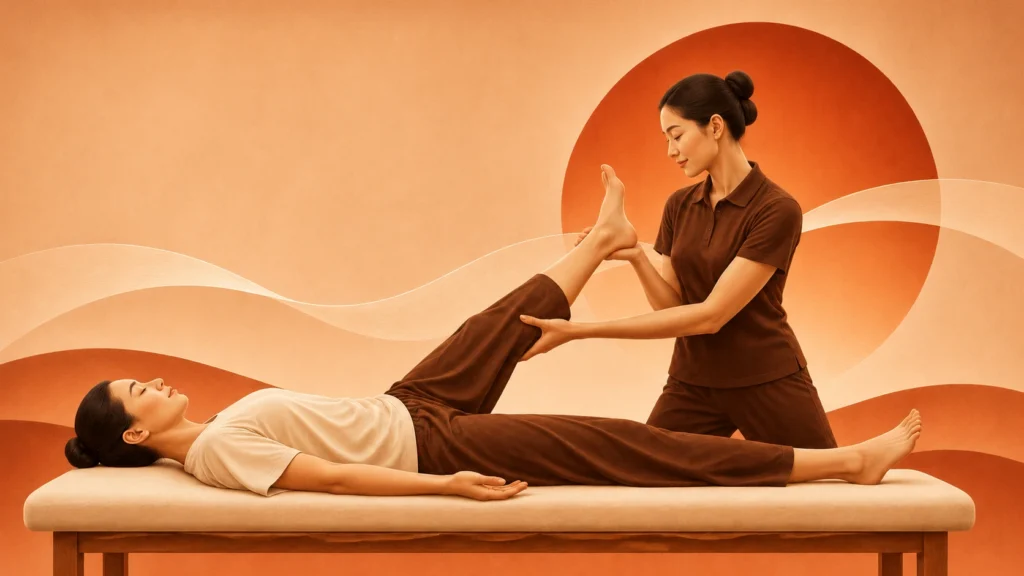
For example, when working around the hamstrings and hips, a practitioner may begin with gentle movements before gradually introducing a supported stretch. Pressure, position and duration can be adjusted according to your comfort.
This emphasis on listening, controlled movement and individual response is central to Asiatic’s Master-Led approach.
How to speak up during the treatment
Movements should stay slow and within a comfortable range, and pressure should never be forced beyond your tolerance. Tell your practitioner immediately about sharp pain, numbness, dizziness or too much pressure.
A good practitioner wants that feedback because it’s how they adapt the session to you.
You can request less pressure, a smaller stretch or a different position at any point. A successful session is not about how far your body can stretch.
Can Thai massage complement your yoga routine, and what does the evidence say?
How can Thai massage and yoga fit into the same routine?
Two scenarios make sense. You might book a session after a demanding week of classes or before a new yoga block to explore supported movement around areas that feel stiff or restricted.
A regular yoga practice develops active strength, balance and movement awareness. Thai yoga massage offers assisted stretching and pressure-based bodywork making the two approaches complementary rather than interchangeable.
Someone who spends long hours at a desk may appreciate guided movement around the shoulders, back and hips. A runner or gym-goer might prefer focused attention around the hamstrings, calves and lower body. The treatment should reflect the individual’s comfort and activity level.
If you’re active in other ways, we also offer deep tissue massage for stubborn knots and firmer pressure, and foot massage, which combines Thai foot techniques with lower-leg work for tired legs.
Honest take on the evidence for benefits
Research suggests short-term relief for some musculoskeletal pain and stiffness and possible gains in range of motion. However, results depend on the type of massage, the condition studied and the individual receiving treatment.
Evidence for stress relief varies across studies and much of the wider research is on massage generally rather than Thai massage specifically.
The overall research picture is mixed. A 2024 systematic review published in JAMA Network Open found that most assessed conclusions about massage for painful health conditions were supported by low- or very-low-certainty evidence. However, fewer had moderate certainty.
Importantly, findings from massage research generally cannot automatically be applied to Thai yoga massage or used to promise that assisted stretching produces lasting changes in flexibility.
Studies are often small and follow-up is limited, so we won’t promise more than that.
We make no claims about circulation, immunity or treating disease, because such claims have much weaker support.
Yoga has its own evidence base and benefits, which is another reason to see the two as complementary. Research into yoga has explored outcomes including balance, physical function, stress and general wellbeing. It is important not to assume that receiving Thai yoga massage produces the same benefits as actively practising yoga.
Research references
- Massage Therapy: What You Need to Know — NCCIH
- Use of Massage Therapy for Pain, 2018–2023: A Systematic Review — JAMA Network Open
- Yoga: Effectiveness and Safety — NCCIH
Possible side effects
Most reported effects are mild: temporary soreness, aches or bruising. Rare serious injuries are possible with aggressive neck or back manoeuvres and the risks have not been thoroughly studied, which is why a skilled, careful practitioner matters.
Strong manipulation is not necessary for a worthwhile experience. Controlled pressure, appropriate positioning and communication help reduce avoidable risks.
When should you talk to a practitioner first about injuries or pregnancy, and how do you choose one?
Conditions to discuss before you book
If you have any of the following, get medical advice from a GP or physiotherapist before booking and tell your practitioner:
- A recent fracture, sprain or surgery
- Osteoporosis or a joint replacement
- Blood clots or blood-thinning medication
- Heart disease or high blood pressure
- Open wounds or infection
- Unexplained pain, numbness or weakness
Seek medical advice first, not massage, for sudden severe pain, pain after an accident, or unexplained numbness or weakness. Sudden swelling in one leg needs urgent medical assessment, as it can signal a blood clot. For chest pain or serious difficulty breathing, call 999.
These precautions matter most for treatments that use assisted stretching, joint positioning, or steady pressure. Sharing your medical history with your practitioner helps them know if your session needs to be changed, delayed, or skipped.
Pregnancy: why it needs a different approach
Deep stretching and pressure may need modification or medical advice during pregnancy. Check with your midwife or GP first and choose a practitioner trained in prenatal care.
Our Pregnancy Massage is a gentle, carefully paced treatment with supportive positioning for expectant mothers.
It is designed around pregnancy-related comfort rather than the assisted stretching techniques typically associated with Thai yoga massage.
How to choose a Thai yoga massage practitioner with confidence
The UK has no single statutory licence for massage, but local councils may require a massage or special-treatment premises licence. Check the requirements for your area.
Check credentials yourself as well. Look for a Level 3 massage qualification (such as VTCT), documented Thai massage training, and membership of a body like the CThA or FHT. Ask to see public and treatment liability insurance that explicitly covers Thai techniques, not just basic relaxation massage.
Relevant specialist training and practical experience with assisted stretching are especially important, because Thai yoga massage involves guiding another person’s joints and limbs through supported movements.
Then ask about their experience with your needs, what the first appointment involves, and whether there is a health consultation. Red flags include no consultation, refusal to discuss training or insurance, guaranteed cures, and pushing through pain.
If you’re looking for Thai massage in north London, you can check these points against our Angel and Highbury studios.
Choosing between Thai massage and yoga?
Thai massage and yoga share mindful movement and stretching. One is something you do, the other something you receive, and many people use both.
Start with how your body feels and what you want from the session: to build something yourself or to have someone guide the stretching for you.
Choose yoga when you want to develop strength, balance, and a repeatable movement practice. Consider Thai yoga massage when you prefer guided stretching, rhythmic pressure and a more passive bodywork experience.
If it is the second, book a table-based Thai Yoga Massage at Asiatic Thai Massage in Angel or Highbury. Mention any injuries, pregnancy, or yoga habits when you book so your practitioner can personalise the session.
You don’t have to pick just one. Both yoga and Thai massage give you different ways to explore movement, comfort, and body awareness.
Frequently Asked Questions
Is Thai yoga massage the same as yoga?
No. Yoga is active and involves postures, movement, and often breathing exercises. Thai yoga massage is hands-on, with a practitioner guiding your stretches and applying pressure while you relax.
Why is Thai yoga massage sometimes called assisted yoga?
Some stretches resemble familiar yoga poses. For example, during a hamstring stretch, your therapist supports your leg and guides the movement while you relax. You can ask for a smaller stretch at any point.
Do I need yoga experience to have a Thai yoga massage?
You don’t need any yoga experience to have a Thai yoga massage. Your practitioner will adjust the movements to fit your flexibility and comfort on the day.
What should I wear for a Thai yoga massage?
For our table-based Thai Yoga Massage, wear loose, comfortable clothes that let you move easily, like yoga pants and a T-shirt. Traditional Thai yoga massage is also usually done fully clothed in loose clothing.
Can Thai yoga massage replace my yoga practice?
Thai yoga massage doesn’t replace an active yoga practice. In massage, your practitioner guides and supports you, while yoga helps you build strength and balance by yourself.
Can Thai massage complement yoga for runners or active people?
Many people use both yoga and Thai yoga massage because they offer different experiences. Yoga is active and works your muscles, while Thai yoga massage gives you supported stretching and rhythmic pressure. Neither should replace proper training, recovery, or injury treatment.
What should I do if a stretch feels painful during a massage?
Tell your practitioner right away if a stretch hurts or the pressure feels too strong. Movements should always feel comfortable, and your practitioner can adjust the session as needed.
Are there any side effects of Thai yoga massage?
You might feel some temporary soreness, aches, or bruising after Thai yoga massage. Serious injuries are rare but can happen if neck or back movements are too forceful, though these risks are not well studied.