Estimated reading time: 17 minutes
Modern London life rarely slows down.
From crowded Underground journeys and long hours at a desk to standing through busy shifts or training for weekend events, daily routines place constant demands on body and mind. Many notice tight shoulders or aching backs, but it is often the feet, the body’s foundation, that absorb the greatest strain.
This is one reason foot reflexology has become increasingly popular across London.
A traditional foot massage relaxes muscles and soft tissues. Reflexology uses a structured method that applies gentle pressure to specific areas of the feet. According to traditional reflexology, these areas connect to different parts of the body, helping encourage deep relaxation and support overall wellbeing.
For many Londoners, reflexology offers something increasingly difficult to find: an opportunity to pause completely.
Whether you spend your day behind a computer, on your feet serving customers, commuting across the city, or balancing family life with work, a dedicated hour of uninterrupted relaxation can profoundly affect how your body feels afterwards.
At Asiatic Massage Boutique & Wellness, we view reflexology as part of a wider philosophy of thoughtful bodywork. Every treatment is tailored to the individual, delivered by experienced therapists, and guided by clear communication, professional standards, and genuine respect for your comfort.
We don’t promise medical results. Our goal is to give you a space where your body can slow down, let go of tension, and help you leave feeling calmer than when you came in.
Quick Guide to Foot Reflexology
What is foot reflexology?
Foot reflexology is a complementary wellness therapy that applies gentle pressure to specific areas of the feet. It is commonly chosen to encourage relaxation, reduce stress, and support overall wellbeing.
If you are exploring foot reflexology in London, this guide explains what to expect and how the treatment works.
What is foot reflexology used for?
People often choose reflexology to:
- Relax after busy days
- Support their overall wellbeing
- Soothe tired feet
- Create time to unwind
- Feel calmer and more balanced
Is reflexology the same as a foot massage?
No.
A foot massage primarily focuses on the muscles and soft tissues of the feet.
Reflexology follows a structured sequence of pressure techniques applied to specific reflex points based on traditional reflexology theory.
How long does a treatment last?
Most treatments last 45-60 minutes, though some clinics also offer shorter or longer sessions.
Which Foot Treatment is right for you?
Although these treatments all focus on the feet, each has a different purpose, technique, and experience. This quick comparison can help you decide which treatment best suits your needs before learning more about reflexology.
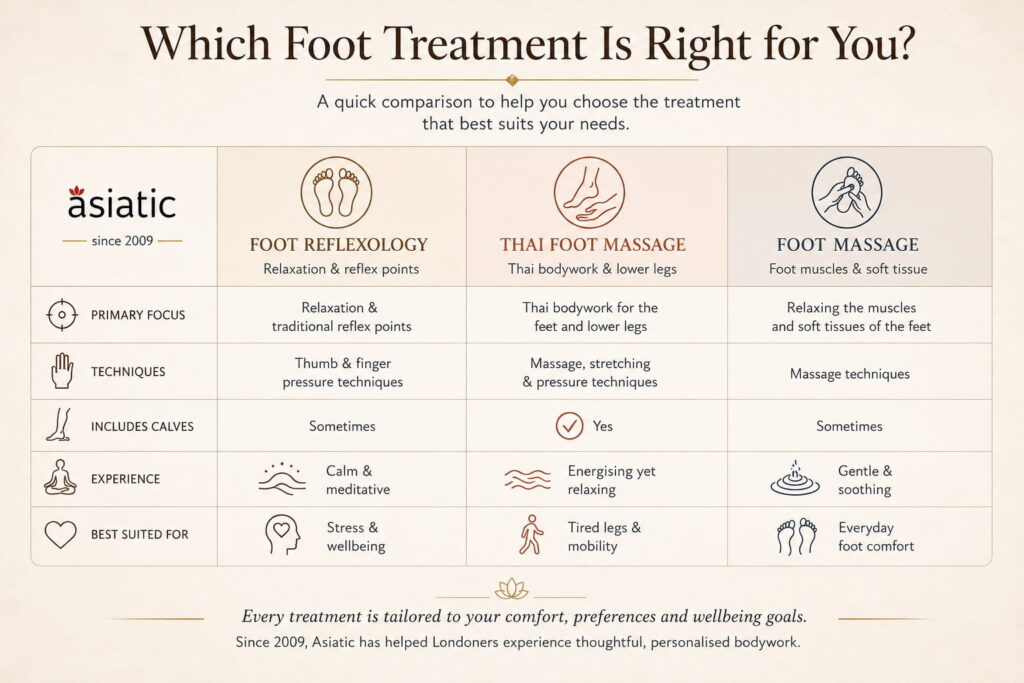
Designed exclusively for Asiatic • Since 2009
Comparison chart showing the differences between foot reflexology, Thai foot massage and traditional foot massage, including techniques, primary focus, treatment experience and who each therapy is best suited for.
Looking for a more detailed explanation? Read our complete guide to Thai Foot Massage.
Understanding Foot Reflexology
Foot reflexology has been practised for generations across many cultures and is based on the traditional concept that specific areas of the feet correspond with different parts of the body.
Today, modern practitioners generally view reflexology as a complementary wellbeing therapy rather than a replacement for medical care.
Unlike many massage treatments, reflexology does not primarily target muscles or joints. Instead, it uses carefully applied pressure, rhythm and touch to create a deeply relaxing experience that many people find calming and restorative.
While everyone experiences reflexology differently, many people appreciate the opportunity to slow down, disconnect from daily pressures and enjoy uninterrupted time focused entirely on their wellbeing.
Why more Londoners are choosing Foot Reflexology
Living in one of the world’s busiest cities brings many advantages, but it also places unique demands on the body.
Long commutes.
Busy offices.
Standing throughout hospitality shifts.
Walking several miles each day without even noticing.
Gym training before work.
Running clubs after work.
Over time, these routines create a constant background of physical and mental tiredness.
Many people don’t feel “injured.”
They no longer feel completely rested.
This is where reflexology fits naturally into modern wellbeing.
Rather than waiting until tension becomes overwhelming, many London professionals now incorporate relaxation therapies into their regular self-care routines.
Clients frequently book reflexology after experiencing:
- Mental fatigue following demanding work weeks
- Tired feet after long commutes
- Lower-leg heaviness from standing all day
- General feelings of stress
- Difficulty switching off after work
- A desire to create healthier wellbeing habits
For many people seeking foot reflexology in London, the appeal is not only physical comfort but the chance to pause and reset.
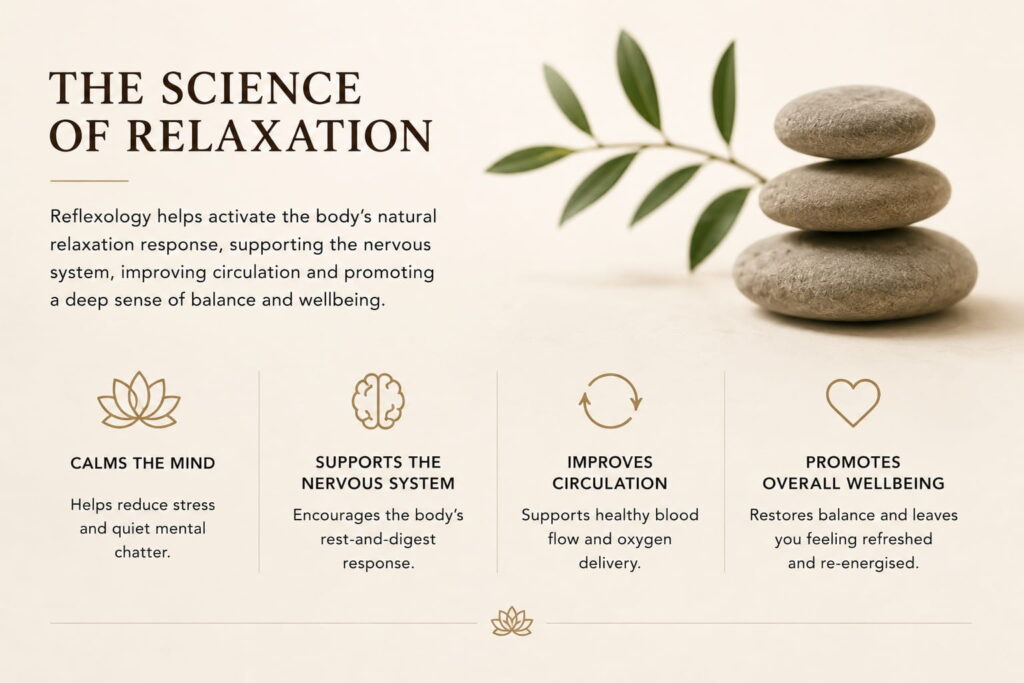
The science of relaxation
Reflexology has long been associated with relaxation, though researchers continue to study how and why people experience these effects. Current evidence suggests several possible explanations. This is one reason reflexology in London is increasingly chosen by busy professionals seeking calm and balance.
The relaxation response
Gentle therapeutic touch has been shown to influence the autonomic nervous system.
When people feel safe, comfortable, and relaxed, the body may shift from its heightened fight-or-flight state toward the rest-and-digest response.
This natural shift is associated with slower breathing, reduced muscle guarding and an overall feeling of calm.
Although individual experiences vary, many clients report feeling mentally quieter by the end of their session.
The importance of therapeutic touch
Research suggests that skilled therapeutic touch may contribute to feelings of relaxation and psychological wellbeing.
Focused attention, steady pressure, and uninterrupted quiet time create an experience many rarely allow themselves in everyday life.
For some clients, reflexology is the first uninterrupted hour spent without checking emails, answering phones, or thinking about work.
That pause alone can feel restorative.
A Calmer Mind
Many clients tell us they leave feeling mentally “lighter.”
Others feel more present, grounded, or less hurried.
While reflexology should not be viewed as a treatment for medical or psychological conditions, it is widely chosen for its calming experience.
For many Londoners, that sense of calm is reason enough to return.
London Lifestyle: Why Environment Matters
Wellbeing begins before the treatment itself.
Stepping away from busy streets, constant notifications, and crowded transport lets the mind begin slowing down before the first pressure point is applied.
At Asiatic, we have always believed the treatment environment plays an important role in the overall experience.
Soft lighting.
Comfortable treatment rooms.
Quiet surroundings.
Clean, organised spaces.
Warm professional hospitality.
These details help clients transition from London’s pace to a calmer environment where relaxation feels possible.
Many regular guests say they feel more settled within minutes of arriving.
For office professionals, hospitality workers, healthcare staff, creatives, runners and residents alike, that change of pace has become an important part of their personal wellbeing routine.
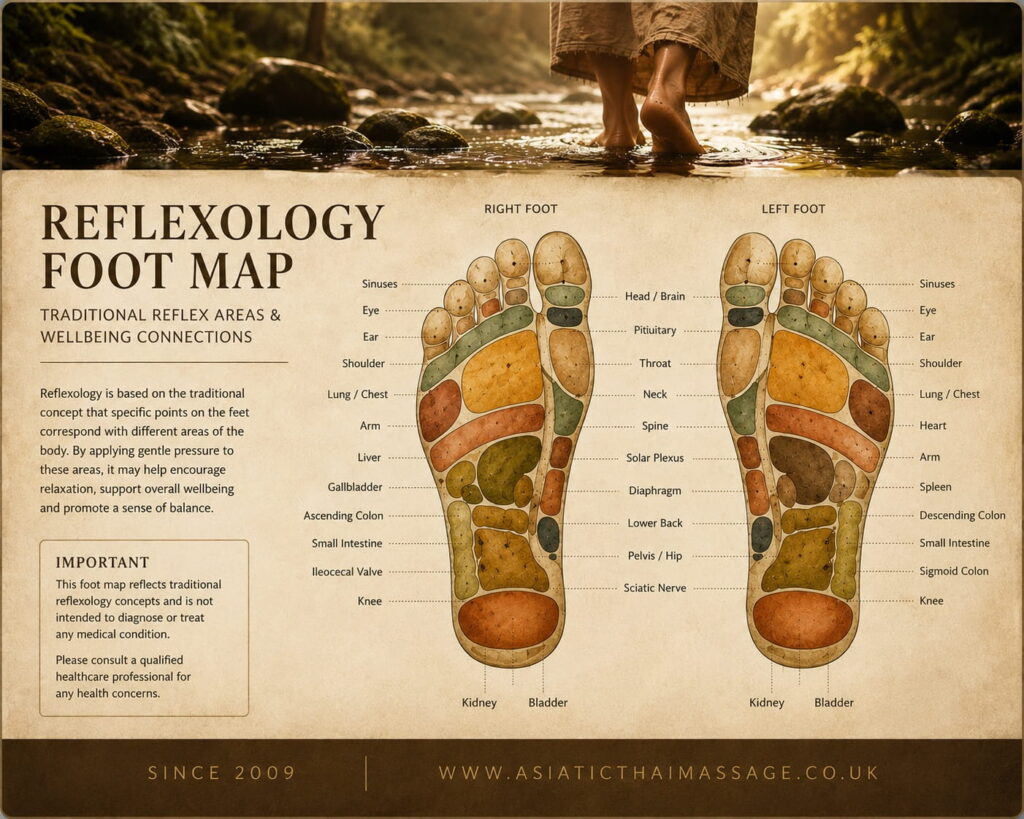
Illustration created exclusively for Asiatic Massage Boutique & Wellness • Since 2009
Traditional reflexology foot map illustrating the reflex points commonly used as a guide during foot reflexology treatments. These traditional wellness concepts are not intended for medical diagnosis.
Educational note: Reflexology maps are based on traditional reflexology principles and are used as a guide during treatment. They should not be interpreted as diagnostic tools or a substitute for medical advice.
Understanding the traditional Reflexology Foot map
One of the most recognisable features of reflexology is the foot reflex map.
Traditional reflexology divides the feet into different zones. Each zone is believed to correspond with particular organs, glands or body systems.
Rather than viewing the feet simply as muscles and joints, reflexology considers them a map of the whole body.
Modern reflexologists use these maps as guides when planning a treatment. They do not diagnose illness from the feet, nor should reflexology replace medical advice or healthcare.
Instead, practitioners use the map as a structured framework while delivering a deeply relaxing treatment.
Many clients enjoy the focused attention and calming rhythm of the therapy, regardless of whether they follow the traditional reflexology philosophy.
What happens during a Foot Reflexology London session?
If this is your first reflexology appointment, the treatment is usually straightforward and relaxing.
Your therapist will begin with a short consultation to understand:
- How you’re feeling
- Any areas of tension
- Your preferred pressure
- Any medical conditions that may affect treatment
Once comfortable, the therapist will work systematically across the feet using thumbs and fingers. The treatment is unhurried.
Some areas may feel more sensitive, while many clients describe long periods of complete relaxation.
Reflexology rarely involves vigorous stretching or deep muscular pressure, unlike some forms of massage.
Instead, the emphasis is on rhythm, precision and allowing your body time to settle.
Many clients notice that they become increasingly relaxed as the session progresses.
If you are booking foot reflexology treatment in London for the first time, the session is usually simple, calm and reassuring.
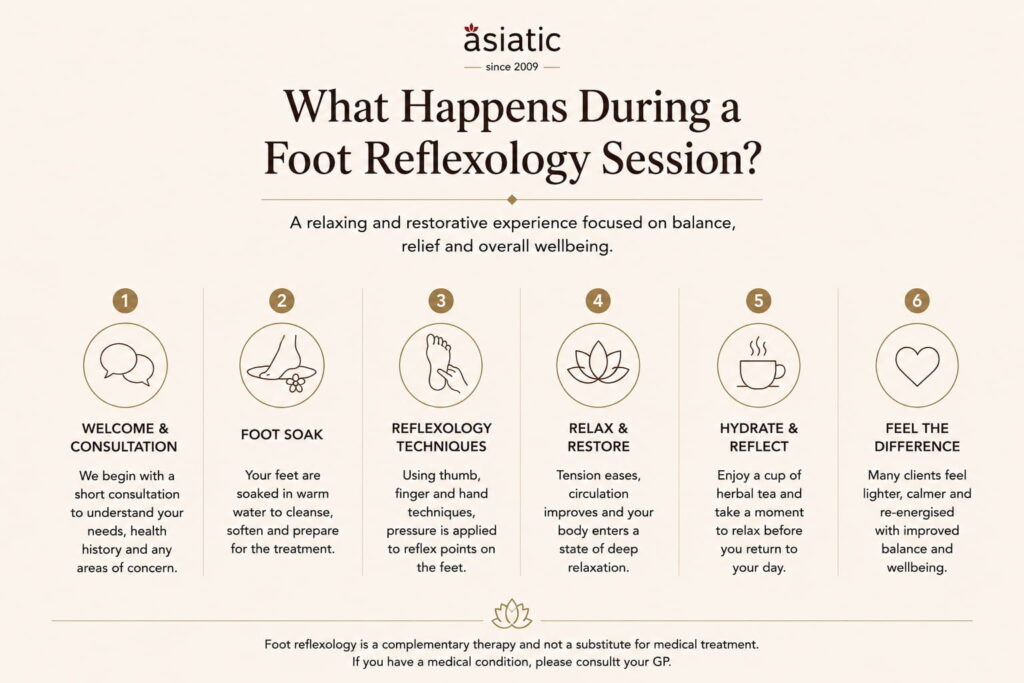
What might you feel afterwards?
Every person responds differently.
Some people leave feeling:
- Deeply relaxed
- Mentally calmer
- Physically lighter
- More refreshed
- Ready for a restful evening
Others appreciate uninterrupted time away from the pace of everyday life.
Because reflexology is intended as a complementary wellbeing therapy, experiences naturally vary from person to person.
Traditional Reflexology and modern wellness
Reflexology has been practised for many generations and continues to be valued worldwide.
Today, many practitioners combine respect for these traditional principles with modern professional standards.
Rather than making medical claims, reflexology is generally presented as a complementary therapy that supports relaxation and wellbeing.
At Asiatic, we believe this balanced approach is important.
Our focus is not on promising to treat illness but on providing thoughtful, professional bodywork within a calm environment where clients can slow down, recharge and enjoy dedicated time for themselves.
Related treatments you may also enjoy
Depending on your needs, you may also wish to explore:
- Thai Foot Massage — combines foot massage with traditional Thai techniques for the feet, ankles and lower legs.
- Deep Tissue Massage — ideal for people looking for firmer muscular work.
- Aromatherapy Massage — combines massage with essential oils to create a deeply relaxing experience.
- Back, Neck & Shoulder Massage — a popular choice for office workers and commuters experiencing upper-body tension.
Why people choose Foot Reflexology
People rarely book reflexology because something is seriously wrong.
More often than not, they want to feel better.
Modern life places constant demands on the body. Long commutes, busy workdays, standing for hours, regular exercise, and screen time can all contribute to feeling physically and mentally drained.
Foot reflexology offers dedicated time to slow down.
Although everyone’s experience is different, many people choose reflexology for its calming, restorative effects.
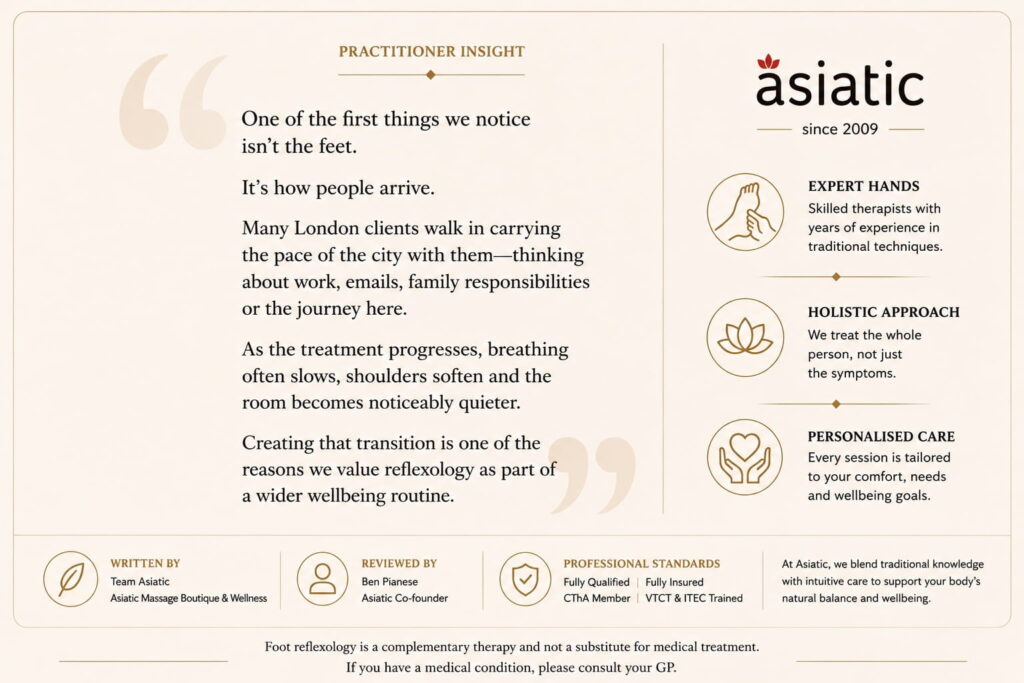
Practitioner insight from Team Asiatic on how foot reflexology can help London clients transition from the pace of daily life into a calmer, more grounded state.
A moment to relax
One of reflexology’s greatest benefits is having permission to stop.
For an hour, there are no emails to answer, meetings to attend, or trains to catch.
Instead, your attention shifts away from everyday demands and towards your own wellbeing.
Many clients describe this uninterrupted quiet time as one of the most valuable parts of the treatment.
Supporting your wellbeing routine
Many Londoners now view wellbeing as an ongoing habit rather than something reserved for holidays or special occasions.
Just as regular exercise supports physical fitness, relaxation therapies can become part of a balanced lifestyle.
Some clients include reflexology in a monthly self-care routine, while others book occasional sessions after demanding work periods or travel.
Rather than replacing healthy habits, reflexology often complements them.
Comfort for tired feet
Our feet work hard every day.
Whether you spend hours standing, walking between meetings, commuting across London, or exercising regularly, your feet absorb a great deal of pressure each day.
Many clients enjoy the focused attention that reflexology gives to a part of the body that is often overlooked.
Encouraging a Sense of Calm
Everyone experiences stress differently.
Some notice busy thoughts.
Others feel physically tense.
Some struggle to switch off.
Reflexology is not a treatment for anxiety or other medical conditions, but many choose it because the experience feels deeply calming.
The combination of skilled touch, quiet surroundings, and uninterrupted time often helps clients feel more settled when they leave than when they arrived.
Who may enjoy foot reflexology?
Many different people can enjoy reflexology.
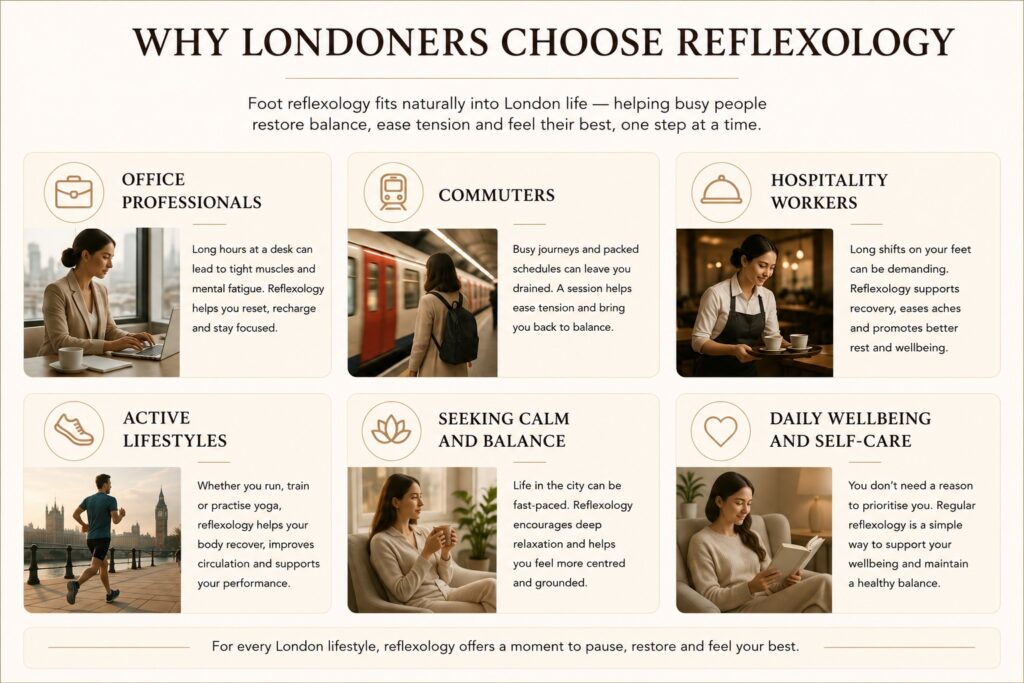
Some of the clients who regularly choose this treatment include:
Office professionals
Hours spent sitting, working at a computer, and attending meetings can leave people mentally tired despite limited physical activity.
Reflexology provides an opportunity to disconnect from work and recharge.
Hospitality professionals
Chefs, restaurant staff, retail teams and healthcare workers often spend entire shifts on their feet.
Many appreciate reflexology as part of their wellbeing routine after long working days.
Commuters
Walking to stations, standing on trains and navigating London’s busy streets places continual demands on the feet.
For regular commuters, reflexology offers a welcome opportunity to slow down.
Active individuals
Runners, gym members, yoga enthusiasts and recreational athletes often choose reflexology as part of a wider recovery routine.
It is not intended to replace sports therapy or physiotherapy, but many active people value the relaxing experience it provides.
Anyone looking to slow down
Sometimes there is no specific reason to book a reflexology session.
Many people want an hour away from the pace of everyday life.
That reason alone is perfectly valid.
How often should you have Reflexology?
There is no single schedule that suits everyone.
The right frequency depends on your lifestyle, personal preference and wellbeing goals.
Some clients visit:
- Once a month
- Every few weeks
- After particularly busy work periods
- Following travel
- After sporting events
- Whenever they feel the need to unwind
Rather than following strict rules, many people listen to their body.
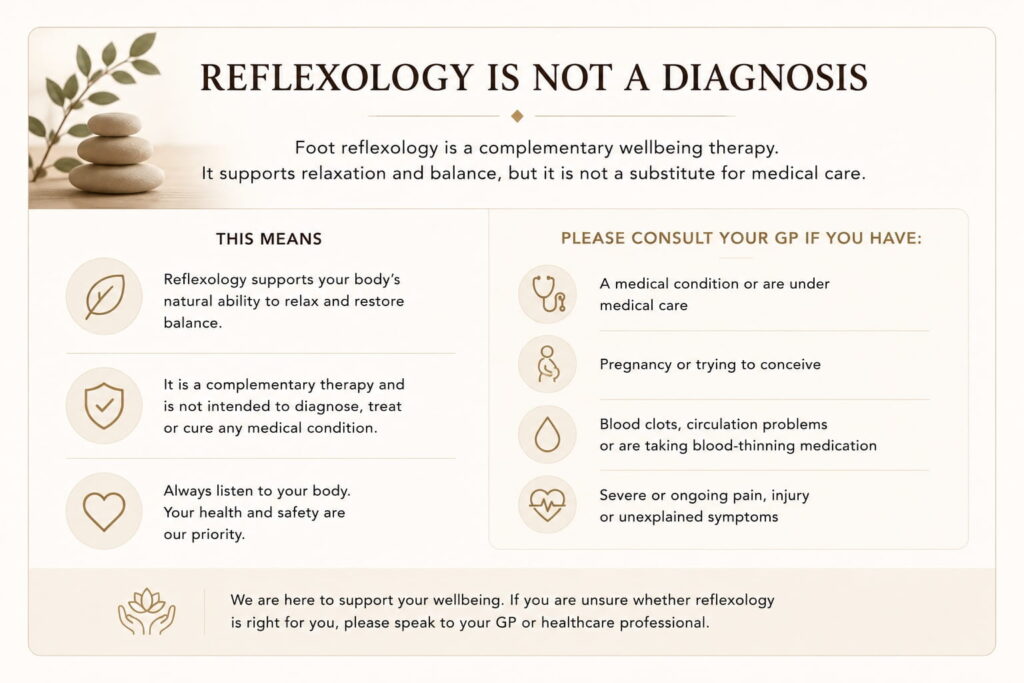
When Foot Reflexology may not be suitable
Reflexology is generally a gentle wellbeing therapy, but there are situations where it may need to be postponed or adapted.
Please let your therapist know before treatment if you have:
- A recent foot or ankle injury
- Fractures or sprains
- Open wounds
- Skin infections affecting the feet
- Unexplained swelling
- Severe pain
- Recent surgery
- Circulatory concerns
- Diabetes-related foot complications
If you are unsure whether reflexology is appropriate, we recommend speaking with a qualified healthcare professional before booking.
Your comfort and safety should always come first.
Choosing a Reflexology Clinic in London
Experience matters when choosing where to book reflexology.
Look beyond photos and introductory offers.
Instead, consider whether the clinic demonstrates consistent professional standards.
Questions worth asking include:
- Are the therapists experienced?
- Is the clinic clean and well maintained?
- Is there a consultation before treatment?
- Is pressure adjusted to suit individual comfort?
- Does the environment feel calm and welcoming?
- Are treatments personalised rather than rushed?
These factors often have a greater influence on your overall experience than price alone.
Reflexology is not simply about pressure applied to the feet.
It is about creating space for the body and mind to slow down together.
If you are booking reflexology in London for the first time, the session is usually simple, calm and reassuring.
Why environment matters
The surroundings play an important role in relaxation.
Soft lighting.
Comfortable treatment rooms.
Professional therapists.
Thoughtful hospitality.
Attention to hygiene.
These details create an atmosphere where people can genuinely switch off from the pace of London life.
Many clients tell us they begin feeling calmer before the treatment even starts.
Building Reflexology into a wellbeing routine
Many think of wellbeing as something that happens occasionally.
Increasingly, clients choose to make relaxation part of everyday life.
That might mean:
- Booking regular massage treatments
- Practising stretching between appointments
- Walking more regularly
- Improving sleep habits
- Making time for moments of quiet
- Combining reflexology with other relaxation-focused therapies
Small, consistent habits often become easier to maintain than occasional intensive efforts.
Reflexology can become one part of that wider wellbeing picture.
Why choose Asiatic for Foot Reflexology?
Choosing a reflexology clinic is more than finding an available appointment. It is about finding experienced practitioners, a welcoming environment, and a treatment tailored to your needs.
At Asiatic Original Massage Boutique & Wellness, we have been caring for clients in Islington since 2009. Our approach combines professional bodywork, thoughtful communication and a calm, boutique setting designed to help you step away from the pace of everyday London life.
Every treatment begins with listening.
Rather than following the same routine for every guest, our therapists adapt pace, pressure, and focus to your comfort, preferences, and wellbeing goals.
Whether you are visiting after a demanding week at work, a long commute or simply because you want time to unwind, our aim is always the same: to help you leave feeling calmer, lighter and more refreshed than when you arrived.
Reflexology within our Asiatic master-led somatic bodywork methodology™
At Asiatic, we believe that effective bodywork begins with understanding the individual rather than simply following a routine.
Our Asiatic Master-Led Somatic Bodywork methodology™ encourages therapists to observe how each person presents on the day of their visit and to adapt their techniques accordingly.
Within this broader approach, reflexology principles may complement a personalised treatment plan where appropriate.
For some clients, reflexology is the primary focus of the session. For others, elements of reflexology-inspired footwork may naturally complement other massage techniques, depending on comfort, preference and treatment goals.
This flexible approach keeps every treatment personal rather than formulaic.
Making time for yourself
One of the most common things we hear from clients is:
“I should have done this sooner.”
Many people wait until they feel completely exhausted before allowing themselves time to relax.
In reality, wellbeing often comes from the smaller habits we maintain consistently rather than the occasional luxury.
Whether booking a monthly reflexology session, combining it with another massage, or taking one quiet hour after a demanding week, making time for your wellbeing is never wasted.
Conclusion
Life in London rarely stops.
Between work, commuting, family commitments, and everyday responsibilities, it is easy to overlook the importance of slowing down.
Foot reflexology offers a simple opportunity to reconnect with yourself.
While every experience is personal, many choose reflexology because it creates space to relax, unwind, and step away from the pace of modern life.
At Asiatic Massage Boutique & Wellness, every session is guided by professionalism, experience and genuine care.
If you are exploring reflexology for the first time or looking for a trusted clinic in London, we would be delighted to welcome you.
At Asiatic, treatments are carried out on premium ergonomic massage chairs, helping clients feel comfortable, supported and able to relax more fully during the session.
Frequently Asked Questions
What is foot reflexology?
Foot reflexology is a complementary wellness therapy that applies gentle pressure to specific areas of the feet. It is commonly chosen to encourage relaxation and support overall wellbeing.
Is reflexology painful?
Most find reflexology comfortable and deeply relaxing. Some areas of the foot may feel more sensitive, but pressure should always stay within your comfort level. Let your therapist know if you want pressure adjusted.
How is reflexology different from a foot massage?
A traditional foot massage focuses on muscles and soft tissues.
Reflexology follows a structured approach based on reflex points traditionally associated with different parts of the body.
Both treatments can be relaxing, but they use different techniques.
How long does a session take?
Most appointments last 45-60 minutes, though treatment times may vary by clinic.
How often should I have reflexology?
There is no universal schedule.
Some people enjoy reflexology once a month, while others book sessions more frequently during busy periods or whenever they feel the need to relax.
Can reflexology replace medical treatment?
No.
Reflexology is considered a complementary wellbeing therapy and should not replace advice, diagnosis or treatment from a qualified healthcare professional.
Is reflexology suitable during pregnancy?
Some people choose reflexology during pregnancy, but it is important to seek advice from your maternity healthcare professional and choose a therapist experienced in working with pregnant clients. Always let your therapist know if you are pregnant before treatment.
Should I drink water afterwards?
Many therapists recommend drinking water after your appointment as part of your normal hydration routine.
Can I combine reflexology with other massage treatments?
Yes.
Many clients combine reflexology with treatments such as Thai massage, aromatherapy massage or back, neck and shoulder massage as part of a broader wellbeing routine.
How should I prepare for my appointment?
Wear comfortable clothing, arrive a few minutes early and let your therapist know about any injuries, medical conditions or areas of concern so your treatment can be tailored appropriately