Estimated reading time: 16 minutes
Thai Yoga Massage is a well-rounded choice for desk tension because it blends hands-on pressure, stretching, movement, and relaxation. Deep tissue massage works best for focused muscle tightness. If you want attention on a specific area, a back, neck, and shoulder massage is a good option.
The best massage for desk tension depends on whether you feel stiff, stressed, restricted, or sore after long periods of sitting.
Desk work can compress your body, especially after long hours at a laptop, video calls, commuting, and sitting without enough movement. Many office workers notice tension in their neck, shoulders, back, and hips. Others feel a dull ache, muscle knots, or stiffness that builds up during the week.
Massage cannot permanently fix posture or replace medical care. Still, the right treatment can help you feel more comfortable, less restricted, and more aware of where your body holds tension.
Quick Answer: What is the best massage for desk tension?
Thai Yoga Massage may suit desk workers who feel generally stiff through the back, hips, neck, and shoulders and want pressure, assisted movement, and stretching in one session.
Deep tissue massage may be more appropriate when the main concern is deeper, concentrated muscular tension or stubborn areas that do not respond well to lighter pressure.
A focused back, neck, and shoulder massage can be a practical choice when discomfort is mainly limited to the upper body.
Sports massage may suit people who combine desk work with running, gym training, cycling or other regular activity.
Aromatherapy or Swedish-style massage may be preferable when stress and the need for relaxation are more prominent than restricted movement.
No single massage works for everyone. The best choice depends on how your body feels, your pressure preference, your activity level, and what you want from the session.
Why desk work can create neck, shoulder and back tension
Desk work often places the body in the same position for long periods. Sitting for hours can contribute to rounded shoulders, stiff upper back, tight hips and tension around the neck.
The problem isn’t just about having one “bad” posture. Our bodies are meant to move, and even a good sitting position can get uncomfortable if you stay in it too long.
→ Common desk-related complaints include:
- Tension through the neck and shoulders;
- Upper-back stiffness;
- Lower-back aching;
- Tightness through the hips;
- Muscle knots around the shoulder blades;
- A compressed or restricted feeling after sitting;
- Discomfort associated with repetitive computer work;
- Headaches that some people associate with stress or muscular tension;
- General stiffness after long periods without movement.
People often blame poor posture for these problems, but it’s more complicated. Your workstation setup, stress, movement habits, strength, sleep, exercise, and how long you sit all matter too.
Massage can help your body feel less tight and restricted, but lasting results usually come from regular movement and good work habits.
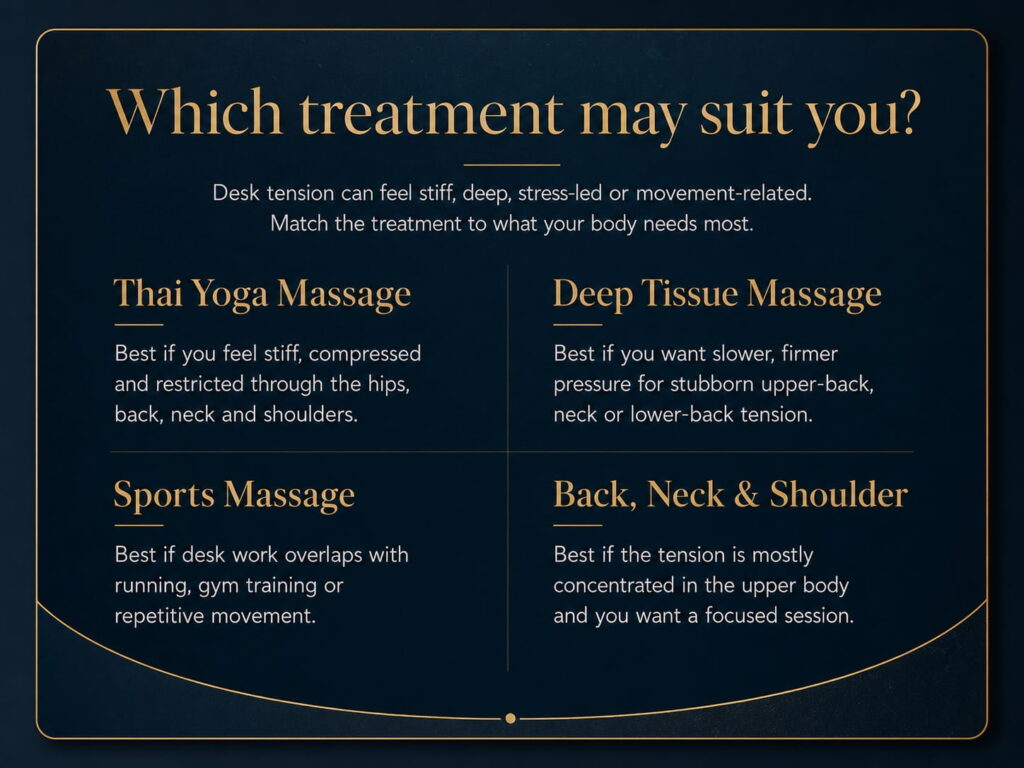
Which massage may suit different types of desk tension?
| Main concern | Massage that may suit |
|---|---|
| General stiffness through the back, hips and shoulders | Thai Yoga Massage |
| Concentrated muscular tightness or stubborn knots | Deep Tissue Massage |
| Localised upper-back, neck and shoulder tension | Back, Neck and Shoulder Massage |
| Desk work combined with gym training, running or cycling | Sports Massage |
| Stress, tiredness and a preference for lighter pressure | Aromatherapy or Swedish-style Massage |
| A preference for stretching with little massage pressure | Assisted Stretching |
Why Thai yoga massage may suit desk workers
Thai Yoga Massage is a traditional form of bodywork that combines pressure, rhythmic compression, assisted movement, and supported stretching.
Unlike a classic oil-based massage, it is usually performed fully clothed on a mat or firm surface. The therapist uses palms, thumbs, forearms and controlled body positioning to work through the legs, hips, back, shoulders, arms and neck.
This whole-body approach is especially helpful for people who feel stiff all over from desk work, not just in one spot.
For example, shoulder tension may come with restricted movement in the upper back. Lower-back stiffness may result from long periods of sitting and reduced hip movement.
Thai Yoga Massage allows the therapist to work on connected areas, not just the spot where you feel discomfort.
→ It may suit you when:
- You sit at a desk for most of the day;
- Your body feels stiff or compressed;
- Your hips, back and shoulders feel restricted;
- You want pressure and stretching in the same session;
- You prefer a clothed treatment;
- You want relaxation without losing the movement element;
- You prefer a broad, whole-body approach.
→ You can learn more about the treatment on our Thai Yoga Massage page.
What is the difference between Thai yoga massage and assisted stretching?
Assisted stretching is mainly a movement-led session. A practitioner guides the body through positions to support flexibility and range of movement.
This suits people who want structured stretching and don’t want massage pressure or a full-body treatment.
Thai Yoga Massage includes assisted stretching, but it focuses more on bodywork. It also uses rhythmic pressure, compression, and calming hands-on techniques.
→ In simple terms:
- Assisted stretching is mainly stretch-focused;
- Thai Yoga Massage combines stretching with pressure and traditional bodywork.
Readers comparing the two approaches can also explore our guide to Thai Yoga Massage vs assisted stretching.
When deep tissue massage may be more suitable
Deep tissue massage generally uses slower, more concentrated pressure around persistent areas of muscular tension.
It may suit desk workers who do not feel generally stiff throughout the body but have one or two specific areas that remain tight. Common examples include the upper back, shoulders, hips or lower back.
→ Deep tissue massage may suit you if:
- You prefer firmer pressure;
- you have stubborn areas of muscular tightness;
- you notice recurring tension around the shoulder blades;
- lighter massage does not feel focused enough;
- you want more time spent on one particular area;
- you combine desk work with physically demanding activity.
Deep tissue massage doesn’t have to be painful to work. The pressure should match your comfort and needs. You can read more about Asiatic’s approach to deep tissue massage London .
For a closer look at localised tightness, our guide to muscle knots and trigger points explains how concentrated areas of tension may be approached within a wider treatment plan.
When a focused back, neck and shoulder massage may be better
Not every desk worker needs a full-body treatment.
→ A focused back, neck and shoulder massage may be the most practical choice when tension is concentrated around:
- The upper back;
- The shoulder blades;
- The base of the neck;
- The tops of the shoulders;
- Areas affected by prolonged screen use.
With this approach, the therapist can spend extra time on the areas that bother you most.
It’s also a good choice if you’re short on time or prefer an oil-based table massage instead of assisted stretching.
Can sports massage help desk workers?
Sports massage is commonly associated with runners, gym-goers, and athletes, but it may also suit people who combine an active lifestyle with long hours at a desk.
For example, someone may have shoulder and hip stiffness from office work while managing leg tightness from running or strength training.
→ Sports massage may include:
- Targeted pressure;
- Movement assessment;
- Stretching;
- Work around activity-related muscular tension;
- Techniques selected around training or recovery goals.
It suits you when:
- You exercise regularly;
- Your tightness relates to both training and desk work;
- You want treatment organised around movement or activity;
- You prefer a more functional, targeted session;
- Particular areas repeatedly become tight during exercise.
For more information, check out our guide to the best massage options for runners and gym-goers in London.
Where relaxation massage fits
Desk tension isn’t always purely physical. Stress, mental fatigue and poor sleep can also influence how tense the body feels.
→ Aromatherapy or Swedish-style massage may suit people who want:
- Slower, flowing movements;
- Lighter or medium pressure;
- A calming oil-based treatment;
- Relief from general stress;
- A gentler introduction to massage.
This treatment may not include the same degree of assisted movement as Thai Yoga Massage or the same concentrated pressure as deep tissue massage.
This can be the best option if your main goal is relaxation.
What about chair massage, hot stone massage and myofascial work?
Chair massage is usually a shorter seated treatment, often offered in workplace environments. It can provide focused attention around the neck, shoulders and upper back, but it is generally less comprehensive than a longer table or mat-based session.
People usually choose hot stone massage for warmth and relaxation rather than mobility-focused work. It may suit someone who wants a calming experience but is less likely to be the first choice for significant desk-related stiffness.
Myofascial techniques focus on connective tissue and restricted areas. How therapists use these techniques varies by therapist, training, and overall treatment approach.
These options can be helpful, but the main choice is between whole-body movement, focused pressure, upper-body work, or relaxation.
Can massage improve poor posture?
Massage can help you notice where your body holds tension. It can also help by easing stiffness in your shoulders, hips, back, or neck.
However, massage should not be presented as a permanent posture correction. The UK Health and Safety Executive provides practical guidance on chair adjustment, screen positioning, desk arrangement and posture for display-screen users.
→ Posture is influenced by:
- How long you remain in one position;
- Workstation setup;
- Movement frequency;
- Strength and physical conditioning;
- Stress and fatigue;
- Personal habits;
- Previous injuries or health conditions.
Massage can help with comfort, relaxation, and movement, but it’s not a substitute for regular activity or exercise.
→ Helpful desk habits may include:
- Adjusting the screen to a comfortable height;
- Keeping the feet supported;
- Changing sitting position regularly;
- Standing up between tasks;
- Avoiding long periods without movement;
- Taking short walking breaks;
- Varying where and how you work.
You don’t need to keep one “perfect” posture all day. It’s usually more helpful to move between comfortable positions.
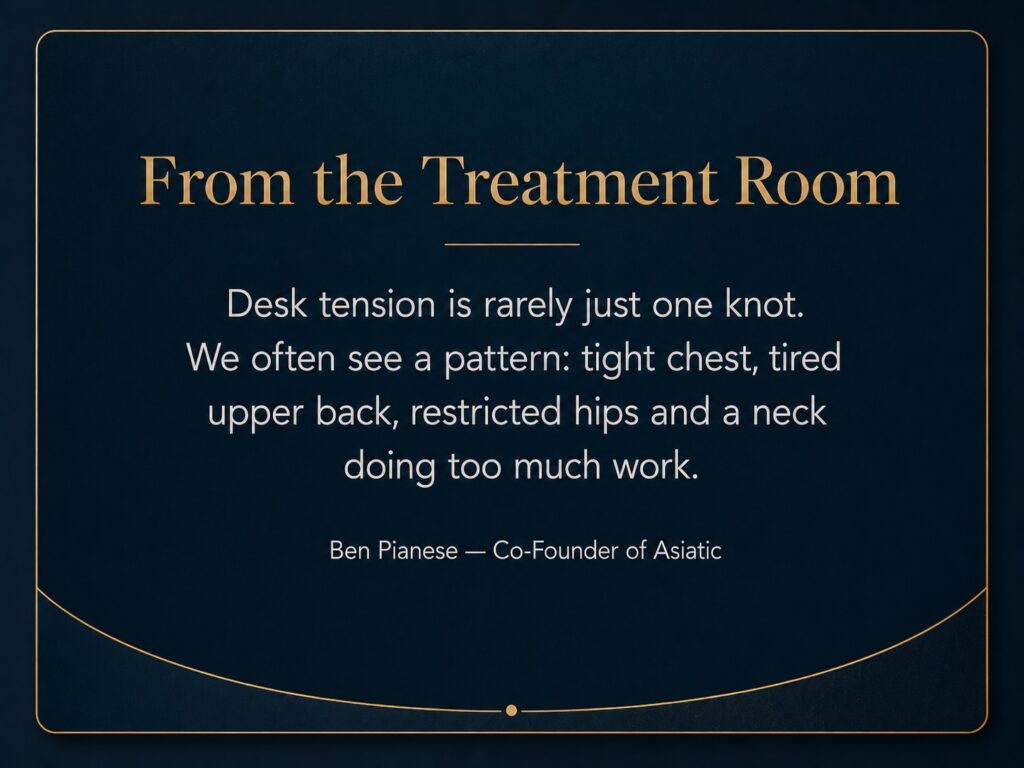
From the treatment room
Desk workers often say they feel compressed, not injured. The most helpful treatment isn’t always the firmest. Some people do better with slow, focused pressure, while others need assisted movement through the hips, spine, and shoulders before deeper work feels good.
Ben Pianese — Co-Founder of Asiatic and bodywork practitioner since 2001
At our Angel and Highbury studios, desk-related stiffness through the neck, shoulders, back, and hips is one of the most common reasons clients ask for guidance when choosing a treatment.
Each session should be tailored to how the client feels, instead of giving every office worker the same massage style.
Composite case study: hybrid worker and recreational runner
The following is a composite illustration based on common treatment patterns. It does not describe one identifiable client.
A hybrid office worker who ran several times a week reported stiffness through the hips, upper back and shoulders. The client did not describe a recent injury, but felt increasingly restricted after several demanding weeks of desk work and training.
Rather than treating only the upper back, the session incorporated Thai-style compression, assisted movement through the hips and legs, and more focused pressure around the shoulders.
The aim was not to “correct” the client’s posture. It was to help the body feel less restricted and to address the combined effects of prolonged sitting and regular running.
This example shows that the best massage for desk tension often depends on your overall lifestyle, not just your job.
Composite case study: localised upper-back tension
A second common presentation involves a client who does little structured exercise but spends long hours working at a computer.
The main complaint is often concentrated tension around the upper back and shoulder blades rather than general stiffness throughout the body.
In this case, a focused back, neck, and shoulder massage or deep tissue massage may be better than a full-body session that focuses on movement.
The therapist may spend more time working gradually through the upper back, while also checking whether the pressure remains comfortable.
Again, the goal isn’t to say massage will permanently change your posture. It’s to help you feel more comfortable and less tight.
How to choose the right massage therapist
A good therapist will ask you some important questions before starting your treatment.
→ These may include:
- Where do you notice the tension?
- How long has it been present?
- Do you want stretching, pressure, relaxation or a mixture?
- Do you prefer a clothed or oil-based treatment?
- Are you comfortable with firm pressure?
- Does the discomfort relate to exercise, desk work or both?
- Are there any health considerations the therapist needs to know?
A professional therapist won’t promise to cure chronic pain, permanently fix your posture, or guarantee results.
Instead, the therapist should adjust the treatment to fit your comfort, preferences, and current needs.
Benefits of massage for desk tension
Everyone responds to massage differently. Many desk workers book sessions to feel less stiff, calmer, and more comfortable after long periods of sitting.
→ Massage may help:
- Ease the feeling of muscular tension;
- Support relaxation;
- Reduce the sense of restriction around the back and shoulders;
- Help the body feel more comfortable after prolonged sitting;
- Improve awareness of areas that become tight during desk work;
- Provide time away from work-related stress;
- Support a broader routine that includes movement and stretching.
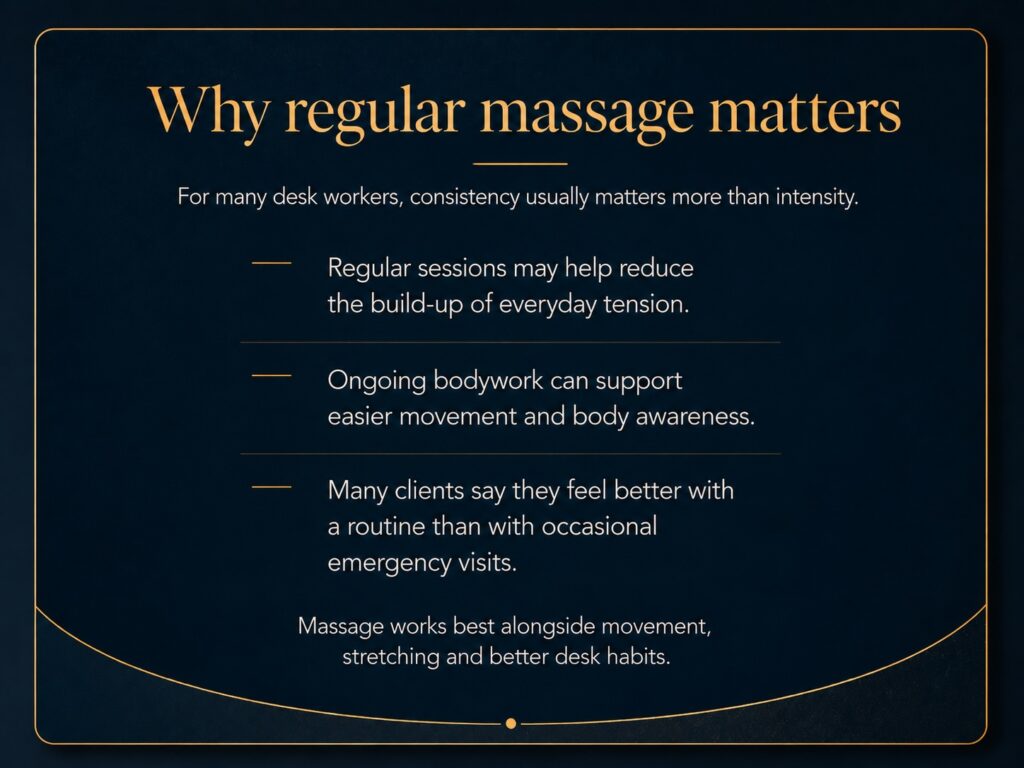
The effects are often most useful when massage is combined with regular movement, sensible exercise, and better desk habits. Some people book when stiffness builds, while others choose regular appointments during demanding periods. No universal schedule suits everyone.
When massage may not be appropriate
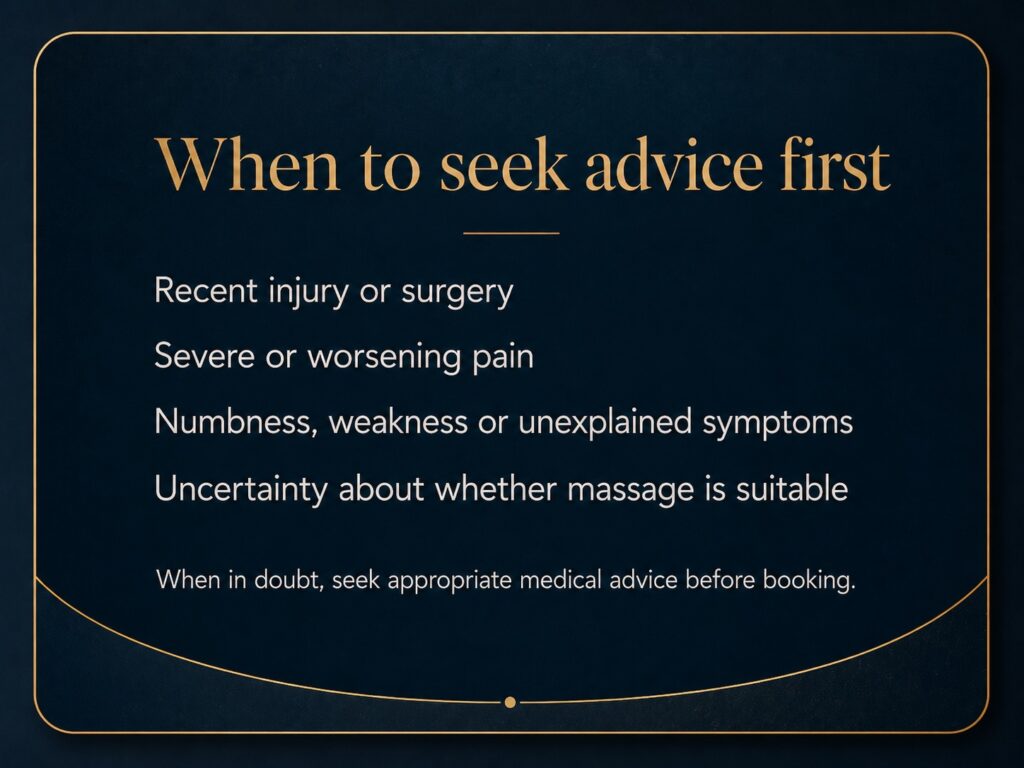
Massage is not a replacement for medical assessment.
→ Seek advice from an appropriately qualified healthcare professional before booking if you have:
- A recent injury;
- Unexplained swelling;
- Numbness or altered sensation;
- Severe or worsening pain;
- Significant loss of movement or function;
- Fever or active infection;
- Symptoms suggesting a blood clot;
- Persistent lower-back pain that has not been assessed;
- New or unusual headaches.
Seek urgent medical help for symptoms such as chest pain, sudden breathlessness or signs of a medical emergency.
The therapist should also be informed about relevant medical conditions, recent surgery, pregnancy, medication and previous injuries before treatment begins.
Massage for desk workers in London
London office workers often combine long commutes, laptop work, meetings and screen-heavy schedules with limited opportunities to move during the day.
Hybrid working can create similar problems. Working from a sofa, kitchen table, or temporary desk can lead to long periods in positions that feel comfortable at first but become tiring over time.
For many people, massage for desk tension isn’t just a luxury. It’s a way to take a break from work, move more comfortably, and notice where tension has built up.
At Asiatic, Thai Yoga Massage is a balanced option if you want stretching, pressure, and relaxation in one treatment.
Clients who prefer more concentrated pressure may choose deep tissue massage, while those with localised upper-body tension may prefer a focused back, neck and shoulder treatment.
We offer treatments at our Angel and Highbury studios on Upper Street.
Is Thai yoga massage the right massage for desk tension?
Thai Yoga Massage may be a suitable choice when desk tension feels like a combination of:
- Stiffness;
- Restricted movement;
- Stress;
- Tightness through several connected areas;
- Discomfort after prolonged sitting.
It can be particularly useful for clients who want assisted stretching without losing the hands-on pressure and relaxation associated with massage.
Thai Yoga Massage may be suitable when desk tension feels like a combination of stiffness, restricted movement and stress across several connected areas.
Deep tissue massage may be preferable when the tension is concentrated, and you want slower, firmer work around a particular area. Sports massage may be more relevant when desk work is combined with regular training.
The best choice is not necessarily the strongest treatment. It is the one that matches how your body feels and what you want from the session.
The best choice isn’t always the strongest treatment. It’s the one that matches how your body feels and what you want from the session.
Conclusion: Which massage is best for desk tension?
The best massage for desk tension depends on whether you feel generally stiff, locally tight, physically restricted or mainly stressed.
Thai Yoga Massage may offer the most complete balance for desk workers who want stretching, pressure, movement and relaxation in one treatment.
Deep tissue massage may suit clients seeking slower, focused work around stubborn muscular tension.
A focused back, neck and shoulder massage may be more practical when discomfort is limited to the upper body.
Sports massage may suit people who combine office work with running, gym training or repetitive physical activity.
Relaxation massage may be the better starting point when stress and tiredness are the main concerns.
No single treatment suits everyone. A short consultation helps the therapist understand your preferences, activity, and tension areas before tailoring the session.
You can book a massage or contact Team Asiatic for help choosing the right treatment at our Angel or Highbury studio.
FAQs: massage for desk tension and poor posture
Which massage is best for desk tension?
Thai Yoga Massage may be one of the most complete options because it combines pressure, assisted stretching, movement and relaxation. Deep tissue massage may suit more concentrated muscular tension, while a focused back, neck, and shoulder massage may be appropriate when discomfort is mainly limited to the upper body.
Can massage help poor posture from sitting all day?
Massage may help reduce stiffness and muscular tension associated with prolonged sitting. It cannot permanently correct posture. Movement, workstation setup, strength, exercise and everyday habits also play an important role.
Is Thai yoga massage suitable for office workers?
Thai Yoga Massage can suit office workers who feel tightness in the hips, back, shoulders, and neck. Its combination of pressure and assisted movement can help when desk work creates whole-body stiffness rather than tension in one isolated area.
Is deep tissue massage better than Thai yoga massage for desk tension?
Deep tissue massage may be more suitable when the client wants firm, focused work around specific areas of muscular tension. Thai Yoga Massage may be preferable when the client wants movement, stretching and broader full-body work as well as pressure.
Can sports massage help desk workers?
Sports massage may help desk workers who also run, train at the gym, cycle or participate in regular physical activity. It can be adapted around activity-related tightness and recovery needs.
What massage is best for neck and shoulder tension?
A focused back, neck and shoulder massage, deep tissue massage or Thai Yoga Massage may all be appropriate. The best choice depends on whether the tension is localised, deep, stress-related or accompanied by broader stiffness.
Is massage safe for lower-back discomfort from desk work?
Massage may be appropriate for mild muscular stiffness, provided there are no contraindications. A qualified healthcare professional should assess persistent, severe, unexplained or worsening lower-back pain.
What should I choose if I am new to massage?
Start with a pressure level and treatment style that feel comfortable. Aromatherapy or Swedish-style massage may suit clients who want gentle relaxation. Thai Yoga Massage can suit those interested in movement and stretching. Deep tissue massage is more appropriate when clients prefer firmer, concentrated pressure.
How often should desk workers have massage?
There is no fixed schedule. Some people book when stiffness builds, while others prefer regular appointments during demanding work periods. Frequency should depend on individual comfort, activity, budget and response to treatment.
Can massage reduce stress from desk work?
Massage may support relaxation and provide time away from work-related demands. Many office workers find that easing physical tension also helps them feel calmer, although individual responses vary.
Editorial note: This article provides general wellbeing information and does not replace individual medical advice.