Estimated reading time: 16 minutes
Written by Ben Pianese, Co-Founder of Asiatic and bodywork practitioner since 2001
Editorial note: This article provides general wellbeing information for active adults. It does not diagnose sports injuries or replace assessment by a doctor, physiotherapist or another appropriately qualified healthcare professional.
Which massage is best for runners and gym-goers in London? The answer is not as simple as it might seem.
Many active people choose what sounds right: deep tissue because it sounds serious, or sports massage because it sounds professional, and hope for the best. Sometimes that choice feels appropriate. On other occasions, taking a little more time to consider your training, comfort and reason for booking can lead to a more suitable session.
Before booking, try a quick self-assessment. Think about:
- Where you feel most tired, tense or restricted;
- How demanding your recent training has been;
- Whether the sensation is ordinary post-exercise soreness or something unusual;
- Whether you have an upcoming race, competition or heavy training session;
- How has your body responded to massage in the past?
These questions can help you choose a treatment that reflects what your body needs rather than simply selecting the strongest-sounding name.
The way a massage feels depends on its style, timing and intensity. Trying a new or unusually firm treatment immediately before an important race may leave some people feeling tender or heavy, while others may tolerate it comfortably. The aim is not always to choose the deepest pressure, but to choose a treatment suited to your body, recent activity and upcoming plans.
This guide compares the main massage options for active people in London: sports massage, deep tissue massage, assessment-led bodywork and Thai Yoga Massage with assisted stretching. It also explains when massage may fit into a training schedule, what it can realistically offer and when clinical assessment may be more appropriate.
Quick answer
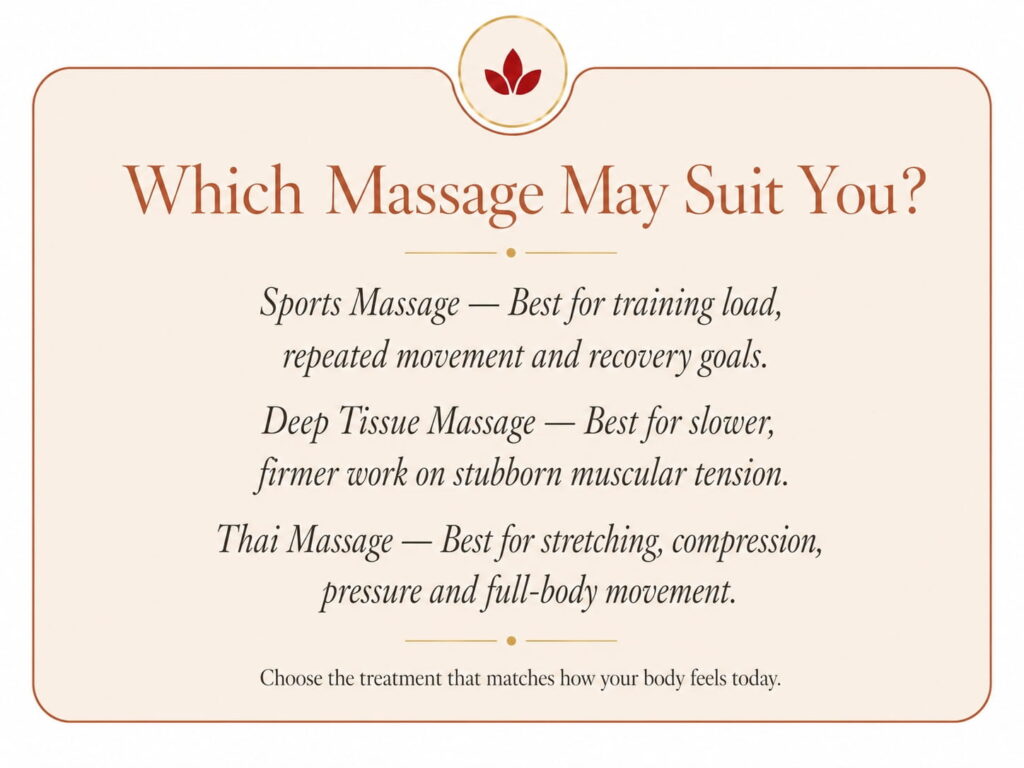
Sports massage may suit activity-specific preparation or post-training recovery. Deep tissue massage may suit people who prefer slower, firmer work around persistent muscular tension. Thai Yoga Massage may suit runners and gym-goers who want assisted movement combined with pressure and compression.
There is no single massage that is best for everyone. The right choice depends on your recent training, comfort, treatment preferences and whether you have pain or an injury that requires professional assessment.
Why active people sometimes choose the wrong treatment
Many runners default to deep tissue massage because it sounds purposeful. Many gym-goers request sports massage because it appears to be the professional choice.
Neither decision is necessarily wrong, but treatment names alone do not explain what your body needs at that particular point in training.
There is a difference between a massage that simply feels intense and one that is appropriately adapted to your comfort, recent activity and reason for booking.
Running and strength training can place different demands on the body. Repeated running may contribute to feelings of tightness or restricted movement around the calves, hips and hamstrings. Resistance training may create more localised fatigue or post-training soreness depending on the exercises, intensity and total workload.
A runner experiencing general stiffness may need a different approach from a gym-goer with a tired shoulder after repeated pressing exercises. The more accurately the therapist understands your activity, recent training and areas of concern, the more appropriately the appointment can be adapted.
Which Massage is Best for Runners and Gym-Goers?
Sports Massage: an activity-focused approach
Sports massage is more than a firm massage for people who exercise. It is a broad category of soft-tissue techniques that may be adapted around a person’s activity, training schedule and current condition.
Before an event, a practitioner may use shorter, lighter or more energising techniques. After demanding exercise, a session may focus more on comfort, relaxation and perceived soreness.
The treatment should reflect:
- How close you are to a race or competition;
- How your body usually responds to massage;
- Your recent training load;
- Your current level of soreness;
- Whether acute pain, swelling or injury is present.
Research suggests that massage may provide small improvements in flexibility and delayed-onset muscle soreness. However, studies have not consistently demonstrated that massage directly improves strength, sprinting, jumping or endurance performance.
Sports massage may suit runners or gym-goers who:
- Want a treatment related to a particular activity;
- Experience ordinary post-training soreness;
- Want the appointment adapted around a race or training schedule;
- Prefer targeted soft-tissue work;
- Understand that massage complements recovery rather than replacing sensible training management.
Deep Tissue Massage for persistent muscular tension
Deep tissue massage uses slower, more sustained pressure and may suit people who prefer focused work around areas of persistent muscular tension.
It is not simply a harder version of relaxation massage. The pace, pressure and intention are different.
Very firm treatment may not be comfortable over areas that are acutely sore, swollen or recently injured. There is no universal rule for how long everyone should wait after training. Treatment intensity and timing should reflect recent exercise, current tenderness and the person’s previous response to massage.
Deep tissue massage may be considered when:
- An area regularly feels tense or restricted;
- Lighter massage does not provide the experience the client prefers;
- The client wants slower, more concentrated pressure;
- There is no suspected acute injury, unexplained swelling or sharp pain.
Stronger pressure is not automatically more effective. A skilled therapist should adjust the depth gradually and respond to the client’s feedback throughout the session.
Remedial or Assessment-Led Bodywork
Some practitioners use the term remedial massage to describe a more assessment-led appointment.
Rather than following one fixed sequence, the practitioner considers the client’s concern, recent activity and movement comfort before deciding which techniques may be appropriate.
A session may include:
- Focused soft-tissue work;
- Slower or firmer pressure;
- Trigger-point techniques;
- Supported movement;
- Gentle mobilisation;
- Stretching.
Remedial massage remains a wellbeing or soft-tissue service unless it is delivered by an appropriately regulated healthcare professional.
Persistent, worsening or recurring symptoms may require assessment by a physiotherapist, doctor or another suitably qualified clinician rather than repeated general massage.
Thai Yoga Massage for pressure and assisted movement
Thai Yoga Massage combines rhythmic pressure and compression with practitioner-guided movement.
Unlike many table-based treatments, it is generally performed fully clothed on a padded mat and may include assisted yoga-inspired positions.
For runners and gym-goers, its defining feature is not that it permanently “fixes” tight or shortened muscles. Instead, it allows pressure and supported movement to be included within the same appointment.
A therapist may apply compression to an area, guide the body through a comfortable supported position and then continue with rhythmic bodywork. Some active clients prefer this variety to a treatment based entirely on localised pressure.
Thai Yoga Massage may suit people who:
- Feel generally stiff across several areas;
- Want stretching and hands-on pressure together;
- Enjoy a clothed, movement-based treatment;
- Prefer a whole-body approach;
- Want assisted movement without attending a yoga class.
Sports Massage, Deep Tissue and Thai Yoga Massage Compared
| Treatment | Main focus | May suit | Important consideration |
|---|---|---|---|
| Sports massage | Activity-related soft-tissue work | Training-related soreness, preparation or general recovery | Style and intensity should reflect proximity to exercise or an event |
| Deep tissue massage | Slower, firmer and more focused pressure | Persistent muscular tension and people who prefer deeper work | Avoid aggressive pressure over suspected acute injury, swelling or sharp pain |
| Thai Yoga Massage | Pressure, compression and assisted movement | General stiffness and clients wanting bodywork with stretching | Movement and intensity should be adapted to comfort and mobility |
| Clinical assessment | Diagnosis and rehabilitation planning | Persistent pain, injury, weakness, swelling or recurring symptoms | Requires an appropriately qualified healthcare professional |
What Assisted Stretching adds to a Massage Session
Assisted stretching can add a movement-based element to massage. For runners and gym-goers, this may mean combining pressure with supported positions rather than receiving a session based entirely on localised soft-tissue work.
When pressure and assisted movement are combined
Firm massage pressure and assisted movement offer different experiences.
Pressure may help someone feel less tense or sore, while assisted movement introduces a guided, stretch-based element. Thai Yoga Massage may combine both approaches within one appointment.
It should not, however, be presented as permanently lengthening muscles, correcting biomechanics or resolving training errors. Longer-term changes in strength, mobility and movement usually depend on consistent exercise and sensible load management.
What practitioner-assisted stretching may offer
During assisted stretching, another person supports the body and controls the position.
Some clients find it easier to relax when the movement is guided rather than self-directed. The practitioner can also adjust the angle and intensity according to the client’s comfort and feedback.
Everyone responds differently, and current evidence does not establish that assisted stretching is universally superior to well-performed self-directed stretching.
It should be viewed as another way to experience guided movement rather than as a guaranteed route to rapid or permanent flexibility gains.
For runners, the hips, calves and hamstrings are often areas of interest. Gym-goers may be more concerned with the shoulders, hips or areas repeatedly loaded during training.
A practitioner should not assume that every active client requires the same stretches.
Myofascial techniques and foam rolling
Myofascial techniques generally use slower, sustained pressure rather than repeated kneading.
Some language surrounding fascia is exaggerated, and it is difficult to demonstrate that a practitioner is physically “breaking down” adhesions or permanently releasing restrictions.
Research into self-myofascial release, including foam rolling, suggests it may support short-term improvements in range of motion without clearly reducing performance. Study methods vary, however, and no single optimal protocol has been established.
Most of this research relates to foam rolling and self-applied techniques. It should not be used as proof that every form of manual myofascial treatment produces better or longer-lasting results than conventional massage.
What the evidence says about massage and recovery
Research into massage and sporting recovery is useful but limited.
Massage may:
- Modestly reduce delayed-onset muscle soreness;
- Support perceived recovery;
- Provide small short-term flexibility benefits;
- Help some people feel more comfortable after exercise.
Evidence that massage directly improves sporting performance or prevents injury is much less convincing.
This distinction matters. Massage may help someone feel more comfortable following exercise, but it cannot:
- Repair a torn muscle;
- Correct poor training progression;
- Eliminate the risk of injury;
- Replace sleep, nutrition or hydration;
- Substitute for appropriate strength and mobility work;
- Diagnose the cause of persistent pain.
Active people often use massage most effectively when they see it as one part of recovery and general body care rather than a solution to every training problem.
Massage timing: before and after training or a race
When to book before a race
There is no single evidence-based interval that applies to every runner.
Response depends on:
- The treatment intensity;
- The person’s massage history;
- Previous reactions to deeper pressure;
- Current soreness;
- How close the appointment is to the event.
Avoid trying an unfamiliar or unusually intense treatment immediately before an important race.
Runners who already receive massage regularly may choose lighter work close to an event. Deeper or more demanding treatment is generally better scheduled with enough time to observe how the body responds.
A pre-event appointment should not aim to create soreness.
Tell the practitioner:
- The race date;
- The distance;
- Your recent training load;
- Your current level of soreness;
- How you have responded to massage previously;
- Any injuries or areas to avoid.
Massage after a race or demanding training session
Ordinary post-exercise soreness is different from sharp pain, significant swelling or a suspected injury.
Gentle massage may feel comfortable for some people after exercise, but firm work should not be applied over an area that appears injured or unusually inflamed.
After a race, allow time for hydration, food, rest and comfortable normal movement.
Seek appropriate assessment before massage when pain is:
- Severe;
- One-sided;
- Worsening;
- Accompanied by significant swelling;
- Associated with weakness or numbness;
- Preventing you from bearing weight or moving normally.
How often should runners and gym-goers book massage?
There is no universal evidence-based massage schedule for runners or gym-goers.
During demanding training periods, some people choose appointments every one or two weeks. Others prefer every three or four weeks or book only when they notice unusual tension or soreness.
These are personal scheduling choices rather than medical prescriptions or guarantees of improved performance.
Frequency may depend on:
- Training volume and intensity;
- Competition schedule;
- Budget;
- Individual treatment response;
- Preferred pressure;
- Recovery habits;
- Whether symptoms require clinical assessment.
The most important factor is not booking as frequently as possible. It is choosing an appropriate treatment, communicating clearly and recognising when massage is not the right intervention.
Choosing a massage clinic in London
When choosing a massage clinic, look beyond treatment names and promotional claims. Practitioner training, communication, insurance and the ability to adapt the session are more important than simply selecting the firmest treatment or the longest menu.
When massage may not be appropriate
Massage can support comfort and general recovery, but it is not suitable for every symptom or situation. Active clients should recognise when to postpone treatment and seek medical or clinical assessment instead.
Contraindications active people should not ignore
Do not book massage directly over an area with:
- A suspected acute muscle tear;
- Unexplained swelling;
- Significant heat or redness;
- Sharp or worsening pain;
- An open wound or skin infection;
- A recent fracture;
- Symptoms that have not been medically assessed.
Reschedule when you have a fever or active infectious illness.
Pain or tenderness in one calf or thigh accompanied by swelling, warmth or skin discolouration may be a sign of deep vein thrombosis and requires urgent medical assessment.
Do not massage the affected area.
Breathlessness, chest pain, coughing up blood or collapse alongside possible blood-clot symptoms requires emergency help.
Tell the practitioner before treatment about:
- Recent injuries or surgery;
- Relevant medical conditions;
- Medication affecting bleeding or clotting;
- Pregnancy;
- Current physiotherapy or rehabilitation;
- Movements or positions that should be avoided.
What matters more than a long treatment menu
Treatment quality depends less on how many services a clinic offers and more on the practitioner’s training, communication and ability to adapt the appointment.
Active clients should expect the practitioner to ask about:
- Recent exercise;
- Current soreness;
- Upcoming races or competitions;
- Previous injuries;
- Preferred pressure;
- Areas to avoid;
- The client’s main reason for booking.
A responsible therapist should not assume that every runner needs deep pressure or that every gym-goer needs sports massage.
What we notice in the treatment room at Asiatic
At Asiatic, runners and gym-goers sometimes arrive asking for the firmest massage available.
In practice, stronger pressure is not always the most appropriate starting point.
Before beginning, we ask about:
- Recent training;
- Upcoming events;
- Current soreness;
- Previous injuries;
- Areas that feel restricted;
- Preferred pressure;
- Whether the client wants focused pressure, assisted movement or both.
Someone preparing for a race may prefer a different session from someone recovering from an ordinary week of gym training.
A desk-based client who also runs may experience a different pattern of tension from someone whose work is already physically demanding.
At Asiatic’s Angel and Highbury studios, Thai Yoga Massage and deep tissue techniques can be adapted for active clients who want pressure, assisted movement or a combination of the two.
The treatment is shaped around comfort and recent activity rather than delivered as an identical routine to every person.
Asiatic has provided massage and bodywork on Upper Street, Islington since 2009, with studios near Angel station and Highbury & Islington station.
Qualifications and questions to ask before booking
When booking sports massage, ask about the practitioner’s relevant qualifications, insurance and experience with your activity.
For Thai Yoga Massage or deep tissue massage, check that the practitioner has verifiable training and insurance for the treatment being offered.
You may also ask to see certificates or details of relevant professional membership where applicable.
Useful questions include:
- What relevant massage or bodywork qualifications do you hold?
- Do you regularly work with runners or gym clients?
- Will you ask about my recent training before beginning?
- Can you adjust the pressure and stretches?
- What should I do if a movement feels uncomfortable?
- When would you recommend that I see a physiotherapist or doctor instead?
A responsible practitioner should be willing to adapt the treatment, avoid unsuitable areas and recommend clinical assessment when massage is not appropriate.
The practical conclusion
There is no single massage that is best for every runner or gym-goer in London.
Sports massage may be useful when you want an activity-focused appointment adapted around training.
Deep tissue massage may suit people who prefer slower, firmer work around persistent muscular tension.
Thai Yoga Massage may suit those who want pressure, compression and assisted movement within the same treatment.
The right choice depends on:
- What your body feels like today;
- What exercise you have recently completed;
- Whether an event is approaching;
- The type of massage you already tolerate well;
- Whether you have symptoms requiring clinical assessment.
Choose a practitioner who asks relevant questions, communicates clearly and adapts the appointment.
Massage should complement sensible training and recovery—not replace them.
Massage for runners and gym-goers at Asiatic
Asiatic offers personalised Thai Yoga Massage and deep tissue bodywork at two Upper Street studios in Angel and Highbury.
Each session can be adapted around recent activity, treatment preferences and comfort on the day.
Explore:
- Deep Tissue Massage
- Thai Yoga Massage
- Asiatic Angel
- Asiatic Highbury
- Contact Team Asiatic if you are unsure which treatment to book
FAQs about massage for runners and Gym-Goers
Is sports massage or deep tissue massage better for runners?
Neither is automatically better.
Sports massage may be adapted around running and the training schedule, while deep tissue massage may suit runners who prefer slower, firmer pressure around persistent muscular tension.
The choice should reflect current soreness, comfort and proximity to an event.
How close to a race should I book a massage?
Avoid trying an unfamiliar or unusually intense treatment immediately before an important race.
Regular massage clients may tolerate lighter work close to an event, but deeper treatment is better scheduled with enough time to observe how the body responds.
Can I have a massage immediately after a marathon?
Some runners may find gentle massage comfortable after an event.
Firm pressure should not be applied over areas with sharp pain, significant swelling or a suspected injury. Rest, rehydrate and seek appropriate assessment when symptoms are severe or unusual.
Is Thai Yoga Massage suitable for runners?
Thai Yoga Massage may suit runners who want assisted movement combined with pressure and compression.
It should be adapted to the runner’s comfort, mobility and recent training rather than performed as a fixed routine.
How often should gym-goers book massage?
There is no universal schedule.
Frequency depends on training load, recovery habits, budget and how the person responds. Massage should not be booked repeatedly to mask persistent or worsening symptoms.
When should I see a physiotherapist instead of booking a massage?
Seek clinical assessment when you have:
- A suspected injury;
- Persistent or worsening pain;
- Marked weakness;
- Numbness;
- Significant swelling;
- An inability to move normally;
- Symptoms that repeatedly return despite reducing your training load.
What should I tell my massage therapist before treatment?
Tell the therapist about:
- Your recent training;
- Upcoming races or competitions;
- Current soreness;
- Previous injuries;
- Relevant medical condition;
- Preferred pressure;
- Areas or movements to avoid.
Mention any sharp, worsening or unexplained symptoms before the session begins.
Sources and Further Reading
- Effect of Sports Massage on Performance and Recovery: A Systematic Review and Meta-analysis
Supports the discussion of sporting performance, flexibility and post-exercise soreness. - Massage Alleviates Delayed-Onset Muscle Soreness After Strenuous Exercise: A Systematic Review and Meta-analysis
Supports the section discussing massage and ordinary post-exercise muscle soreness. - A Systematic Review and Meta-analysis of the Effects of Foam Rolling on Range of Motion, Recovery and Markers of Athletic Performance
Supports the discussion of foam rolling, short-term range of motion and recovery. - NHS: Deep Vein Thrombosis (DVT)
Supports the safety guidance concerning one-sided leg pain, swelling and symptoms that require urgent medical attention