Estimated reading time: 14 minutes
Tech syndrome describes the physical strain that can build up from long hours using phones, laptops and other screens. It often includes tech neck, shoulder tension, upper-back stiffness, headaches, tired eyes and muscular fatigue linked to posture, stress and repeated screen time.
For screen-related tension, many clients choose back, neck and shoulder massage because it focuses directly on the neck, shoulders and upper back.
Wellbeing note:
This article is for general education only and does not replace medical advice. If you have severe pain, numbness, pins and needles, weakness, pain spreading into the arm, balance problems or worsening symptoms, please speak with a GP, physiotherapist or healthcare professional.
What Is Tech Syndrome?
Tech syndrome is a modern term for the physical effects of prolonged use of digital devices. It is not a single medical diagnosis, but rather a pattern many people notice: a tired neck, rounded shoulders, upper-back stiffness, heavy eyes, headaches, and a tense body after long periods of screen use.
One of the most common patterns linked to tech syndrome is tech neck, also called text neck. This usually refers to the strain that builds when the head stays forward or tilted down for long periods, especially when using a phone, laptop or tablet.
For many Londoners, the pattern is familiar: laptop work, phone scrolling, commuting, video calls, messages, emails, and evening screen time. The body rarely gets a chance to reset.
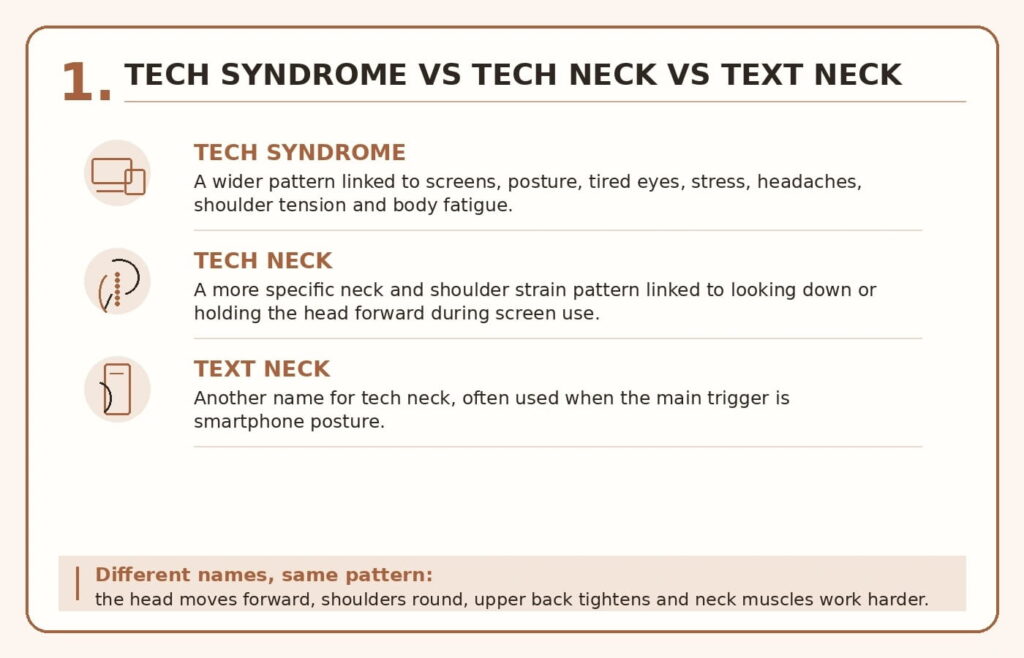
Tech Syndrome vs Tech Neck vs Text Neck
Tech syndrome
A wider pattern linked to screens, posture, tired eyes, stress, headaches, shoulder tension and body fatigue.
Tech neck
A more specific neck and shoulder strain pattern linked to looking down or holding the head forward during screen use.
Text neck
Another name for tech neck, often used when the main trigger is smartphone posture.
The names are different, but the body pattern is similar: the head moves forward, the shoulders round, the upper back tightens, and the neck muscles work harder than they should.
Why screen time can affect the neck and shoulders
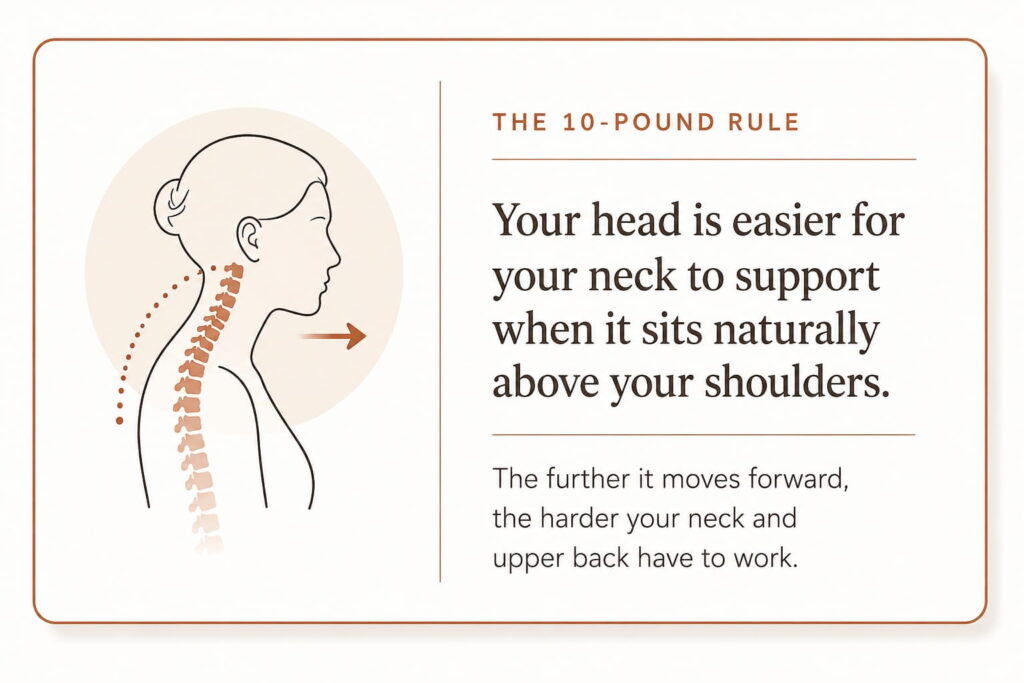
The adult head weighs about 10 to 12 pounds in a neutral position. When it moves forward or tilts down, the neck muscles work harder to support it. Research on “text neck” often describes the load on the cervical spine increasing as the head tilts forward, with a 60-degree tilt estimated to exert up to 60 pounds of force.
The 10-pound rule:
Your head is easier for your neck to support when it sits naturally above your shoulders. The further it moves forward, the harder your neck and upper back have to work.
Common symptoms of Tech Neck
Tech neck symptoms can build gradually. Some notice mild stiffness at first. Others feel a heavier pattern through the neck, shoulders, and upper back.
Common symptoms include:
- Neck stiffness or aching
- Shoulder tension
- Upper-back tightness
- Headaches linked to muscular tension
- Jaw, chest or shoulder tightness
- Fatigue around the head and neck
- Reduced ease of movement
- A feeling of heaviness after desk work or phone use
- Discomfort after long periods of sitting
Some symptoms should be taken more seriously. If you notice numbness, pins and needles, weakness, clumsiness in the hands, pain travelling into the arm, balance issues, or severe headaches, seek medical advice. NHS Inform lists worsening numbness, pins and needles, weakness, hand clumsiness, and balance problems as symptoms needing urgent assessment.
Why students, office workers and busy professionals are affected
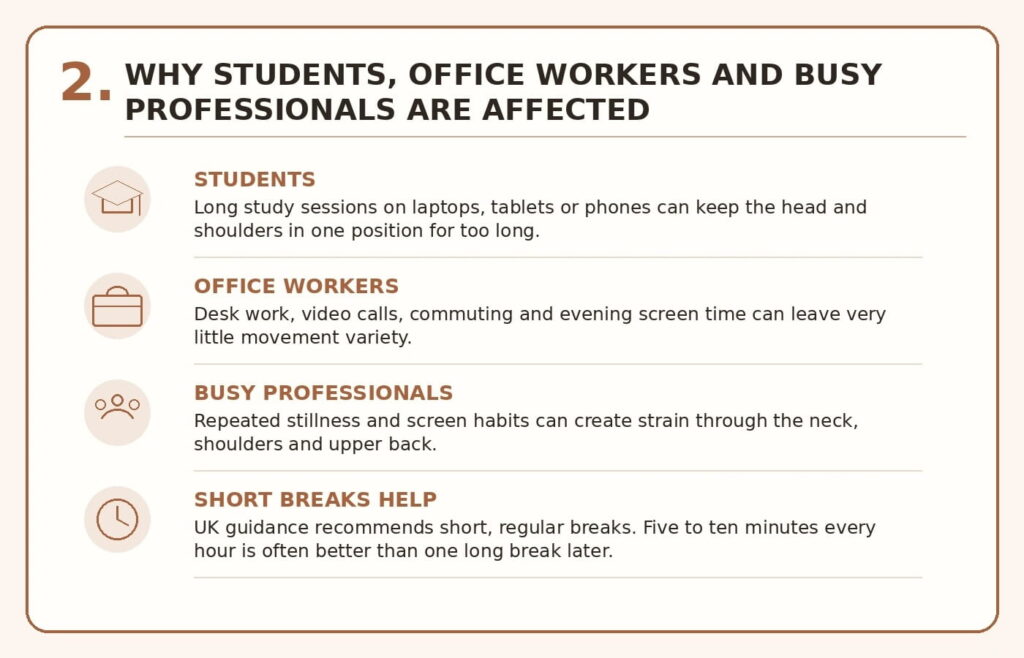
Tech syndrome is not limited to one age group. Students may spend hours studying on laptops, reading from tablets, or looking down at phones between lectures. Office workers may move from desk work to video calls, commuting, and evening screen time with little variety in movement. UK workplace guidance recommends that people using display screen equipment take short breaks often rather than fewer long breaks. As a simple guide, 5 to 10 minutes every hour is usually better than one long break after several hours of sitting.
Small habits matter because tech neck is rarely caused by a single moment. It usually builds from repeated positions, long stillness, and the body’s response to stress.
What happens to the body during tech neck?
When the head moves forward, the neck and upper back often compensate. The shoulders may round, and the chest may tighten. The muscles at the back of the neck may become overworked, while the front may feel restricted or tense.
This can create a holding pattern across the:
- Neck muscles
- Upper trapezius
- Shoulders
- Chest
- Upper back
- Jaw
- Mid-back
- Arms and hands in some cases
This is why tech neck is not only a “neck problem.” Many people feel it across the whole upper body.
Can massage help Tech Neck?
Massage may help when discomfort is mainly muscular. Focused bodywork around the neck, shoulders, upper back and chest may help ease tightness, reduce heaviness and support better body awareness.
At Asiatic, we do not treat tech neck as one fixed routine. Your therapist will ask about your pressure preference, areas of tension, comfort level, and the reason for your visit. The treatment can then be adapted around how your body feels on the day.
Massage is not a replacement for medical care. If your symptoms are severe, worsening, neurological, or linked to injury or a medical condition, seek professional advice first.
The Asiatic difference: Somatic Bodywork for screen tension
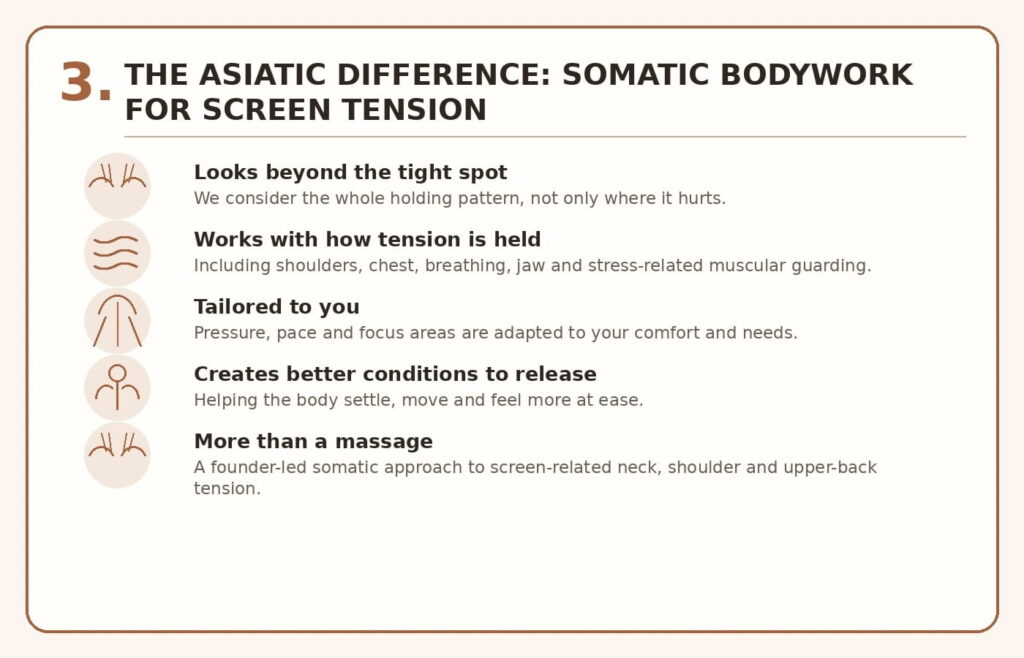
A standard massage often focuses only on areas that feel tight. At Asiatic, our approach looks at the wider holding pattern. The tight spot may be the neck, but the pattern often involves the shoulders, chest, upper back, breathing, jaw, and the nervous system’s response to stress. This is where a more somatic approach can be helpful.
Somatic bodywork means working with how the body holds tension, not just where it feels sore.
For clients who spend long hours at a desk, this may include:
- Focused pressure for the shoulders and upper back
- Slower work around the neck and shoulder line
- Chest and upper-back release where appropriate
- Assisted stretching to support movement
- Pressure adapted to the client’s comfort
- A calm pace to help the body settle
- Awareness of how stress contributes to muscular holding
This approach may be especially useful for people who say, “I have had massage before, but the tension keeps coming back.”
Often, the aim is not to force the body to change but to give it better conditions to release, move, and reset.
Which massage is best for Tech Neck?
The best treatment depends on your body, pressure preference and symptoms.
If you are unsure or have special preferences, our therapists can help you choose the best fit when you arrive.
Back, Neck and Shoulder Massage
Best for focused tension around the neck, shoulders and upper back.
Deep Tissue Massage
Best for people who prefer firmer pressure and feel tight, heavy, or overworked in the shoulders, back, or hips.
Sports Massage
Best for active clients, gym-goers, runners, cyclists, and people who want more targeted work on muscular tension, posture, and movement habits.
Thai Massage
Best for people who feel stiff, compressed or restricted and want a combination of pressure, stretching and whole-body movement.
Thai Yoga Massage
Best for people who want assisted stretching, mobility support and a more movement-led treatment.
Aromatherapy Massage
Best for people whose screen tension is strongly linked to stress, poor sleep or nervous system overload.
Support options for Tech Neck symptoms
The most effective approach usually combines relief with habit change. Massage can ease muscular tension, but daily screen habits often recreate the pattern.
Helpful support options include:
- Raising your screen closer to eye level
- Taking short, regular breaks
- Changing position often
- Avoiding long periods of static neck flexion
- Moving the shoulders and upper back during the day
- Supporting the lower back when sitting
- Reducing unnecessary phone scrolling
- Using hands-free options where possible
- Receiving massage or bodywork for muscular tension
- Seeking physiotherapy or medical advice when symptoms persist
UK HSE guidance also highlights the importance of workstation assessment and of reducing risks for people who use display screen equipment daily for continuous periods of an hour or more.
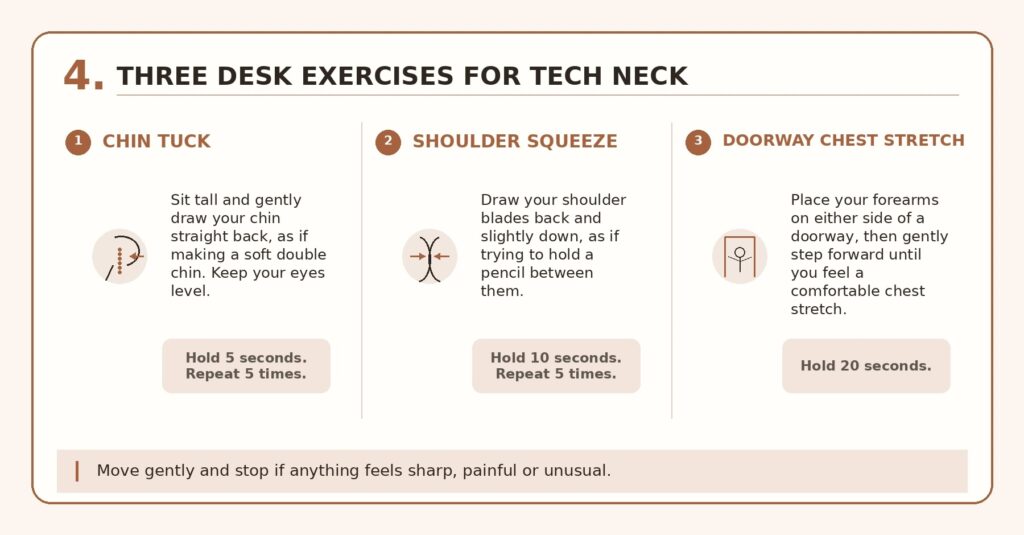
Three desk exercises for Tech Neck
These simple movements can be used as short desk breaks. Move gently and stop if anything feels sharp, painful or unusual.
1. Chin tuck
Sit tall and gently draw your chin straight back, as if making a soft double chin. Keep your eyes level and avoid tilting the head up or down.
Hold for 5 seconds. Repeat 5 times.
This can help you notice forward head posture and gently wake up the muscles that support better neck alignment.
2. Shoulder blade squeeze
Sit or stand tall. Gently draw your shoulder blades back and slightly down, as if you are trying to hold a pencil between them.
Hold for 5–10 seconds. Repeat 5 times.
This helps counter the rounded shoulder position that often builds during screen use.
3. Doorway chest stretch
Place your forearms on either side of a doorway, then gently step forward until you feel a comfortable stretch across your chest.
Hold for 15–20 seconds.
This may help ease chest tightness that pulls the shoulders forward.
Case study 1: sports massage for desk-related Shoulder Tension
Client profile:
A 39-year-old marketing manager who works long hours on a laptop and trains at the gym three times a week.
Main concern:
Persistent tightness through the neck, shoulders and upper back, especially after long days of presentations, emails and commuting. The client also noticed that pressing exercises at the gym felt more restricted than usual.
Treatment approach:
The session focused on sports massage techniques for the upper back, shoulders, and chest, with careful pressure applied to the trapezius, shoulder blade area, and upper thoracic region. The therapist also included assisted movement and gentle mobility work to help the client notice where they were holding tension.
Why sports massage helped:
Sports massage can be useful for people who combine desk work with training because the body may be dealing with both static posture and exercise load. In this case, the treatment helped address tight, overworked areas and supported better movement awareness around the shoulders.
Client outcome:
After the session, the client reported feeling lighter through the upper back and less compressed around the shoulders. They were advised to take regular desk breaks, avoid training through sharp discomfort, and seek physiotherapy advice if symptoms returned, including arm pain, weakness, or numbness.
Best linked treatments:
Sports Massage
Back, Neck and Shoulder Massage
Deep Tissue Massage
Case study 2: remedial bodywork for Long hours at a computer
Client profile:
A 46-year-old finance professional who spends most of the day at a computer and often works from home.
Main concern:
A heavy feeling through the neck and shoulders, occasional tension headaches, and stiffness after sitting for long periods. The client did not want very strong pressure but wanted focused work rather than a purely relaxing massage.
Treatment approach:
The therapist used remedial-style bodywork techniques adapted to the client’s comfort level. The session included focused work around the upper back, shoulder line and neck, slower pressure to reduce guarding, and gentle stretching for the chest and shoulders.
Why remedial techniques helped:
For desk-related tension, the issue is often not only one tight muscle. It can involve repeated posture, stress, shallow breathing and protective holding patterns. A remedial-style approach allows the therapist to work more specifically while still respecting the client’s comfort.
Client outcome:
The client left feeling calmer and more open, with the chest and shoulders open. They also became more aware of how often they lifted their shoulders while working. They also became more aware of how often they lifted their shoulders while working. The therapist recommended short movement breaks, a workstation check and gentle daily shoulder mobility.
Best linked treatments:
Back, Neck and Shoulder Massage
Deep Tissue Massage
Thai Yoga Massage
When to choose massage and when to seek clinical care
Massage may be helpful when symptoms feel muscular, posture-related or stress-related. It can support relaxation, comfort and body awareness.
However, massage is not the right first step for every symptom.
Please seek medical advice if you experience:
- Pain spreading into the arm or fingers.
- Numbness or pins and needles that does not settle
- Weakness in the arm or hand
- Loss of grip strength
- Clumsiness in the hands
- Balance problems
- Severe or unusual headaches
- Neck pain after injury or trauma
- Symptoms that are worsening
- Neck pain that does not improve after a few weeks
NHS guidance advises seeing a GP if neck pain or stiffness does not go away after a few weeks, if you are worried about the pain, or if symptoms such as pins and needles or a cold arm occur.
A calmer way to care for screen tension
Tech syndrome is not only about posture. It reflects how modern life asks the body to stay still, look down, concentrate, scroll, commute, and respond to constant digital input.
Over time, the body may begin to hold that pressure in the neck, shoulders, upper back and jaw.
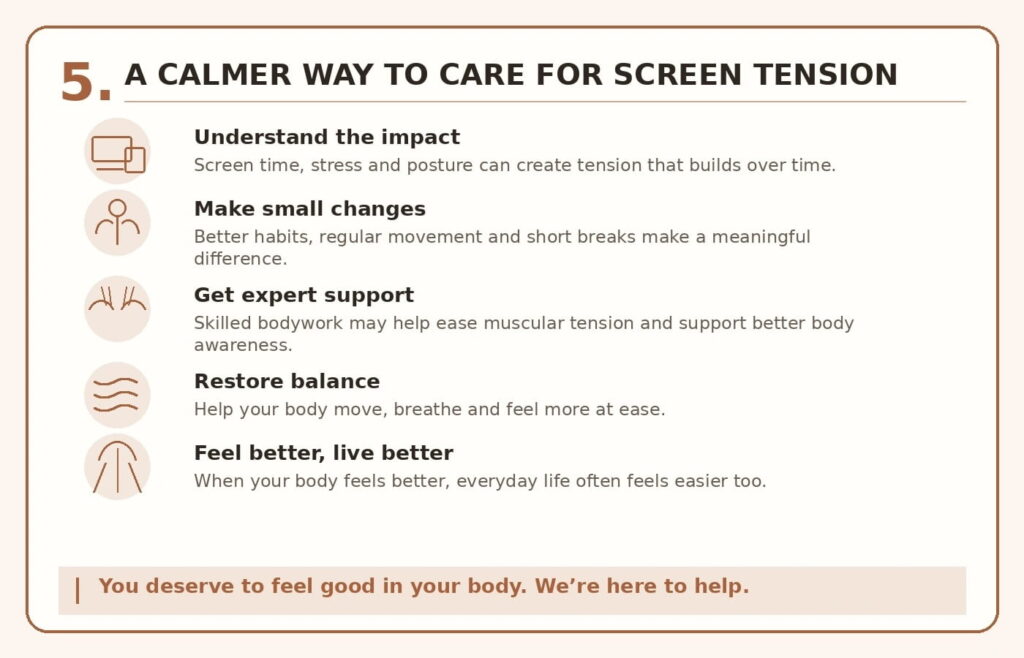
The good news is that small changes can help. Regular movement, better screen habits, mindful posture, and skilled hands-on care can all support a more comfortable body.
At Asiatic, many clients visit after long workdays, heavy screen use, or busy London routines. Treatments are tailored to your comfort, pressure preference, and reason for visiting, whether you need focused shoulder work, deeper pressure, assisted stretching, or a calmer treatment to help the body settle.
Feeling heavy through your neck and shoulders after long screen days?
Try our Back, Neck and Shoulder Massage, Deep Tissue Massage, Sports Massage or Thai Yoga Massage, or contact our team to help you choose the right treatment.
You can book at our Angel and Highbury studios or contact our team to choose the right treatment.
Explore our full range of massage treatments to find the option that best fits your body and pressure preference.
FAQs About Tech Syndrome and Tech Neck
Feeling heavy through your neck and shoulders after long screen days?
Try our Back, Neck and Shoulder Massage, Deep Tissue Massage, Sports Massage, or Thai Yoga Massage—or contact our team to help you choose the right treatment.
What is tech syndrome?
Tech syndrome is a broad term for the physical effects of long hours spent using phones, laptops, and other screens. It can include tech neck, shoulder tension, upper-back stiffness, headaches, tired eyes, and muscular fatigue linked to posture, stress, and repeated screen time.
What is the difference between tech syndrome and tech neck?
Tech syndrome is the wider pattern. Tech neck refers specifically to neck and shoulder strain caused by looking down or holding the head forward while using screens. Text neck, also called tech neck, is often linked to smartphone posture.
What are the symptoms of tech neck?
Common symptoms include neck stiffness, shoulder tension, upper back tightness, headaches, reduced movement, and a heavy feeling around the neck and shoulders. If symptoms include numbness, pins and needles, weakness or pain spreading into the arm, seek medical advice.
Can massage help with tech neck?
Massage may help when tech neck symptoms are mainly muscular. Focused work around the neck, shoulders, upper back and chest can help ease tightness and support better body awareness. It should not replace medical care for severe, worsening, or neurological symptoms.
Which massage is best for tech neck?
Many clients choose Back, Neck and Shoulder Massage, Deep Tissue Massage or Sports Massage for screen-related tension. Thai Massage, or Thai Yoga Massage, may also suit people who feel stiff or restricted in the upper back, chest, and shoulders.
Can sports massage help if I sit at a desk all day?
Sports massage may help people who sit for long hours, as well as those who train, commute, or exercise regularly. It can focus on overworked muscles, shoulder tension and movement restriction, while still being adapted to your comfort level.
How can I prevent text neck?
Try to raise your phone or screen closer to eye level, avoid staying in one position for too long, take short breaks, move your shoulders and upper back regularly, and check your workstation setup. Short, frequent breaks are generally recommended for display screen work.
When should I seek treatment for tech neck?
Consider professional support if discomfort is persistent, affects sleep or work, or does not improve with simple changes. Seek medical advice if symptoms include numbness, pins and needles, weakness, severe pain, pain spreading into the arm or symptoms that are worsening.