The landscape of urban wellness is undergoing a quiet but profound shift. In an era when clients increasingly seek genuine therapeutic depth over superficial pampering, the language of healing has become a highly contested currency. For discerning clients walking along Upper Street in Islington, or searching online for specialist massage and wellness services in London, distinguishing between an authentic treatment philosophy and carefully borrowed terminology has never been more important.
Recently, an unsettling pattern has emerged within the local wellness market. Our internal digital reviews have identified examples of distinctive wellness language across competitor metadata, search snippets, website copy, and repeated blog content. Terms closely associated with our treatment philosophy, including:
- Master-Led Somatic Bodywork™
- Expert-Led Thai Massage™,
- Master Level Technique™
- Luxury Wellness
- Chic Lifestyle
- Massage Boutique
- Byond Massage
are now being used in ways that may occupy the same semantic space that Asiatic has built through years of hands-on practice, local presence, and original brand development.
Disclaimer
For clarity, this article does not publish private evidence, screenshots, or competitor names. Its purpose is to explain a broader issue affecting independent wellness businesses: how original treatment language can be copied, repeated, and amplified online, creating confusion for both search engines and clients.

Authentic hands-on bodywork cannot be replaced by copied digital language.
This is not simply a matter of businesses sharing general industry language. When distinctive phrases are copied without the supporting training framework, authentic history, or treatment experience, it does more than just confuse clients and disorient search engines. It is a deliberate act of digital sleight of hand, where opportunists use algorithmic manipulation to appropriate another’s life’s work and masquerade as the architects of this specialised care.
At Asiatic Massage Boutique & Wellness™ on Upper Street, the words we use are tied to real practice, not just marketing. Phrases such as “massage boutique”, “master-led bodywork™, and “somatic bodywork™” reflect our approach to massage therapy, body awareness, nervous system calm, and skilled hands-on care in Islington™. When these terms are copied and amplified through metadata, repeated content, paid backlinks, or private blog networks, the concern extends beyond mere imitation. It may become a form of semantic hijacking — an attempt to take over the language, authority, and search relevance that the original business has built.
The Origin of the True Massage Boutique & Wellness on Upper Street
To understand why these specific terms are being targeted, one must look at the history of the local wellness market. Years ago, the term “massage boutique” was not commonly used in the Islington or wider London massage landscape. The market was largely shaped by clinical treatment rooms, traditional massage shops, or heavily commercialised wellness spaces.
Recognising this gap, Asiatic invested significant time in researching how to adopt a more refined, personal, and craft-led approach to massage™. The goal was to pioneer an entirely new category—one that fused clinical excellence with an intimate, deeply personalised environment. To establish this differentiation, we intentionally looked to the classical French concept of the boutique—a term denoting a highly specialised, artisanal workshop where elite craftsmanship takes precedence over mass production.
Asiatic was among the first to introduce this boutique language into the local massage and wellness landscape, establishing a distinctive identity as a Massage Boutique & Wellness™ centre on Upper Street, Islington. Every design choice, from our curated atelier™ environment to our operational philosophy, was shaped by this more personal, craft-led model™.
Master-Led Somatic Bodywork™ and the Meaning Behind the Words
True innovation requires time, deep training, observation, and commitment to the craft. Over years of practice, Asiatic developed a treatment language to describe the space between physical bodywork, skilled therapeutic touch, body awareness, and nervous system calm. We call this approach Master-Led Somatic Bodywork™.
This phrase is not a decorative marketing label. It represents a treatment philosophy shaped by therapist standards, hands-on experience, client communication, and the careful adaptation of bodywork to each person’s needs. It was created to stand apart from generic, repetitive massage routines and to describe the level of care we aim to provide within our Islington massage boutiques.
When a newly established local entity begins using closely related phrases without the same visible history, training framework, or treatment experience, it raises a fair question: Is the language being used to describe a genuine practice, or to borrow the authority of an already-built brand?
Why Language Matters in Wellness
In the wellness industry, language is not just decoration. Words help clients understand what kind of care they are choosing, what level of experience to expect, and whether a business has a clear treatment philosophy. A phrase such as “Master-Led Somatic Bodywork™ or Somatic Mastery™” carries meaning only when it is connected to real therapist training, consistent client care, hands-on experience, and a recognised internal standard. Without that foundation, the same words become marketing camouflage rather than a genuine description of treatment.
Reason A: Influencing AI and the “Semantic Blueprint”
Historically, low-quality websites relied on crude keyword stuffing to rank on Google. Today, search algorithms and AI engines are vastly more sophisticated. They do not just look for keywords; they map out conceptual ecosystems and entities.
How distinctive wellness language can be copied and repeated online, creating confusion for clients and search engines.
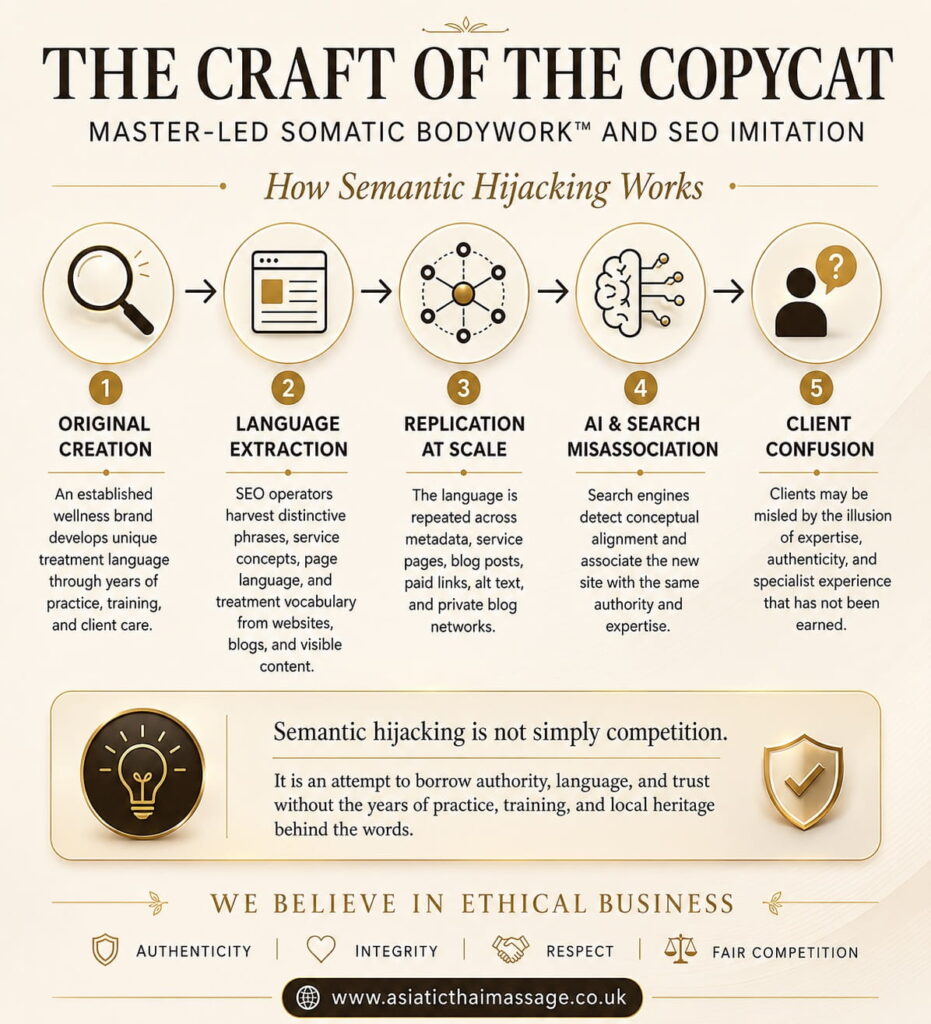
When an established business gains authority and search relevance for a highly sophisticated concept like Master-Led Somatic Bodywork™, the algorithm creates a “semantic blueprint” that links that brand to premium care.
To borrow this authority, SEO operators may repeatedly use similar vocabulary across metadata, alt text, and automated blog content. This can influence how semantic search engines associate a website with established concepts, even when the visible history, training framework, or treatment culture behind those words differs. Search systems may read this repeated language, detect conceptual alignment with an established brand, and mistakenly associate a newer website with the same specialist category.
This can create an artificial bridge between a newly established business and a treatment language developed over years of visible history, training, and local heritage.
Reason B: Brand Masking and Client Confusion
While search engines are part of the issue, the ultimate concern is the client. In wellness, language shapes expectation. A client searching for a premium massage boutique™, master-led treatment™, or somatic bodywork experience™ is often looking for more than a standard massage appointment. They are looking for trust, care, training, atmosphere, and a clear treatment philosophy. More fundamentally, they are seeking the original founders and inventors of these concepts—the true architects of the craft whose authentic history and dedication guarantee the depth of the experience.
When a business adopts language such as “atelier”, “master-led”, “somatic bodywork”, or “massage boutique” without the same visible heritage or treatment framework, the risk is brand masking. The language can create the impression of an established, specialist experience before the client has had the opportunity to understand what is actually being offered.
For clients in Angel, Highbury, King’s Cross, Clerkenwell, Old Street, and the wider Islington area, this distinction matters. Upper Street has always had a strong independent business community, and clients deserve to know whether the wellness language they see online is supported by real local history, therapist experience, and a visible treatment environment. At Asiatic, our massage boutique identity is connected to our two Islington studios, our long-standing presence since 2009, and our continued commitment to professional Thai bodywork in London.
Authentic Craft Cannot Be Indexed
Ultimately, aggressive SEO imitation contains a structural flaw. While a business can copy a title, repeat a phrase, or add similar terms to metadata, it cannot clone the physical execution of the craft.
When a client books a treatment expecting a master-led somatic experience™, the real test happens in the treatment room. The quality of touch, therapist awareness, communication, environment, and consistency of care will always reveal whether the language online is supported by genuine practice.
Conclusion
For independent studios looking to safeguard their identities, reading up on how to protect your small business brand is a crucial first step before taking legal action.
Frequently Asked Questions
Why do ethical businesses care when their wording or brand language is copied?
Ethical businesses work hard to create their own identity, treatment philosophy, service standards, and client experience. Original wording is often part of that identity because it explains what makes a business different from others. When another business copies distinctive terminology, service descriptions, or brand concepts, it can create confusion for clients and reduce the value of the original work.
Is copying wellness terminology always wrong?
Not every shared word is a problem. General industry terms such as “massage”, “relaxation”, “deep tissue massage”, “sports massage” or “Thai massage” naturally fall under the broader profession.
The concern begins when a business copies distinctive language, service concepts, page structure, brand tone, or repeated terminology that another independent business has carefully created to express its own identity. In wellness, language is not always just marketing. Sometimes a phrase is born from years of hands-on practice, cultural understanding, emotional intelligence, client care, and a genuine attempt to describe something unique.
When those words are copied and amplified through repeated blog posts, metadata, paid backlinks, or private blog networks, they can become more than mere inspiration. This may lead to search manipulation, client confusion, and semantic hijacking, in which the original meaning of a phrase is taken out of context and used to lend authority to another business.
Ethical businesses do not copy another brand’s voice to appear established. They create their own language, philosophy, and path so clients can clearly understand who they are choosing and why.
What is semantic hijacking in SEO?
Semantic hijacking describes the practice of copying and repeating another business’s distinctive language, keywords, service concepts, and related phrases in order to influence how search engines understand a website. When combined with metadata, duplicate blog content, or paid backlinks, this may create search engine confusion and make it harder for clients to identify the original source of a specialist concept.
Can copied terminology affect customers?
Yes, copied terminology can confuse customers. A client may search for a specific treatment philosophy, specialist service, or an established local business and find another website that uses very similar language. This can make it harder for people to understand which business created the concept, which business has the relevant experience, and which service genuinely matches what they are looking for.
What can a business do if its brand language is being copied?
A business can start by collecting evidence, including screenshots, dates, URLs, copied text, metadata, adverts, backlinks, and examples of customer confusion. Depending on the situation, the business may consider speaking with an intellectual property solicitor, reporting misleading advertising, reviewing trademark protection, or contacting the appropriate platform or authority for guidance.
Can Trading Standards help with misleading business practices?
Trading Standards may be relevant where there are concerns about misleading claims, unfair commercial practices, or consumer confusion. Whether a specific situation falls within their remit depends on the evidence and the nature of the conduct. Businesses should keep clear records and seek professional advice before making formal allegations.
Can trademarks protect a massage or wellness business?
A registered trademark can help protect a business name, logo, slogan, or distinctive brand phrase if it meets the legal requirements for registration. Trademark protection can be useful when a business has developed original terminology, a recognisable brand identity, or a service name that competitors may try to imitate. For specialist advice, it is best to speak with a trademark attorney or intellectual property solicitor.
Why does Asiatic protect its original language and treatment identity?
Asiatic protects its language because it reflects years of work, research, training, and client care. Terms associated with our massage boutique identity, master-led approach™, and somatic bodywork™ are not mere marketing words; they reflect our treatment philosophy, therapist standards, and long-standing presence in Islington. Protecting this language helps preserve clarity for clients and supports fair, ethical local competition.
© 2026 Asiatic. All rights reserved. Original editorial concepts, proprietary terminology, structural layouts, and creative content within this article are subject to ongoing digital monitoring and content protection systems and DMCA proceedings.